

The Price of Applause
By Lokanath Mishra
Sangeeta never imagined that silence could be so loud.
It sat with her in her room long after midnight, when the ceiling fan spun lazily and her phone screen glowed with unanswered messages she never sent. It followed her into the mornings, where tea turned cold before she could finish it, and her mother’s eyes avoided hers with a mixture of concern and quiet helplessness.
Three years. Three long years since she had graduated with an engineering degree in 2020—ironically, the year the world shut down and opportunities disappeared into thin air. While others posted job offers and relocation selfies, Sangeeta posted nothing. At first.

Then one day, she broke.
On Facebook, she wrote:
“It’s getting overwhelming. I don’t know how long I can keep pretending I’m okay.”
The post wasn’t poetic. It wasn’t curated. It was raw. Painfully raw.
And people noticed.
Not all of them kindly.
Relatives whispered in drawing rooms, over tea and snacks. “What was the use of spending so much on her education?” some said. Others were harsher, questioning her character, her lifestyle, her worth.
She was 26 now. That number echoed louder than her achievements.
Her boyfriend, Arjun, who once spoke of shared dreams and distant cities, quietly exited her life. “You’ve changed,” he had said. “You’re always negative.” And just like that, she was alone again.
Her closest friend, Meera, followed soon after—not with a dramatic goodbye, but with absence. Messages went unread. Calls unanswered. One day, Sangeeta realized she had no one left to tell her stories to.
Even her own voice had begun to feel like a burden.
Her health deteriorated slowly, like a fading photograph. Sleepless nights. Skipped meals. Endless scrolling. Endless thinking. Endless self-doubt.
One evening, gathering courage like scattered pieces of herself, she approached her father.
“Baba… if I prepare for an MBA? Or maybe a bootcamp? I just need a chance.”
Her father didn’t look up immediately. When he did, his eyes carried something heavier than refusal—it was resignation.
“We don’t have that kind of money, Sangeeta.”
That sentence stayed with her longer than any insult ever had.

And then, life turned.
Unexpectedly. Quietly. Almost suspiciously.
A letter arrived.
She had cleared the SSC examination.
Selected as an Inspector in the Income Tax Department.
For a moment, she didn’t react. It felt unreal, like reading someone else’s story. But then her mother cried. Her father’s hands trembled slightly as he held the letter.
For the first time in years, Sangeeta felt something unfamiliar.
Relief.
Kolkata welcomed her with chaos and charm—yellow taxis, tram bells, crowded streets, and a rhythm that refused to slow down. Her office overlooked a busy road where life never paused, and slowly, she learned to move with it.
Work gave her structure. Identity. Dignity.
People began addressing her differently now.
“Inspector Sangeeta.”
The same relatives who once questioned her worth now praised her perseverance. The same society that judged her silence now applauded her success.
She smiled politely.
But somewhere inside, a quiet voice asked—
Where were you when I needed you?

Soon after joining, her parents brought up marriage.
This time, the conversation wasn’t hesitant.
It was enthusiastic.
Arrangements began swiftly. Families met. Horoscopes aligned. Dates were fixed.
And then, the celebrations unfolded.
Haldi. Mehendi. Sangeet. Wedding.
Each event more extravagant than the last.
A luxurious hotel was booked—grand halls, crystal chandeliers, designer décor. The kind of place where everything shimmered under artificial lights.
The budget crossed forty-five lakhs… and kept rising.
Fifty. Sixty. Perhaps even more.
Sangeeta stared at the numbers as if they were written in a foreign language.
She remembered the day her father had said—
“We don’t have that kind of money.”
She smiled outwardly, posed for photos, danced when asked, laughed when expected. But inside, something churned.
One night, unable to hold it in anymore, she wrote again on Facebook:
“They have money to get me married, but for my education, there was none.”
“He’s spending this much now, but couldn’t bear 20–25 lakhs for my career.”
“To prioritize a hotel booking over a career is to trade a daughter’s lifelong independence for a few days of social applause.”
The post went viral.
People shared it. Debated it. Some agreed passionately. Others defended tradition.
But Sangeeta didn’t argue.
She had already lived the truth.
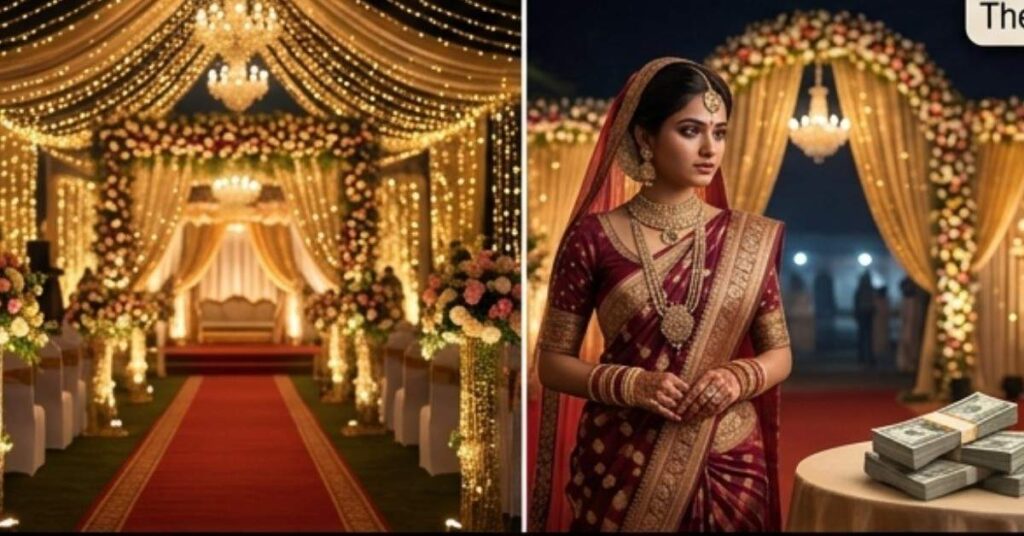
There was something deeply unsettling she had come to understand—
A peculiar, toxic hypocrisy.
Parents who claimed “poverty” when it came to a daughter’s dreams, but discovered “prestige” when it came to her wedding.
Society that valued spectacle over substance.
Applause over independence.
The saddest part?
The expenses had already crossed forty-five lakhs—and were still climbing, with no clear end in sight.
Jewelry. Gifts. Rituals. Endless expenses stacked upon endless expectations.
All for a few days.
A few photographs.
A few compliments.

On the night before her wedding, Sangeeta sat by the window of her hotel room, the city lights of Kolkata flickering like distant thoughts.
She wasn’t sad.
She wasn’t entirely happy either.
She was aware.
Aware of everything she had endured. Everything she had become. Everything she still wanted.
She thought of the girl who had once typed through tears on a glowing screen.
The girl who felt invisible.
The girl who almost gave up.
And then she thought of the woman she was now.
An officer. Independent. Strong. Scarred—but standing.
Her marriage would begin tomorrow.
But she made a silent promise to herself tonight—
That her story wouldn’t end in a wedding.
That she would continue to grow, to learn, to invest in herself.
That if she ever had a daughter, she would never have to choose between education and acceptance.
As the music from the sangeet echoed faintly in the distance, Sangeeta whispered into the night—
“Let this be the last generation that confuses love with display, and support with ceremony.”
And for the first time in a long while, the silence around her felt… peaceful.