
Mahabharata in Prose – Part 39 (continued)
A story of the Dvapara Yuga based on the Odia Sarala Mahabharata by Lokanath Mishra, Jenamath Lane, Puri.
Time flowed gently in Indraprastha after the arrival of Subhadra. Harmony prevailed in the palace, and the bond between Draupadi and Subhadra grew stronger with each passing day. Arjuna, relieved of inner conflict, devoted himself to both family life and royal duties.
In due course, Subhadra gave birth to a radiant पुत्र—a son whose brilliance seemed to illuminate the entire palace. The moment of his birth was marked by auspicious signs: celestial music was heard, fragrant winds blew, and the hearts of all present were filled with joy.
The child was named Abhimanyu.
From the very beginning, Abhimanyu displayed extraordinary qualities. His eyes shone with intelligence, and his movements reflected the grace of a born warrior. Elders in the court whispered among themselves that this child was destined for greatness.
When news reached Dwaraka, Krishna and Balarama were filled with delight. Krishna soon came to Indraprastha to see the newborn. Taking the child in his arms, he gazed deeply and smiled.
“This child,” Krishna said softly, “is no ordinary soul. He carries within him the brilliance of the सूर्य and the valor of the Pandavas. His fame will spread across the world.”
Balarama, too, blessed the child, placing his strong hand gently upon Abhimanyu’s head. “May you become a warrior of unmatched courage,” he said.

As Abhimanyu grew, his upbringing was entrusted to the finest teachers. Under the guidance of his father Arjuna, he began learning the art of warfare at a very young age. His training included archery, chariot warfare, swordsmanship, and the use of celestial weapons.
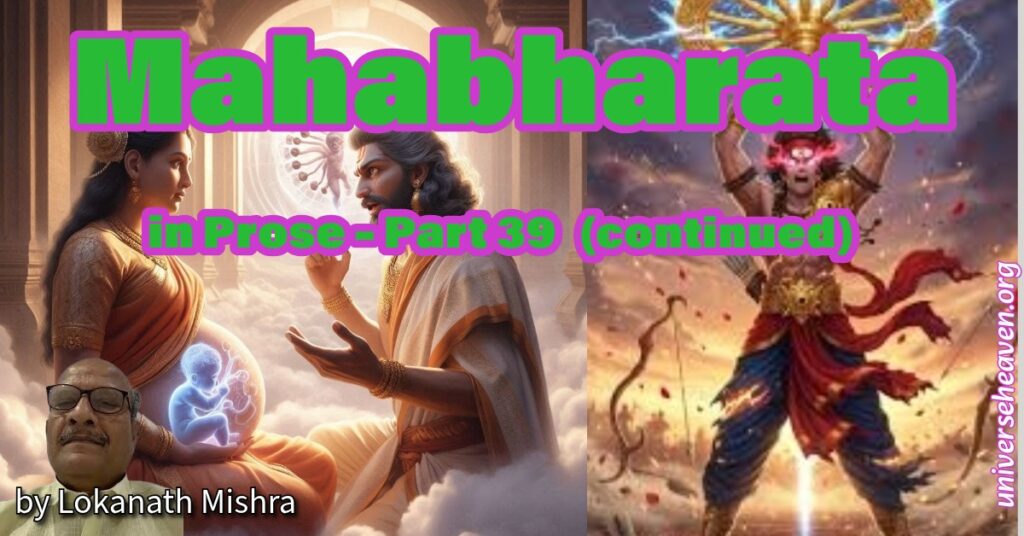
It is said that even while in his mother’s womb, Abhimanyu had heard Arjuna explaining the strategy of penetrating the Chakravyuha, the most complex military formation. Though he had learned how to enter it, the knowledge of exiting remained incomplete—a subtle thread of destiny woven into his life.
His progress astonished everyone. What others learned in years, Abhimanyu grasped in days. His dedication, discipline, and natural talent made him the pride of the Pandava lineage.
⸻
Meanwhile, the political landscape of Aryavarta continued to shift. The Kauravas in Hastinapura, led by Duryodhana, watched the growing strength and prosperity of the Pandavas with increasing unease.
Shakuni, ever cunning, began sowing seeds of discord. “As long as the Pandavas flourish,” he said to Duryodhana, “your claim to supremacy remains threatened.”
Duryodhana’s envy deepened. Though bound by ties of kinship, his heart was consumed by rivalry. He resolved to find a way to undermine the Pandavas.
⸻
Back in Indraprastha, Yudhishthira ruled with justice and wisdom. The kingdom prospered under his guidance. Encouraged by his success and guided by Krishna, he began to contemplate performing the Rajasuya Yajna, a grand imperial sacrifice that would establish his sovereignty over other kings.
However, such a ritual was not merely ceremonial—it required the submission or alliance of powerful rulers across the land.
Krishna advised, “Before undertaking the Rajasuya, one obstacle must be removed—Jarasandha, the mighty king of Magadha. As long as he lives, many kings remain imprisoned under his power, and your sovereignty cannot be complete.”
This marked the beginning of a new chapter—one that would test the strength, unity, and destiny of the Pandavas.
Thus, while joy blossomed in the form of Abhimanyu’s birth, the currents of fate began to gather force, steering the story toward greater challenges and monumental events.
(To be continued)