
Mahabharata in Prose : Part- 41 ( continued)
( A story of Dvapar Yuga in prose based upon the Odiya Sarala Mahabharata)
by Lokanath Mishra IRS ( rtd) , Jenamath Lane, Puri:
The splendor of the Rajasuya Yajna lingered in Indraprastha, its glory spoken of in every corner of Aryavarta. Yet, as the invited kings and sages gradually departed, carrying tales of Yudhishthira’s grandeur, a shadow quietly followed Duryodhana back to Hastinapura.
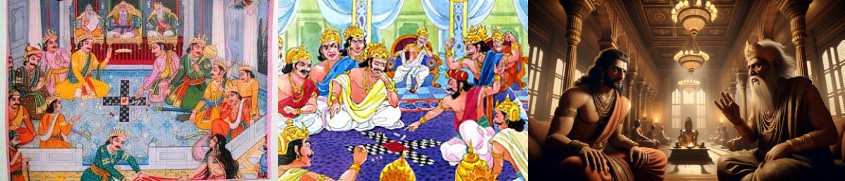
He spoke little during the journey, but his silence burned with humiliation. The memory of the मायामय palace, the laughter that had echoed when he faltered, and the unmatched prosperity of the Pandavas—all churned within him like a storm.
At Hastinapura, he went straight to Shakuni. The cunning गांधार prince observed his nephew carefully and soon understood the turmoil in his heart.
“What troubles you so deeply?” Shakuni asked, though he already knew the answer.
Duryodhana’s voice trembled with suppressed anger.
“I have seen their wealth, their power, their influence. The world bows before them now. What remains for us? Are we to live in their shadow forever?”
Shakuni smiled faintly, his eyes gleaming with calculation.
“Strength does not always lie in arms, my dear nephew. There are other ways to bring even the mightiest to their knees.”
Duryodhana leaned closer, his curiosity awakening.
“What do you propose?”
Shakuni spoke slowly, each word deliberate.
“Yudhishthira has one weakness—his fondness for dice. Invite him to a game. A game where skill is not of arms, but of chance… and cunning.”
Duryodhana’s eyes lit up. The idea, dark yet enticing, took root instantly.
“If he accepts, we can strip him of everything—his wealth, his kingdom… even his pride.”
Thus, a योजना was set in motion, one woven not with honor, but with deceit.
Soon, a royal invitation was sent from Hastinapura to Indraprastha. It was presented as a gesture of kinship—a friendly game of dice between cousins.
When the message reached Yudhishthira, his heart grew uneasy. He understood the dangers of gambling, yet the code of kshatriya honor did not permit him to refuse such an invitation.
Krishna was not present in Indraprastha at that time, and his guiding presence was missed.
Despite the concerns of Bhima and Arjuna, Yudhishthira resolved to go.
“Dharma must be upheld,” he said. “We cannot decline the invitation of our elders.”
And so, the Pandavas, along with Draupadi, journeyed to Hastinapura.
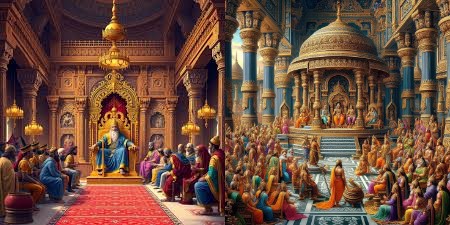
The सभा was prepared, grand and imposing. Kings, elders, and courtiers gathered to witness the game. Among them sat Dhritarashtra, blind yet aware, and Bhishma, whose heart already sensed the unfolding tragedy.
At the center of the hall sat Shakuni, holding the dice with practiced ease. He would play on behalf of Duryodhana.
The game began.
At first, the stakes were modest—gold, jewels, and treasures. But with every throw of the dice, guided by Shakuni’s छल, Yudhishthira lost.
Again and again, the dice favored Shakuni.
The सभा grew tense, yet no one intervened.
Blinded by the flow of the game and bound by his own vow, Yudhishthira continued. One by one, he staked and lost his wealth, his kingdom, and all that he possessed.
A heavy silence fell.
Yet the खेल did not end.
Urged on by Shakuni’s cunning words, Yudhishthira placed even greater stakes. He wagered his brothers—Bhima, Arjuna, Nakula, and Sahadeva—and lost them all.
Still, the madness of the moment did not cease.
In a final, devastating move, he staked Draupadi.
The dice rolled.
And once again, Yudhishthira lost.
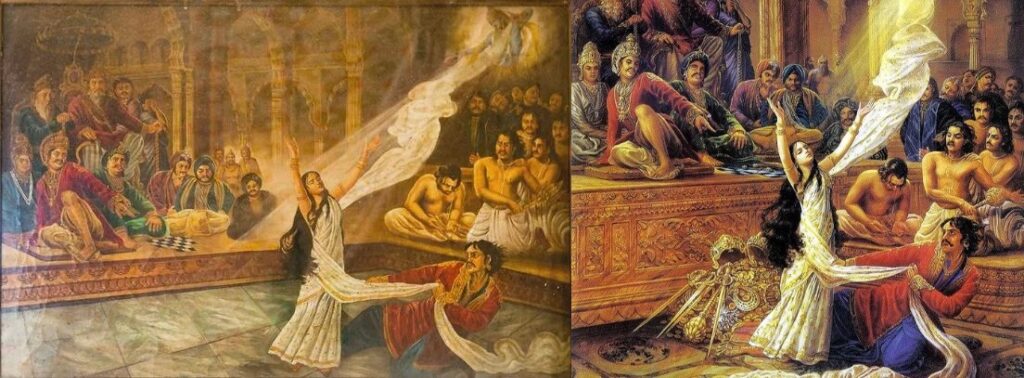
A gasp spread through the सभा. Even the walls seemed to tremble at the weight of what had occurred.
Duryodhana’s face broke into a cruel smile.
“Bring Draupadi to the court,” he commanded.
Thus began one of the darkest moments in the history of the Kuru dynasty—a moment where dharma would be tested, and the silence of the महान would echo louder than any cry.
(Continued in Part 42…)