
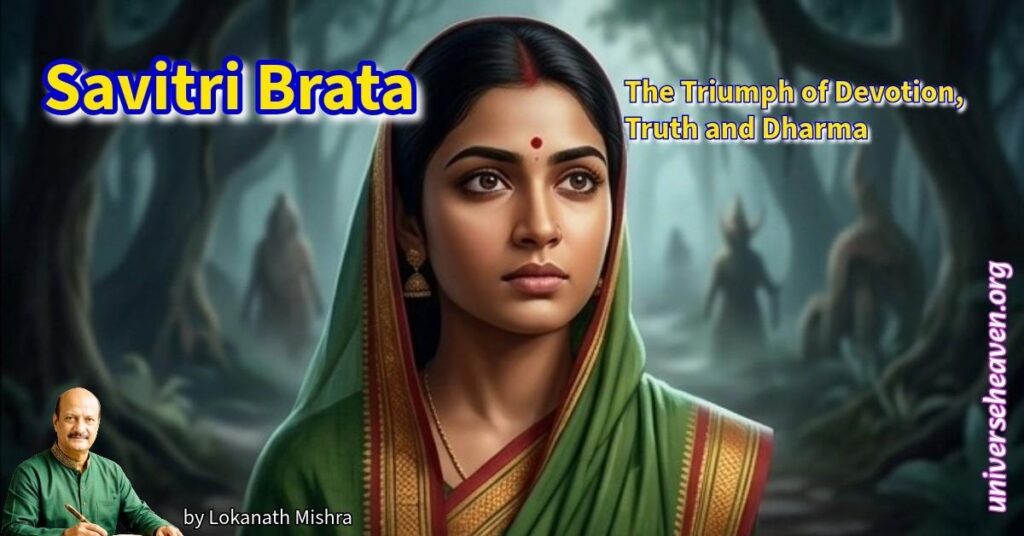
Savitri Brata – The Triumph of Devotion, Truth and Dharma
In the sacred land of Bharatavarsha, where rivers were worshipped like mothers and forests echoed with the chants of sages, there once ruled a noble king named King Ashwapati in the kingdom of Madra. Though wealthy, wise, and beloved by his subjects, the king carried a silent sorrow in his heart — he had no child to continue his lineage.
For many years, the king and queen performed yajnas, charity, and severe penance. Every day King Ashwapati offered thousands of prayers to Goddess Savitri, the divine embodiment of purity and wisdom. Pleased by his unwavering devotion, the goddess finally appeared in radiant light and blessed him:
“O King, your devotion has pleased me. A daughter of extraordinary virtue shall be born to you. She will illuminate the world through her chastity, courage, and righteousness.”
In time, a daughter was born. Her beauty resembled the golden dawn, and her wisdom surpassed even learned scholars. Remembering the grace of the goddess, the king named her Savitri.
From childhood, Savitri was unlike ordinary princesses. She possessed compassion for the poor, respect for elders, devotion toward the gods, and deep spiritual understanding. Her face shone with serenity, and wherever she walked, people felt peace.

As she reached marriageable age, King Ashwapati searched for a worthy groom. But Savitri’s brilliance intimidated many princes. Finally, the king said lovingly:
“My daughter, choose your husband according to your heart and dharma.”
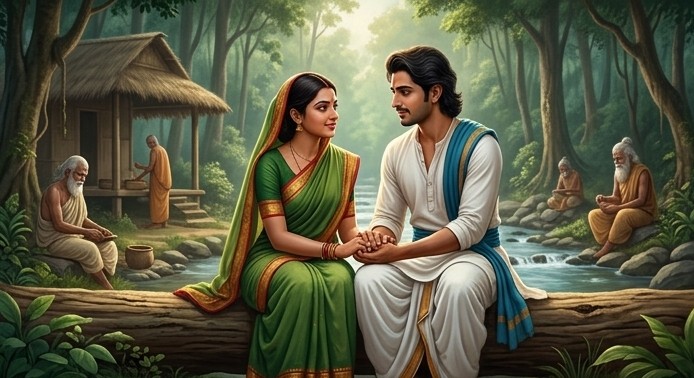
Accompanied by ministers and sages, Savitri traveled through forests, hermitages, and kingdoms. One day, in a peaceful woodland hermitage, she saw a young man gathering firewood for his blind parents. His face glowed with humility and inner strength.
He was Satyavan, the son of the exiled and blind King Dyumatsena.
Though living in poverty, Satyavan served his parents with love and honesty. His words were gentle, his mind pure, and his life rooted in dharma. The moment Savitri saw him, her heart recognized its eternal companion.
Returning home, she informed her father of her decision.
At that very moment, the celestial sage Narada arrived in the royal court. Upon hearing Savitri’s choice, Narada became grave.
“O King,” said the sage, “Satyavan possesses every noble quality. He is truthful, brave, and righteous. But fate has written a terrible destiny — he has only one year left to live.”
The entire court fell silent.
King Ashwapati trembled with fear and pleaded with his daughter:
“Choose another husband, my child. I cannot bear to see you widowed.”
But Savitri folded her hands respectfully and replied with calm determination:
“Father, a woman chooses her husband only once. Just as truth cannot be changed, my resolve cannot be broken. Whether his life is long or short, Satyavan alone is my husband.”
Her words reflected the strength of dharma itself.
The marriage was solemnized with sacred rituals, and Savitri left the comforts of the palace to live in the forest hermitage with Satyavan and his aged parents. She wore simple garments, served her in-laws with devotion, and performed all duties with humility. Though she knew the shadow of destiny approached, she never revealed her sorrow.
As the foretold day drew near, Savitri began intense fasting and prayer. For three days she neither ate nor slept properly. She meditated upon Lord Vishnu, Goddess Savitri, and the sacred power of truth.
The elders of the hermitage admired her spiritual strength.
Finally came the fateful Amavasya day in the month of Jyeshtha — the day now observed as Savitri Brata.
That morning, Savitri completed her prayers and insisted on accompanying Satyavan into the forest. Though hesitant, he smiled and agreed.
The forest was unusually silent that day. Birds stopped singing, and the wind carried an unknown sadness.
As Satyavan chopped wood, sudden weakness overcame him. Holding his head, he said softly:
“Savitri, my head burns with pain. I feel exhausted.”
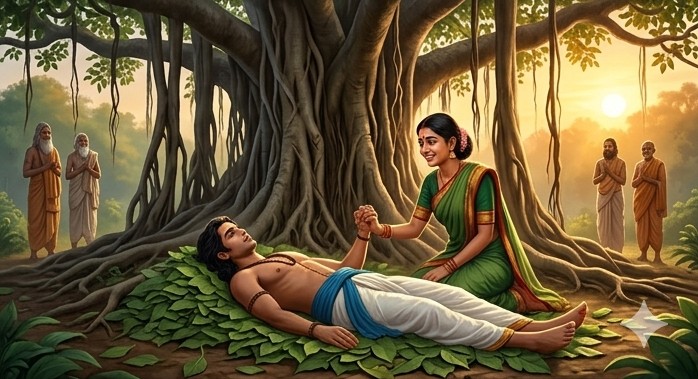
Savitri immediately seated him on her lap beneath a विशाल banyan tree. She gently caressed his forehead while tears silently filled her eyes.
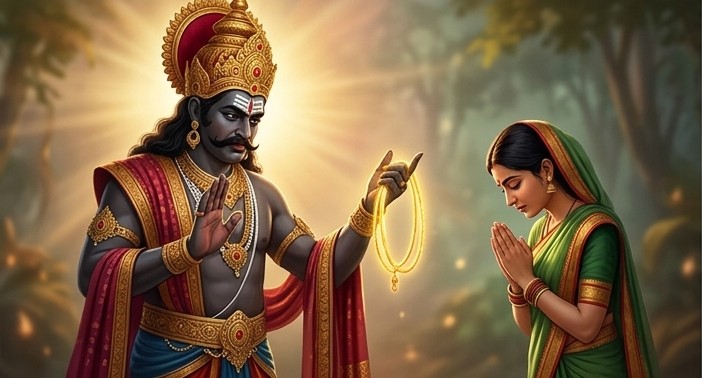
Then, from the depths of the forest, appeared a majestic and fearsome figure clothed in deep crimson, carrying a noose in his hand.
It was Yama, the Lord of Death.
With divine authority, Yama drew out the subtle soul of Satyavan and began walking southward toward the realm of the departed.
But Savitri rose and followed him.
After some distance, Yama turned and said:
“Return, noble woman. Your duty to your husband is complete. No mortal can follow the path of death.”
Savitri replied humbly:
“Where my husband goes, there lies my path. Serving one’s husband is the eternal dharma of a devoted wife.”
Yama was impressed by her wisdom and devotion.
“Ask for a boon, except the life of Satyavan.”
Savitri requested:
“May my blind father-in-law regain his eyesight and lost kingdom.”
“So be it,” said Yama.
Yet Savitri continued following him.
Again Yama warned her to return, but Savitri spoke about compassion, righteousness, and the greatness of truth. Her words were filled with spiritual wisdom.
Pleased again, Yama granted another boon.
“May my father Ashwapati be blessed with many sons.”
“So be it,” replied Yama.
Still Savitri followed.
Now Yama marveled at her extraordinary determination.
“O virtuous lady, ask one final boon.”
Savitri bowed and said:
“Grant me the blessing of becoming the mother of a hundred sons born from Satyavan.”
Yama instantly granted the boon. But within moments, he realized the hidden truth in her request. Without Satyavan alive, the boon could never come true.
The Lord of Death smiled with admiration.
“O Savitri, no one has ever defeated me through devotion and wisdom as you have done today. Your purity has conquered even death itself.”
Yama released Satyavan’s soul and blessed the couple with long life, prosperity, and spiritual glory.
At once, life returned to Satyavan’s body beneath the banyan tree. He awoke as though from deep sleep and saw Savitri’s radiant face glowing in the moonlit forest.
Meanwhile, King Dyumatsena miraculously regained his eyesight and kingdom exactly as Yama had promised.
Thus, through unwavering faith, wisdom, courage, and chastity, Savitri transformed destiny itself.
Spiritual Message of Savitri Brata
The story of Savitri is not merely the tale of a devoted wife; it is the eternal victory of truth over fate, devotion over fear, and dharma over death.
Savitri teaches humanity that:
- True love is rooted in sacrifice and spiritual strength.
- A pure heart possesses immense divine power.
- Determination guided by righteousness can overcome even impossible obstacles.
- Respect toward parents, elders, and spouse brings divine blessings.
- Fasting and prayer are meaningful when combined with sincerity and self-discipline.
Even today, married women across Odisha, Bihar, Jharkhand, Chhattisgarh, West Bengal and Nepal observe Savitri Brata with deep faith for the wellbeing and long life of their husbands.
The sacred banyan tree worshipped during the Brata symbolizes eternal life, strength, and steadfast devotion — qualities embodied perfectly by Savitri herself.
And so, whenever the dark Amavasya night of Jyeshtha arrives, countless lamps of faith glow in homes and temples, reminding the world that the light of devotion can conquer even the deepest darkness.