
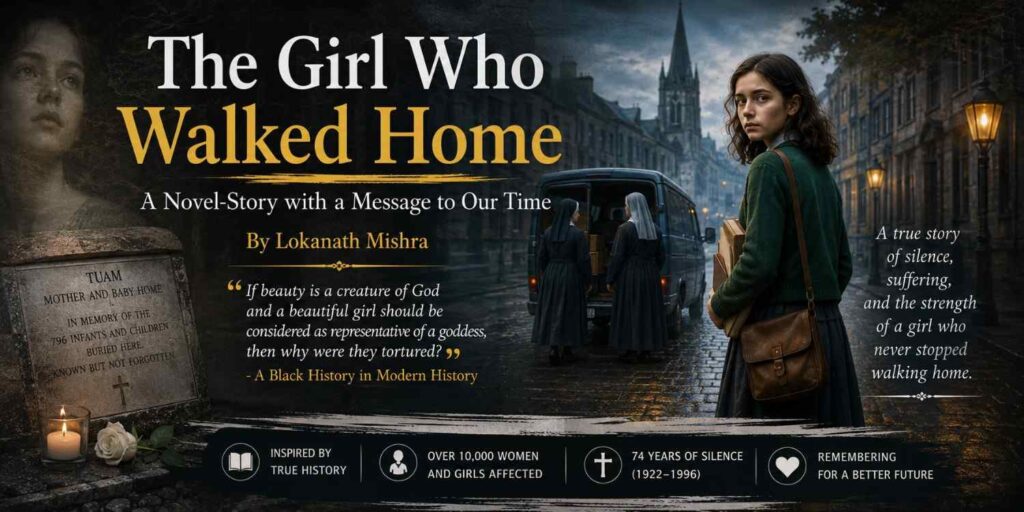
The Girl Who Walked Home*
A Novel-Story with a Message to Our Time
By Lokanath Mishra
Author’s Preface
I came across this story while reading different history books in Kingston Library, not far from the Thames where families feed swans on quiet afternoons. The shelves held government reports, survivor memoirs, and old newspapers. Page by page, a grey building kept appearing. Page by page, a girl kept walking home and never arriving. What follows is written as a novel-story, drawn from documented history, to remember her and to ask one question: If beauty is a creature of God and a beautiful girl should be considered as representative of a goddess, then why were they tortured? This is the black history in modern history. The aim is not only to mourn, but to call our society to good work.
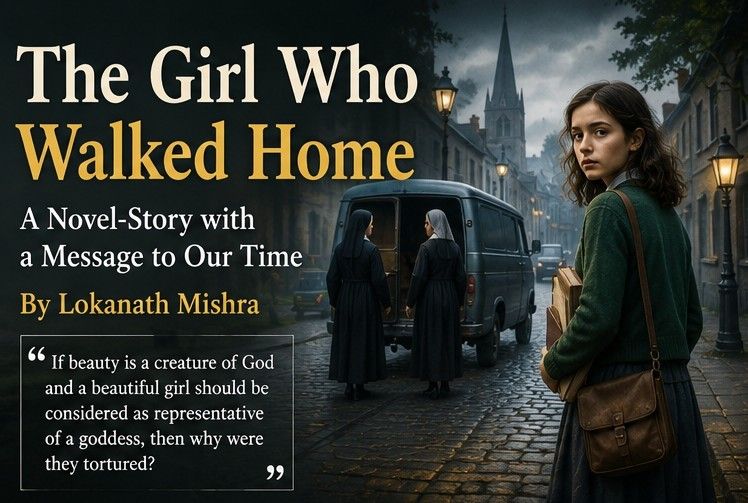
Chapter One: The Afternoon in Dublin, 1963
Mary was sixteen. She wore the green jumper her mother had knitted last winter. Her schoolbooks were tied with a leather strap. The road from school to home passed a bakery, a church, and a row of houses with low gates. She knew the names of the dogs behind those gates.
A van stopped. The side door slid open. Two women in dark habits stepped out. They did not ask her name. They looked at her face and said, “You are too pretty. You are a temptation to men.”
Mary did not understand the sentence. She understood the hands on her arms. She understood the van door closing. She understood that the street she had walked every day was suddenly far away.
Chapter Two: The Grey Building
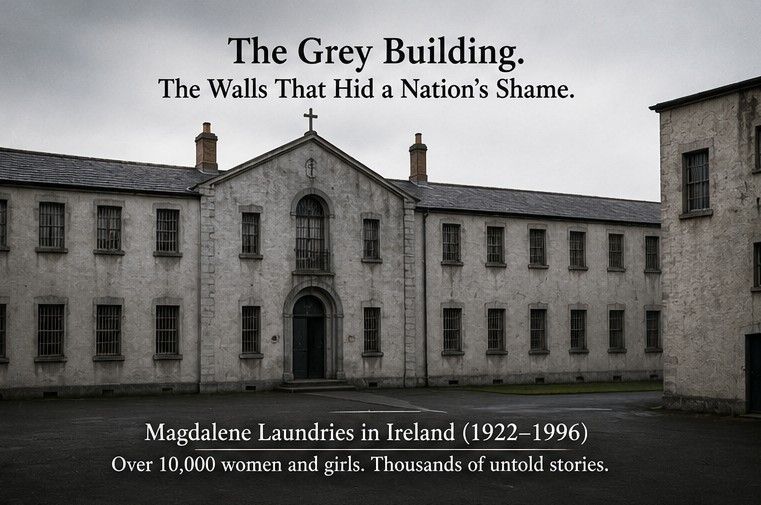
The building had tall windows with iron bars. Inside, the air smelled of soap and steam. A nun took Mary’s jumper and gave her a coarse dress. Another took scissors to her hair. The blades were cold against her scalp.
“Your name is now Twenty-Seven,” the nun said. “You will work to wash the sin from your soul.”
Mary learned the rules without them being written. Speak only when spoken to. Do not look out of the windows. Do not ask about the world outside. Do not cry where others can hear.
The laundry was hot and loud. Great vats of water boiled. Sheets from hospitals and hotels came in carts. Mary’s hands reddened and cracked. The chemicals burned. At night she slept in a dormitory with forty other girls and women. Some were thirteen. Some were forty. All had stories that began with the word “pretty” or “pregnant” or “no one to take me.”
Chapter Three: The Babies
Bridget was seventeen and already heavy with child when she arrived. She worked until the day her pains began. The nuns took her to a small room. When Bridget woke, her arms were empty.
“They said my son died,” Bridget told Mary in a whisper, after lights out. “But I heard him cry.”
No one gave Bridget a paper. No one gave her a grave to visit. Years later, she would learn that children were sent to America, to Australia, to families who paid money. The mothers were told they were unfit. The children were told they were unwanted. Both were lies.
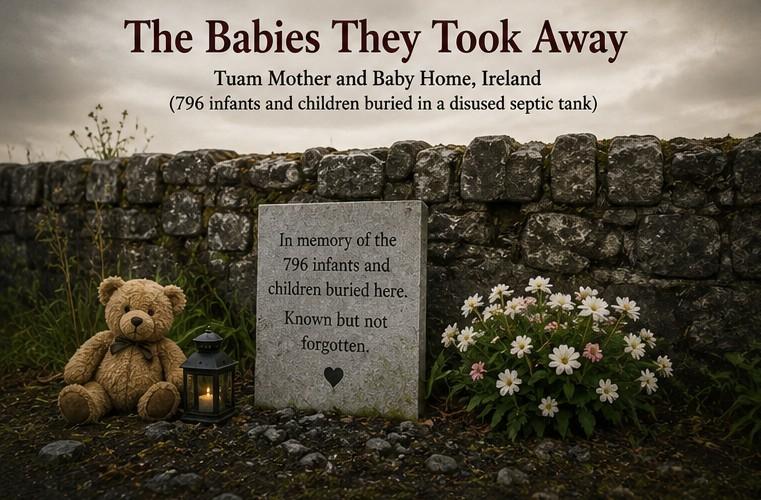
In Tuam, at the Bon Secours Mother and Baby Home, 796 infants and children were later found buried in a disused septic tank. They were aged from thirty five weeks gestation to three years. They had names, but the ground had kept them without markers.
Chapter Four: The Theology of a Lock
Mary asked herself the same question every night. If beauty is a creature of God, if a beautiful girl should be considered as representative of a goddess, then why was she here?
The books in Kingston Library did not answer for the men who built the locks. The state reports said the laundries operated from 1922 to 1996. Seventy four years. The last laundry closed when many of us were already adults. This is not ancient history. This is the black history in modern history.
The teaching Mary had heard in school said that the body was a temple. Yet here, the body was treated as a crime. Rape victims were admitted for being “impure.” Orphans were admitted for having no protector. A girl who laughed too loud at a dance was admitted for “leading men astray.”
The punishment was not decided by a court. It was decided by a shared idea: that female shame would keep society in order. That idea had buildings. It had budgets. It had laundry contracts with the state.
Chapter Five: The World Outside the Walls
The vans that took the women were seen on streets. The laundry was collected and delivered. Neighbors knew where their daughters had gone. Police brought girls to the door. Doctors signed papers. Families were told it was for the girl’s own good.
For seventy four years, the ordinary life of towns continued around the grey buildings. That is how silence becomes a habit. That is how a sin is redefined, from an act to a face.
Chapter Six: The Years That Did Not Come Back
Mary left when she was thirty. She had no education, no money, no family who would speak to her. She had a number in her memory and scars on her hands. She looked for her parents’ house. Another family lived there.
In 2013, the Irish Taoiseach Enda Kenny stood in the Dáil and said, “For your shame, our collective shame. We are deeply sorry.” The state set up redress. Some women received payments. None received their years.
Mary did not want money. She wanted the afternoon back. She wanted the walk home.
Chapter Seven: What We Owe Now
This novel-story is true in its facts. The Magdalene Laundries held over 10,000 women and girls. Thousands never left. Thousands of children were separated from mothers. These are not symbols. These were people.
If we believe that beauty is a creature of God, then a beautiful girl is not a problem to be solved. She is a life to be protected. If we believe a girl can represent a goddess, then we must not shave her head and call her Twenty-Seven. We must ask, “Are you safe? Are you hungry? Do you need help?”
The black history in modern history warns us of four duties:
- Never punish a body for existing. Pregnancy, rape, disability, or loveliness are not crimes.
- Open every door that claims to care. Any institution that houses the vulnerable must be open to family, to inspection, to law.
- Support before shame. Healthcare, housing, education, and choice prevent grey buildings better than any sermon.
- Remember out loud. Kingston Library gave me the books. Books gave me Mary. Speaking gives Mary back her name.
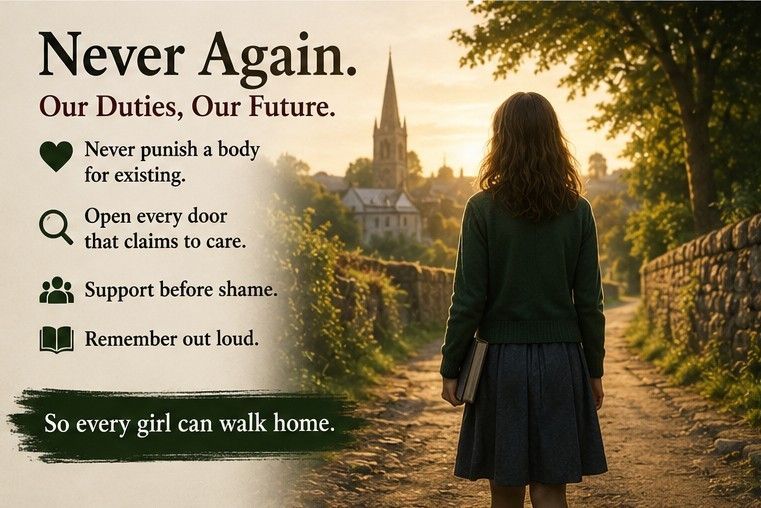
Epilogue: The Road Mary Did Not Finish
I think of Mary when I walk past Two Waters Road in Hemel Hempstead, or when I see girls coming home from school in Kingston upon Thames. The light is the same as it was in Dublin in 1963. Ordinary and gold.
The good work of society is to make sure that every girl finishes her walk. That no van stops for the crime of being pretty. That no law, no custom, no belief turns a goddess into a prisoner.
We cannot return Mary’s fourteen years. We can refuse to take fourteen years from anyone else.
That is the message. That is the work