
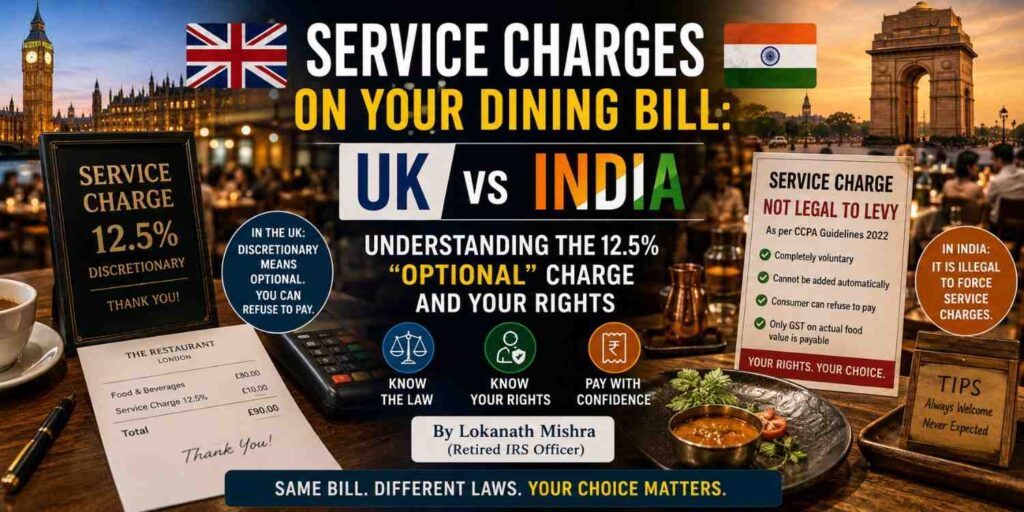
SERVICE CHARGES ON YOUR DINING BILL: UK vs INDIA
Understanding the 12.5% “Optional” Charge and Your Rights
By Lokanath Mishra
- Introduction: The Same Bill, Two Different Countries
Whether I am having dinner with family in a restaurant in London or in Delhi, one line on the bill now catches my eye: “Service Charge @10% / 12.5%”.
In the UK it is called “discretionary”. In India it was called “service charge” until the government intervened. The question is the same in both places: What is this charge, why is it collected, and can the customer refuse to pay it?
This article compares the legal position in both jurisdictions.
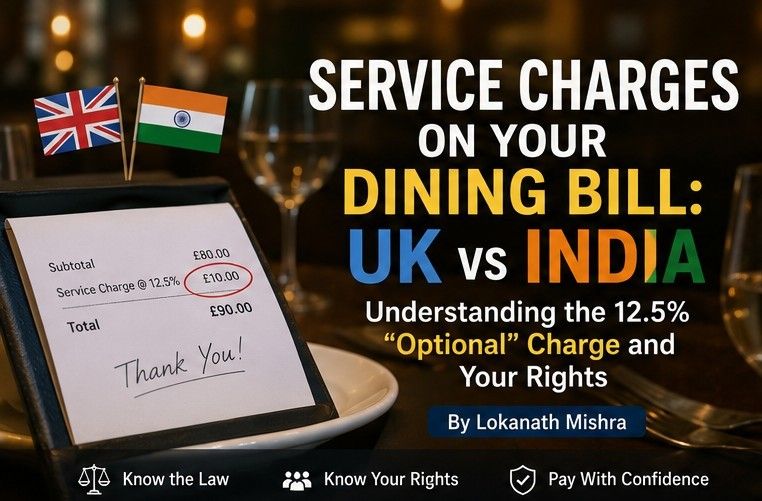
- THE UK SYSTEM: “DISCRETIONARY” MEANS OPTIONAL
A. History & Purpose
Traditionally, Britons left 10% cash tips. From the 2000s, restaurants began adding a fixed 12.5% to the bill to pool tips for both front-of-house and kitchen staff. With card payments replacing cash, this became the norm.
Since Oct 2024, the Employment (Allocation of Tips) Act 2023 legally requires that 100% of tips and service charges go to staff.
B. Legal Position: You Can Refuse
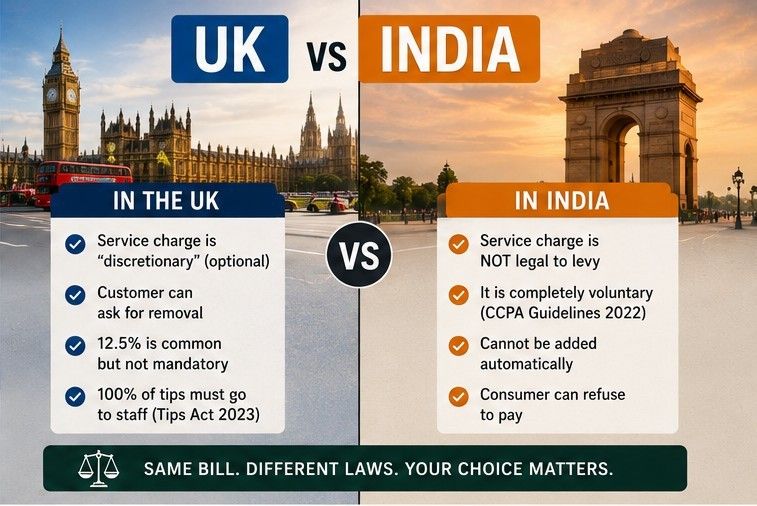
In the UK, the overwhelming majority of service charges are “discretionary”.
Key legal provisions:
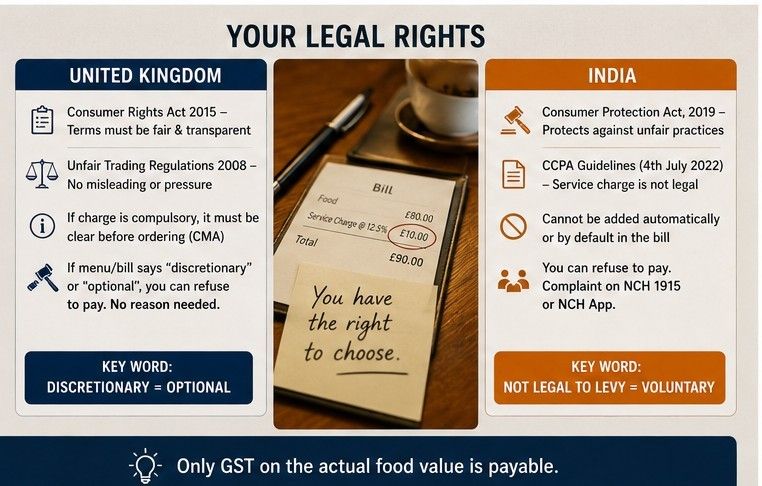
- Consumer Rights Act 2015: Terms must be fair and transparent.
- Consumer Protection from Unfair Trading Regulations 2008: Businesses cannot mislead or pressure customers into paying.
- CMA Guidelines: If a charge is compulsory, it must be made clear before you order.
Rule: If the menu or bill says “discretionary” or “optional”, the customer absolutely can ask for it to be removed. No reason is needed. The restaurant cannot treat you differently for it.
HMRC also treats optional charges differently for VAT. If the menu states it is optional, it is not part of the contract for the meal.
C. Current Debate
There is growing public pushback against “drip pricing” and pre-set tip screens on card machines, with petitions calling for all tipping to be 100% voluntary.
- THE INDIAN SYSTEM: FROM “VOLUNTARY” TO “BANNED”
A. History & Purpose
In India, 5-star hotels and fine-dining restaurants started adding 10% “service charge” to bills in the 1990s. Restaurants claimed it was to pay staff salaries and maintain service standards. Unlike in the UK, this was often added automatically, with no mention of “optional”.
B. Legal Position: Govt Says It Is NOT Compulsory
Following widespread consumer complaints, the Central Consumer Protection Authority, CCPA, issued clear guidelines.
Key Legal Provisions:
- Consumer Protection Act, 2019: Protects consumers against unfair trade practices.
- CCPA Guidelines dated 4th July 2022:
- Levying of service charge is not legal.
- Restaurants cannot force a consumer to pay service charge.
- No hotel or restaurant shall add service charge automatically or by default in the bill.
- No restriction on entry or provision of services based on collection of service charge.
- Service charge shall not be collected from consumers by any other name.
- If you are forced: You can file a complaint to the National Consumer Helpline 1915, or through the NCH app, or to the District Consumer Commission under the CPA, 2019.
Rule in India: Any “service charge” is completely voluntary. If you wish to pay it, you may. If you do not, the restaurant cannot refuse service or harass you. Only GST on the actual food value is payable.
C. Difference from Tips
Indian law makes a clear distinction. A tip is at the customer’s discretion and given directly to staff. A service charge is a charge levied by the restaurant. The CCPA said restaurants cannot decide how much to pay staff through an automatic charge.
- UK vs INDIA: A COMPARATIVE TABLE
Aspect United Kingdom India
Typical Rate 12.5% – 15% 10% when it was practiced
Legal Nature Mostly “Discretionary”. Customer can ask for removal Not legal to levy. Completely voluntary as per CCPA 2022
Key Law Consumer Rights Act 2015; Tips Act 2023 Consumer Protection Act 2019; CCPA Guidelines 2022
Can You Refuse? Yes, if labelled discretionary Yes. It is illegal to force payment
Where it goes Must go to staff by law since 2024 Up to restaurant. No legal mandate to pass to staff
- PRACTICAL ADVICE FOR CONSUMERS
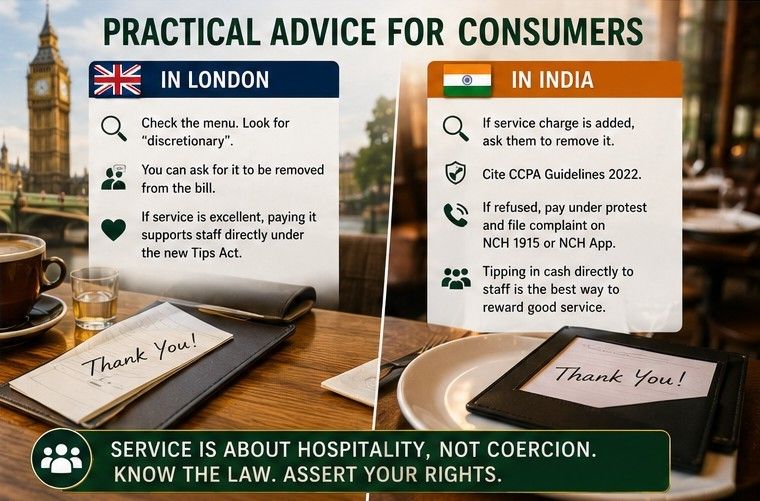
In London:
Check the menu. If it says “discretionary”, you may ask for it to be removed. If service was excellent, paying it supports staff directly under the new Tips Act.
In India:
If a restaurant adds service charge to your bill, politely ask them to remove it. Cite CCPA Guidelines 2022. If they refuse, pay under protest and file a complaint on NCH 1915 with the bill.
In both countries, tipping in cash directly to staff remains the most transparent way to reward good service.
- Conclusion: The Principle is the Same
Whether it is 12.5% in London or 10% in Mumbai, the underlying principle is consumer choice.
Service is about hospitality, not coercion. Law in both the UK and India now recognizes that. In the UK, the charge is “optional” by contract law. In India, it is “illegal to enforce” by consumer law.
As customers, we should value good service. As citizens, we should also protect our right not to be charged for it by default.
A good meal should end with satisfaction, not with confusion on the bill.
The author is a retired IRS officer and frequent diner in both London and Indian cities.