
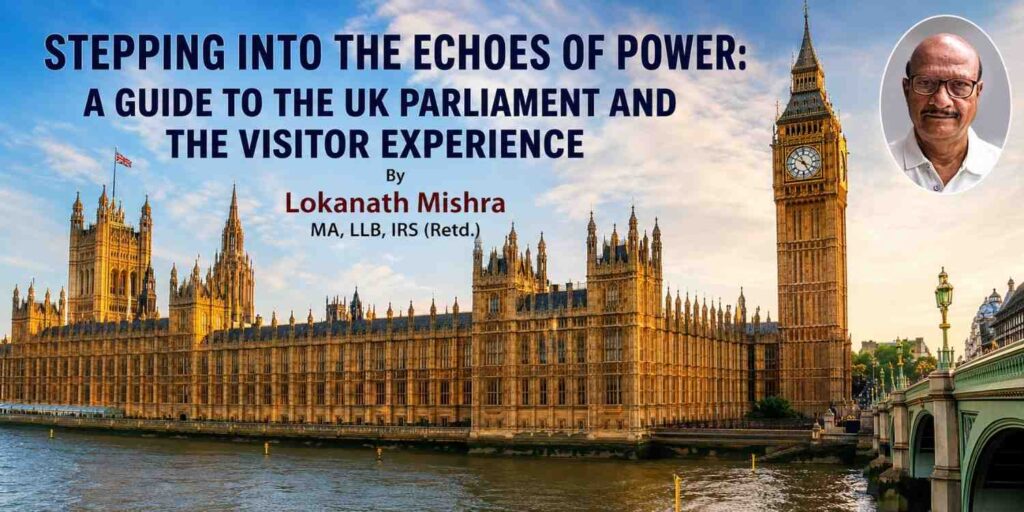
STEPPING INTO THE ECHOES OF POWER : A GUIDE TO THE UK PARLIAMENT AND THE VISITOR EXPERIENCE
By Lokanath Mishra, MA, LLB, IRS (Retd.)
Few buildings in the world carry the historical weight and global political influence of the Palace of Westminster. For centuries, the UK Parliament has been the stage for fierce debates, landmark legislation, and historic shifts in power.
A visit to this living monument offers a firsthand view of where modern democracy was shaped, combining centuries of heritage with the vibrant energy of a working legislature.

A Brief Walk Through Parliamentary History
The roots of the UK Parliament stretch back over a thousand years. The Palace of Westminster itself began as a royal residence in the 11th century.
I had the opportunity to visit the present Parliament building last Saturday. I thoroughly enjoyed the visit and came to know the following in detail:
- Westminster Hall: Built in 1097 under King William II, this is the oldest surviving part of the estate. Its magnificent hammerbeam roof has witnessed coronation banquets of medieval kings, and the state trials of Sir Thomas More, Guy Fawkes, and King Charles I.
- The Birth of Two Chambers: What began as a royal council evolved into a bicameral system. The House of Lords historically represented the aristocracy and senior clergy, while the House of Commons came to represent the elected representatives of the people.
- The Modern Palace: Following the catastrophic fire of 1834, architects Sir Charles Barry and Augustus Pugin designed the present Gothic Revival masterpiece. Pugin’s attention to detail is evident in the gilded interiors of the Lords and the structured woodwork of the Commons.
The Visitor Experience: A Multimedia Tour
Visiting Parliament is not limited to viewing architecture from behind barriers. It is an immersive, self-paced exploration. Tickets, often available at promotional rates, make this access to British heritage remarkably affordable.
On entry, visitors are provided with a multimedia headset. Instead of following a large group, one can explore the estate at one’s own pace. The device combines audio narration with visual content, drawing attention to historical details in each room’s decor and craftsmanship.
Route Highlights
The tour follows a carefully curated path through key democratic spaces:

- Westminster Hall: The starting point, where one stands on the same ground as medieval monarchs and historic trials.
- Central Lobby: The heart of the Palace, where the routes of the Commons and Lords meet. This is the traditional place where members of the public “lobby” their Members of Parliament.
- The House of Commons Chamber: Instantly recognisable by its green benches. This is where the Prime Minister and MPs debate national legislation. The intimacy of the chamber underscores the directness of British political debate.
- The House of Lords Chamber: In marked contrast, the Lords chamber is rich in crimson upholstery, gold leaf, and carved wood. It houses the Royal Throne, from which the Monarch delivers the King’s Speech at the State Opening of Parliament. I particularly enjoyed this part of the tour.
The estate ensures that this heritage is accessible to all. At the start of the tour, I selected English on the multimedia guide.
I was genuinely astonished by the grandeur and dignity of one of the world’s finest parliamentary buildings.
The Evolution of Parliament
The evolution of the UK Parliament spans a millennium of changing power, institutional development, and architectural renewal. Its origins lie in the Anglo-Saxon Witenagemot, an assembly of wise men advising the monarch. After the Norman Conquest of 1066, this developed into the Curia Regis, or King’s Court.
The sealing of the Magna Carta in 1215 established that the monarch was bound by law and could levy taxation only with consent. Representative government took a decisive step in 1265, when Simon de Montfort summoned an assembly that included knights and burgesses. By the mid-14th century, Parliament had formally divided into the House of Lords and the House of Commons.
Through the English Civil War, the execution of Charles I, and the Glorious Revolution of 1688, sovereign authority gradually shifted from the Crown to Parliament, laying the foundation of the modern constitutional monarchy.
Walking Through History
Stepping through the security gates as a visitor brings these narratives to life. In Westminster Hall, beneath the hammerbeam roof commissioned by Richard II in 1394, one feels the scale of medieval authority.
Moving onward, the architecture shifts from medieval austerity to Victorian Gothic Revival, a direct result of Barry and Pugin’s work after the 1834 fire.
In the Central Lobby, the crossroads of both Houses, and then in the Commons Chamber, one observes the famous two sword-lengths between the green benches — a design that still shapes the intensity of Prime Minister’s Questions.
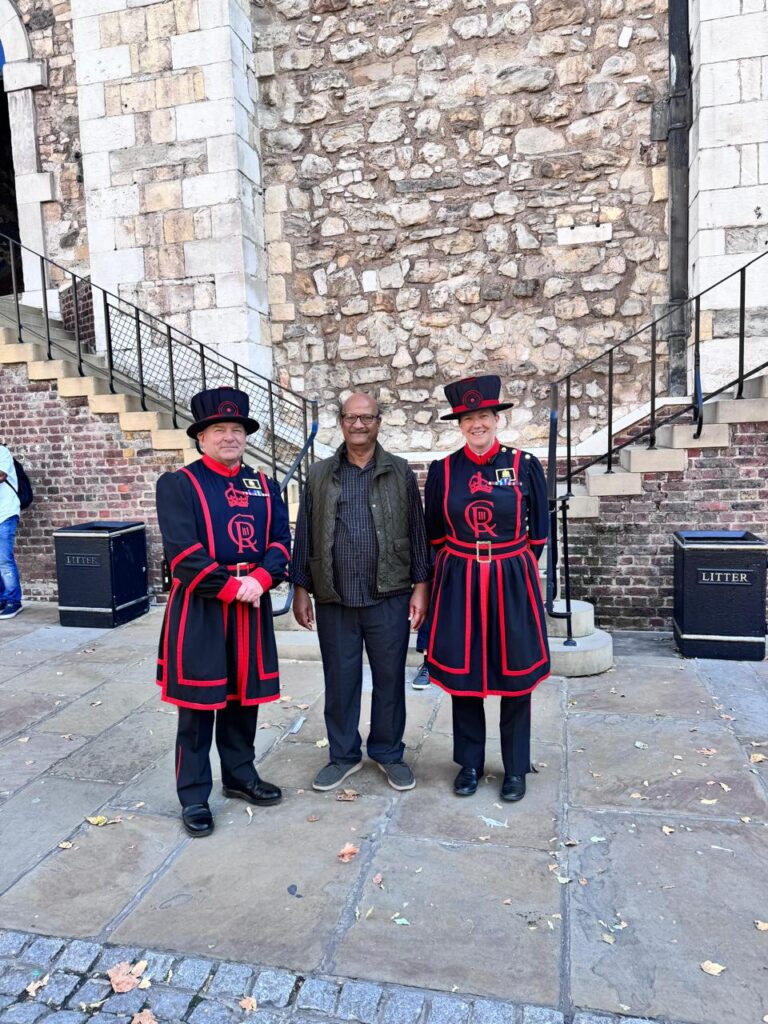
The Lords Chamber, by contrast, presents a scene of ceremonial opulence, centred on the Royal Throne.
Conclusion
The Palace of Westminster is not a distant relic or a closed government building. It is a living institution, belonging to the public. To stand in the chambers where laws are made, to walk corridors where history is written daily, and to hear the echoes of centuries of debate, is to gain a new understanding of governance itself.
Whether one’s interest lies in architecture, legal history, or contemporary politics, a visit to the UK Parliament is an essential experience.
It is well worth remembering the British Parliament. I appeal to others to come and experience it.
Lokanath Mishra
Great content! Keep up the good work!
Смотреть подробный отчет: микро займ онлайн