
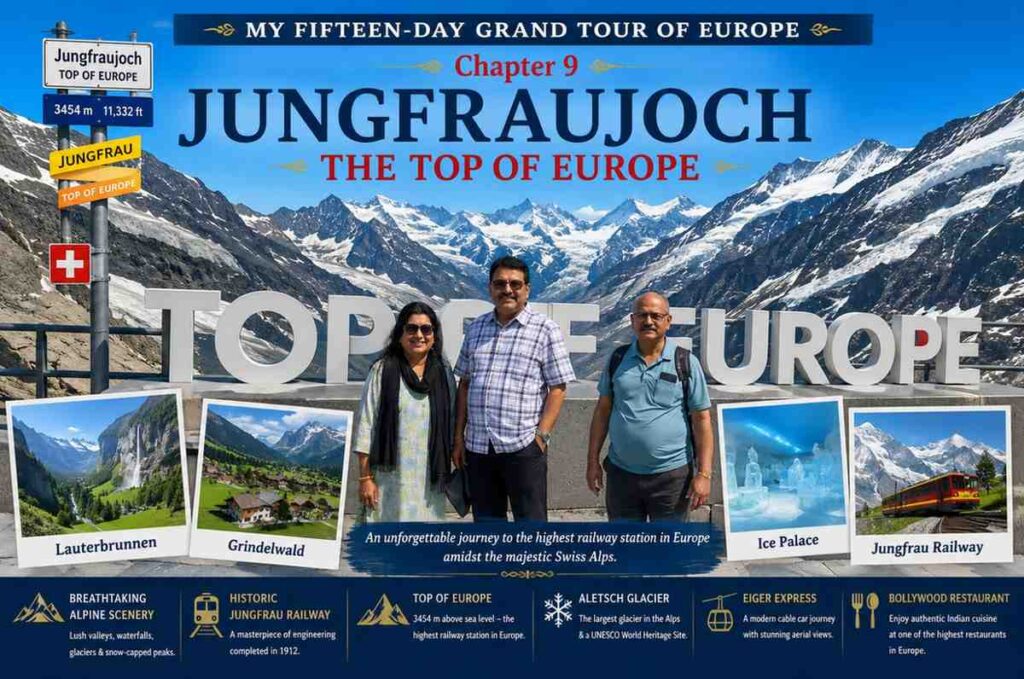
My Fifteen-Day Grand Tour of Europe
Chapter 9: Jungfraujoch – The Top of Europe
By Lokanath Mishra, M.A., LL.B., IRS (Retired)
On the morning of 17th July 2026, we woke up early at Hotel Central, Engelberg, surrounded by the magnificent Swiss Alps. The fresh mountain air, the peaceful surroundings and the sight of snow-covered peaks filled us with excitement. This was one of the most eagerly awaited days of our entire European tour, for we were to visit the world-famous Jungfraujoch, popularly known as the “Top of Europe.”
After breakfast, our Star Tour coach left Engelberg and proceeded towards the Bernese Oberland, one of the most beautiful mountain regions in Switzerland. The journey itself was a visual delight. The roads wound through lush green valleys, crystal-clear rivers, waterfalls and picturesque Alpine villages. Wooden chalets decorated with colourful flowers stood amidst green meadows where cows grazed peacefully, their traditional bells echoing across the valleys.
Every turn of the road revealed another breathtaking landscape. Nature seemed to have bestowed all its beauty upon this remarkable region.
Lauterbrunnen – The Valley of Seventy-Two Waterfalls
Our first destination was the beautiful village of Lauterbrunnen.
Nestled between towering cliffs rising nearly one thousand metres on both sides, Lauterbrunnen is often regarded as one of the most beautiful valleys in Europe. The name “Lauterbrunnen” literally means “Many Fountains,” an appropriate description for a valley blessed with numerous waterfalls.
The village is famous for its 72 waterfalls, many of which descend directly from high cliffs into the valley below. The most celebrated among them is the Staubbach Falls, which plunges almost 300 metres in a graceful cascade. During summer, melting snow from the Alps feeds these waterfalls, making them even more spectacular.
The valley inspired many poets, artists and writers. It is believed that the famous German writer Johann Wolfgang von Goethe found inspiration here while composing one of his poems. Even today, Lauterbrunnen retains its peaceful charm and traditional Swiss character.
Standing amidst such magnificent scenery, one feels humbled by the grandeur of nature.
Grindelwald Terminal – Gateway to the High Alps
From Lauterbrunnen, we continued towards Grindelwald Terminal, one of the most modern mountain transport centres in Switzerland.
Grindelwald is a charming Alpine village located at the foot of the mighty Eiger Mountain. It has been welcoming climbers and tourists since the nineteenth century.
The newly developed Grindelwald Terminal combines railway services with modern cable cars, allowing visitors to reach the high mountains comfortably while preserving the fragile Alpine environment.
Swiss engineering and organisation were clearly evident. Every train, cable car and passenger facility operated with remarkable efficiency and punctuality.
The Journey Towards Jungfraujoch
Our ascent to Jungfraujoch was an unforgettable experience.
From the terminal, we travelled by modern mountain railway and through the spectacular Alpine route towards Eigergletscher Station, situated near the famous Eiger Glacier.
The railway journey itself is regarded as one of the greatest engineering achievements in the world.
The train gradually climbed higher and higher through green meadows before entering tunnels carved deep inside solid mountain rock. At several points, specially constructed observation windows offered magnificent views of glaciers, valleys and snow-covered peaks.
The remarkable precision of Swiss engineering became evident as the train moved smoothly through steep gradients and tunnels built over a century ago.
Every passenger looked outside with admiration, capturing unforgettable photographs of the magnificent Alpine scenery.
The History of Jungfraujoch Railway
The Jungfrau Railway is one of the greatest engineering marvels in Europe.
The project was conceived by Swiss industrialist Adolf Guyer-Zeller in 1893, who envisioned a railway leading to the high Alps.
Construction began in 1896 and involved enormous difficulties. Engineers had to blast tunnels through the solid rock of the Eiger and Mönch mountains while working under extremely harsh weather conditions.
Thousands of workers participated in the construction, which required more than sixteen years to complete.
The railway was finally opened in 1912, becoming one of the highest railway lines in Europe.
Even today, it remains one of Switzerland’s greatest engineering achievements and attracts millions of visitors from around the world.
Jungfraujoch – The Top of Europe
At last, we arrived at Jungfraujoch, situated at an altitude of 3,454 metres (11,332 feet) above sea level.
Often called the “Top of Europe,” Jungfraujoch is the highest railway station in Europe.
The station lies between two magnificent mountains—Jungfrau and Mönch—overlooking the vast Aletsch Glacier, the largest glacier in the Alps and a UNESCO World Heritage Site.
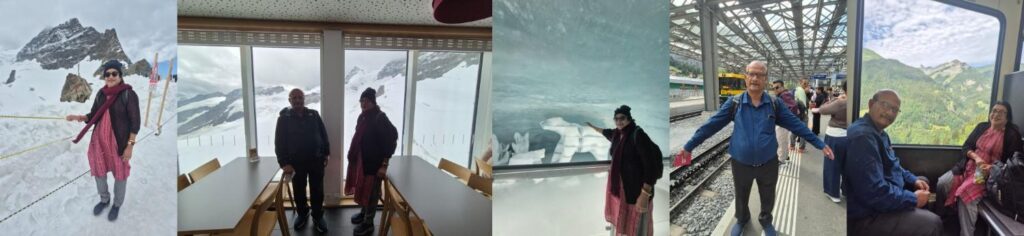
As we stepped outside, we were greeted by a breathtaking world of snow and ice stretching endlessly in every direction.
Although it was July, the entire landscape remained covered with snow.
The cool mountain air, brilliant sunshine and sparkling white snow created a magical atmosphere unlike anything we had previously experienced.
Attractions at Jungfraujoch
There was much to explore.
We visited the famous Ice Palace, where tunnels and chambers carved entirely from glacier ice displayed beautifully sculpted figures of animals, birds and human forms.
The observation decks offered panoramic views extending across the Alps into neighbouring countries on clear days.
The immense Aletsch Glacier, stretching over twenty kilometres, appeared like a frozen river flowing through the mountains.
Visitors from every continent walked carefully across the snow, enjoying snow activities and taking photographs.
For us, standing amidst the eternal snow while surrounded by towering Alpine peaks was truly a once-in-a-lifetime experience.
Lunch at Bollywood Restaurant
After completing our sightseeing, we enjoyed lunch at the Bollywood Restaurant, one of the highest Indian restaurants in Europe.
The availability of authentic Indian cuisine at such a high altitude pleasantly surprised us.
The restaurant served freshly prepared Indian vegetarian dishes, rice, dal, vegetables, paneer, chapatis and desserts.
Looking through the restaurant windows while enjoying Indian food, we admired the spectacular mountain scenery outside. It was a unique experience—tasting the flavours of India while sitting amidst the snow-covered Alps of Switzerland.
Return Journey by Cable Car
Our return journey was equally exciting.
Instead of retracing our route entirely by train, we descended using the modern Eiger Express cable car, one of the most advanced aerial cableway systems in the world.
The spacious cabins moved silently above deep valleys, forests and mountain slopes.
From above, we enjoyed magnificent aerial views of glaciers, waterfalls, Alpine villages and grazing pastures.
The journey demonstrated once again the extraordinary engineering capabilities of Switzerland.
Within a short time, we reached Grindelwald Terminal, where our coach awaited us.
Reflections
Our visit to Jungfraujoch was undoubtedly one of the highlights of our fifteen-day European tour.
The journey combined the wonders of nature with the triumph of human engineering. The magnificent railway tunnels, the modern cable cars, the endless snowfields, the mighty glaciers and the spectacular mountain scenery together created an unforgettable experience.
Standing at the “Top of Europe,” I realised that mankind, through determination, scientific knowledge and respect for nature, can achieve remarkable feats without destroying the environment.
As we returned to our hotel in Engelberg that evening, our hearts were filled with gratitude for having witnessed one of the world’s greatest natural and engineering wonders. The memories of Jungfraujoch would remain with us forever as one of the brightest chapters of our European journey.
(To be continued in Chapter 10…)