
My Fifteen-Day Grand Tour of EuropeMy Fifteen-Day Grand Tour of Europe
Chapter 21: Venice – The Floating City of Canals, Islands and Timeless Beauty : Venice – The Floating City of Canals, Islands and Timeless Beauty
By Lokanath Mishra, M.A., LL.B., IRS (Retired)
One of the most memorable experiences of our fifteen-day European tour was our visit to Venice on the evening of 20th July 2026. Our Star Tour luxury coach carried 48 passengers, most of whom had come from the United States of America, Canada and Pakistan, while only a few of us were from India. This created a truly international atmosphere within the coach. Travellers from different countries shared their experiences, cultures and perspectives, making the journey even more enjoyable and enriching.
After our stay in Padova, we proceeded towards Venice, one of the most extraordinary cities in the world. Unlike any other city we had visited, Venice appeared to float gracefully upon water, surrounded by canals, islands and magnificent historic buildings.
Venice – A City Built on Water
Venice, known in Italian as Venezia, is located in northeastern Italy and is built upon more than 100 small islands in a lagoon of the Adriatic Sea.
The city is famous for its canals, bridges, gondolas, palaces and artistic heritage. Instead of roads, Venice has a network of waterways that serve as its main transportation routes.
The Grand Canal, the city’s principal waterway, winds through Venice in the shape of a large “S” and divides the city into two main parts.
Venice is connected by more than 400 bridges, creating a unique urban landscape unmatched anywhere else in the world.
The History of Venice
The history of Venice dates back to the fifth century, when people fleeing invasions by barbarian tribes sought refuge in the marshy islands of the Venetian lagoon.
Over time, these settlers built wooden foundations in the shallow waters and constructed houses, churches and marketplaces upon them.
By the Middle Ages, Venice had grown into a powerful maritime republic known as the Republic of Venice.
For nearly a thousand years, Venice controlled important trade routes between Europe and the East.
Venetian merchants traded in spices, silk, precious stones and luxury goods, bringing immense wealth to the city.
The city became a centre of art, architecture, music and culture during the Renaissance.
Famous artists such as Titian, Tintoretto and Canaletto contributed to Venice’s artistic glory.
In 1797, Venice lost its independence when it was conquered by Napoleon Bonaparte.
Later, it became part of Austria and eventually joined the unified Kingdom of Italy in 1866.
Today, Venice is recognised as a UNESCO World Heritage Site and attracts millions of tourists every year.
Journey by Boat to Venice
Since Venice is surrounded by water, we travelled from the mainland to the city by boat.
As our boat glided across the lagoon, we enjoyed breathtaking views of the shimmering water, distant islands and the skyline of Venice rising from the sea.
The cool evening breeze, the gentle movement of the boat and the sight of historic buildings emerging from the water created an atmosphere of magic and wonder.
For us, this was not merely a journey; it was an introduction to one of the world’s most romantic and fascinating cities.
The Islands of Venice
Venice is composed of numerous islands, each with its own unique character and history.
During our boat tour, we visited and observed several important islands.
Murano
Murano is world-famous for its glassmaking industry.
For centuries, Murano artisans have produced exquisite glass objects, including vases, chandeliers, jewellery and decorative sculptures.
The Venetian government moved glassmaking to Murano in the thirteenth century to reduce the risk of fires in Venice and to protect the secret techniques of glass production.
Murano glass is admired worldwide for its beauty, craftsmanship and artistic excellence.
Burano
Burano is known for its brightly coloured houses and traditional lace-making.
The vibrant colours of the houses were originally used by fishermen to identify their homes from a distance while returning from the sea.
Walking through Burano feels like entering a painting, with every street displaying a different combination of colours.
Torcello
Torcello is one of the oldest inhabited islands in the Venetian lagoon.
It was an important centre of trade and religion during the early history of Venice.
The island is famous for its ancient cathedral and peaceful atmosphere.
St. Mark’s Square (Piazza San Marco)
The heart of Venice is St. Mark’s Square, often described as “the drawing room of Europe.”
As we entered the square, we were astonished by its grandeur and beauty.
The square is surrounded by magnificent buildings, cafés and historic monuments.
It has been the centre of Venetian public life for centuries.
St. Mark’s Basilica
The most impressive building in the square is St. Mark’s Basilica.
This magnificent church was originally built in the ninth century and later rebuilt in its present form.
Its golden mosaics, domes and Byzantine architecture make it one of the most beautiful churches in the world.
The basilica houses the relics of St. Mark, the patron saint of Venice.
Doge’s Palace
Adjacent to the basilica stands the Doge’s Palace, which was once the residence of the Doge, the ruler of Venice.
The palace also served as the centre of government and justice during the Venetian Republic.
Its elegant Gothic architecture reflects the wealth and power of medieval Venice.
The Campanile
The Campanile, or bell tower of St. Mark’s Basilica, rises majestically above the square.
From its top, visitors can enjoy panoramic views of Venice and the surrounding lagoon.
The Grand Canal
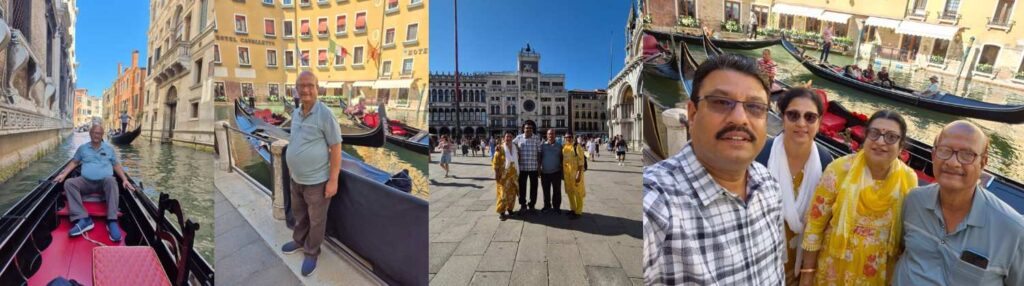
We also enjoyed a memorable boat ride along the Grand Canal.
This famous waterway is lined with magnificent palaces, churches and historic buildings dating from the thirteenth to eighteenth centuries.
Some of the most notable buildings along the Grand Canal include:
Ca’ d’Oro
Palazzo Grassi
Palazzo Barbarigo
Santa Maria della Salute
The reflections of these buildings in the water created a scene of extraordinary beauty.
The Rialto Bridge
One of Venice’s most famous landmarks is the Rialto Bridge.
Built in the sixteenth century, it is the oldest and most famous bridge across the Grand Canal.
The bridge is lined with shops selling jewellery, souvenirs, masks and Venetian crafts.
From the bridge, we enjoyed spectacular views of the canal and the bustling water traffic below.
Venetian Markets
Venice’s markets are vibrant and full of life.
We visited several market areas where shops displayed:
Venetian masks
Murano glass products
Lace from Burano
Leather goods
Jewellery
Souvenirs
Italian clothing
Traditional handicrafts
The narrow streets and small bridges leading to the markets added to the charm of shopping in Venice.
Gondolas and Water Transport
No visit to Venice is complete without seeing the famous gondolas.
These elegant black boats have been used for centuries as a traditional means of transportation.
Although modern motorboats and water buses are now widely used, gondolas remain a symbol of Venetian romance and culture.
Watching gondoliers skillfully navigate the narrow canals was a fascinating experience.
Culture and Cuisine
Venice has a rich cultural heritage influenced by Italian, Byzantine and Mediterranean traditions.
The city is famous for:
The Venice Carnival
Venetian masks
Classical music
Opera
Fine arts
Seafood cuisine
Traditional Italian dishes
Venetian cuisine includes fresh seafood, pasta, risotto and delicious Italian desserts.
Reflections
Our visit to Venice was truly a dream come true.
The city’s unique combination of water, architecture, history and culture created an unforgettable experience.
Travelling by boat through the canals, visiting the islands, exploring St. Mark’s Square and walking through the colourful markets allowed us to witness the timeless beauty of this floating city.
Venice taught us how human creativity and determination can transform a marshy lagoon into one of the world’s greatest centres of art, trade and civilization.
As we returned by boat in the evening, the lights of Venice reflected upon the calm waters of the lagoon, creating a magical scene that will remain forever in our memories.
(To be continued in Chapter 22…)