
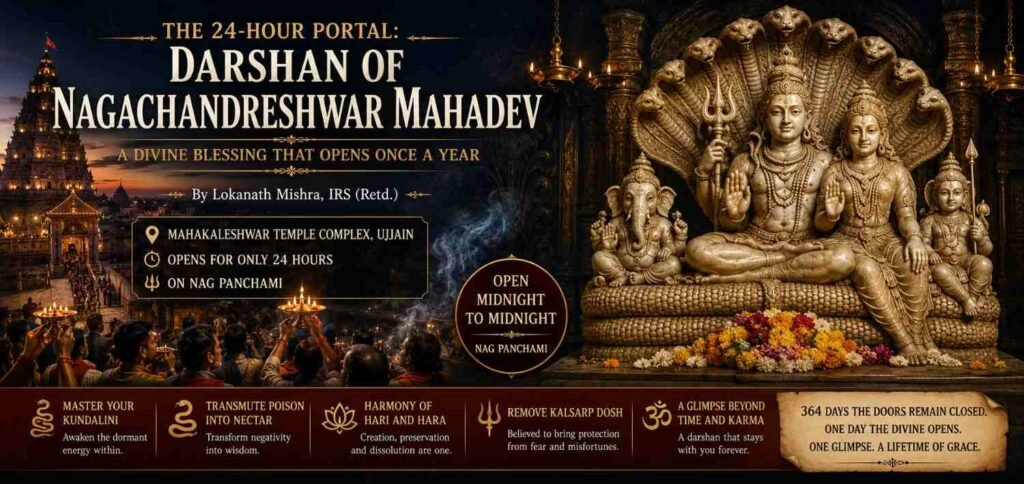
The 24-Hour Portal: Darshan of Nagachandreshwar Mahadev:
By Lokanath Mishra, IRS (Retd.)
There are places in India that you visit. And then there are places that visit you, long after you have left them.
Ujjain is one such city. The ancient, holy city of Avantika—the land of Mahakal and the energy center of Time itself, Kala. Here, time does not merely pass. It coils, it waits, and once a year, it opens.
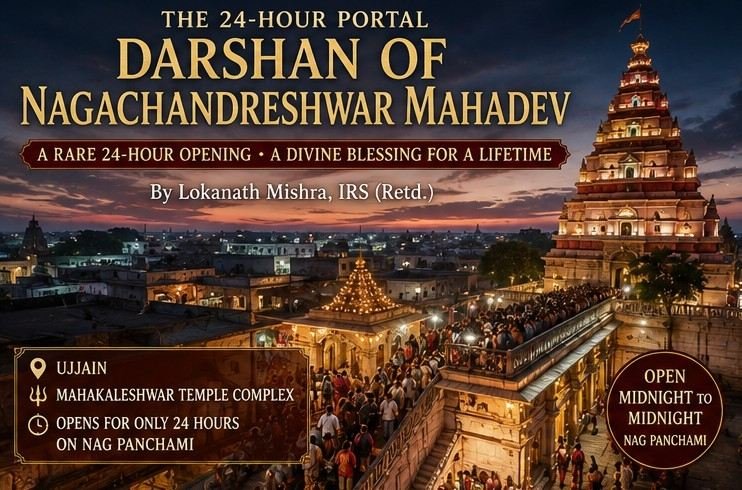
On the third floor of the famed Mahakaleshwar temple complex, above the din of pilgrims and the endless chant of Om Namah Shivaya, lies one of the most sacred and elusive sanctums in all of Shaivism: Nagachandreshwar Mahadev Temple.
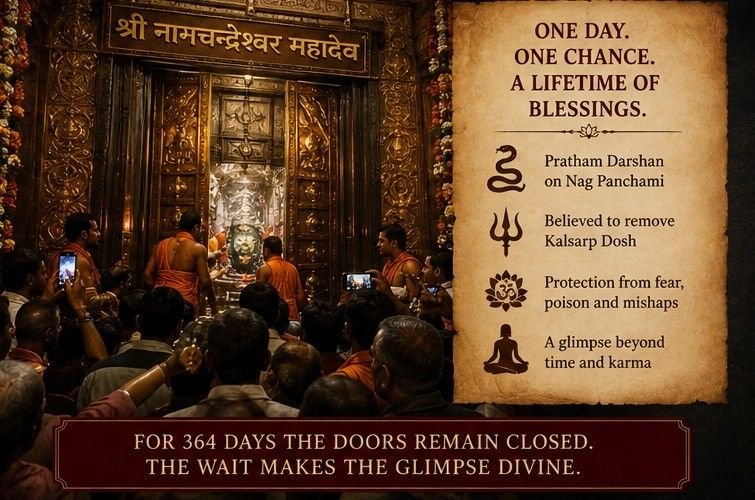
Its wooden doors open for just 24 hours a year. Starting at midnight on the eve of Nag Panchami, and closing at the next midnight. For 364 days, it remains silent. Sealed. Guarded by royal secrecy and priestly austerity.
To witness the Pratham Darshan—the First Glimpse—is not tourism. It is considered an extraordinary spiritual blessing. A rare portal into the mystery of Shiva, of cosmic energy, and of the Nāga Tattva.
I. The Legend of Takshaka: Where Stone Learns to Breathe:
The history of Nagachandreshwar does not begin in ledgers or inscriptions. It begins in penance.
According to sacred tradition, Takshaka, the formidable king of the Nagas, the serpent race, sought a place untouched by worldly chaos to perform severe tapasya. He wanted purity, and protection for his kind. He chose Avantika, for this was a city governed directly by the cosmic vibrations of Lord Shiva.
Moved by Takshaka’s single-minded devotion, Mahadev appeared. But the boon granted was not ordinary. Shiva did not just bless the Naga king. He invited him to stay.
Eternally.
In a divine, unified form. Shiva chose to sit upon a throne forged from the coils of the mighty serpent, fanned by the multi-hooded canopy of the Nāga.
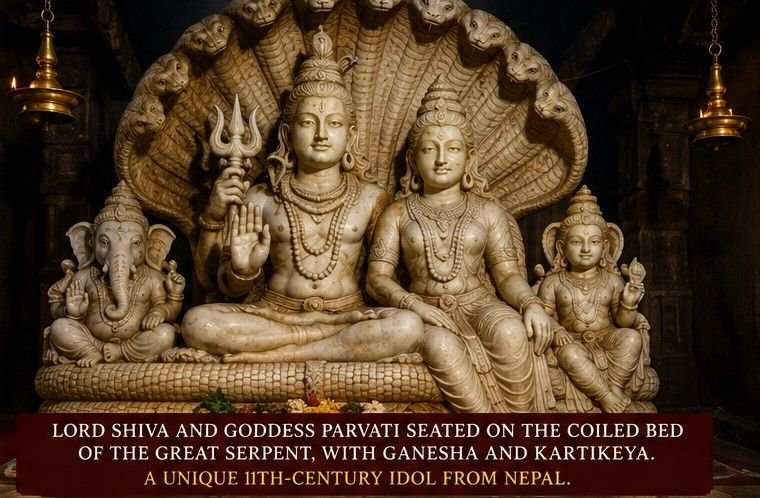
The proof of this moment sits before us today: a unique 11th-century idol carved in white stone, brought from Nepal. This is not the iconography we know. Here, Lord Vishnu does not recline on Sheshnag. Here, Shiva does not merely wear Vasuki around his neck.
Here, Lord Shiva and Goddess Parvati are seated together upon the coiled bed of the Great Serpent. Beside them stand Lord Ganesha and Kartikeya. It is a family portrait, but on a throne of eternity. It is creation, preservation and dissolution, seated in one frame.
II. The Sacred Window: One Day, One Chance:
The annual opening on Nag Panchami is more than ritual. It is a cultural event, a cosmic appointment.
The doors are opened at midnight. Thousands wait in silence. The first aarti is the Pratham Darshan. By the next midnight, the doors close again.
There is a reason for the timing. Ujjain has long marked the Prime Meridian of ancient Hindu astronomy—the Tropic of Cancer runs through it. And this shrine sits at the highest level of Mahakaleshwar. The symbolism is deliberate. If Mahakal is the lord of time at the ground, Nagachandreshwar is the ascent above time. In yogic terms, it aligns with the Sahasrara chakra—the crown—where consciousness rises beyond death.
Those who receive Pratham Darshan believe it severs karmic knots. It is said to neutralize Kalsarp Dosh—the astrological affliction of Rahu and Ketu—and to grant protection against sudden mishaps, fear, and the “poison” of life.
III. The Esoteric Message: What the Serpent Teaches:
Behind the rare iconography lies profound Vedic and Tantric wisdom. The temple is not just stone. It is a teaching.
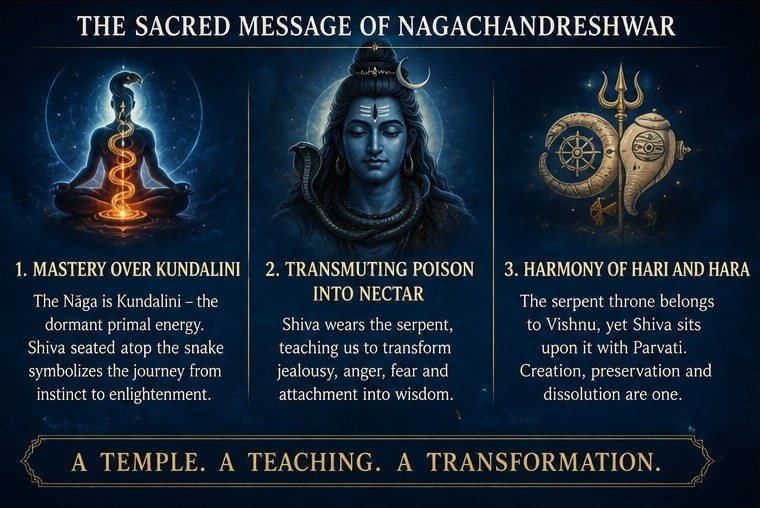
- Mastery Over Kundalini
The Nāga is Kundalini—the dormant primal energy coiled at the base of the spine, in Muladhara. Most of us live with it sleeping. Shiva seated atop the snake is the image of mastery. It is the journey of that energy rising, from instinct to enlightenment, from earth to the crown. - Transmuting Poison into Nectar
A serpent carries venom. So do we—jealousy, anger, fear, attachment. Shiva does not kill the serpent. He does not run from it. He wears it. He sits upon it. The message is stark and beautiful: do not destroy your lower nature. Acknowledge it, master it, and transform it into wisdom. That is true vairagya. - The Harmony of Hari and Hara
The serpent throne belongs, in popular imagination, to Vishnu—the preserver. Yet here it is Shiva—the destroyer and transformer—who sits on it with Parvati. This is Hari-Hara unity. Creation, preservation, dissolution are not separate departments of the cosmos. They are one consciousness, playing different roles.
Epilogue: The Ascent:
I stood in line that midnight, like everyone else. The air was heavy with incense and anticipation. When the doors finally opened and the lamps fell upon that white stone, time seemed to pause.
Nagachandreshwar is not a god you ask things from. He is a reminder.
A reminder to look inward and find the coiled energy within ourselves. To stop fearing our poison. To rise above it. And to rest, like Shiva, peacefully, upon it, in the eternal presence of the Supreme.
For 364 days the doors remain closed. Perhaps that is the point. Some truths are not meant to be accessed daily. They are meant to be earned, waited for, and received in a single, luminous glimpse.
And that glimpse is enough to last a lifetime.