

A Story of Dvapara Yuga in Prose ( part-7)
By Lokanath Mishra:
The Birth-Naming of Krishna and Radha : Divine Mysteries in Gopa-Nagara
The Fear in Gopa-Nagara
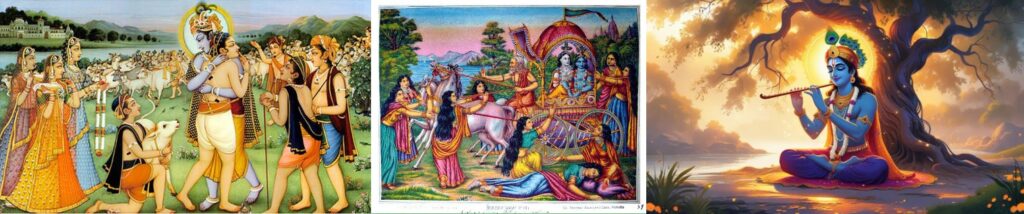
A sense of deep fear and unrest had fallen upon the cowherd settlement of Gopa-Nagara. None knew at what moment or from which direction the formidable army of the demon king Kaṁsa would march in and wreak havoc. Anticipating danger, King Nanda entrusted a group of strong cowherds with the responsibility of guarding his palace. At the same time, another armed force was deployed along the borders of the settlement, keeping constant watch. They guarded day and night, taking turns, so that no hostile intrusion would escape their eyes.
Arrival of Sage Garga
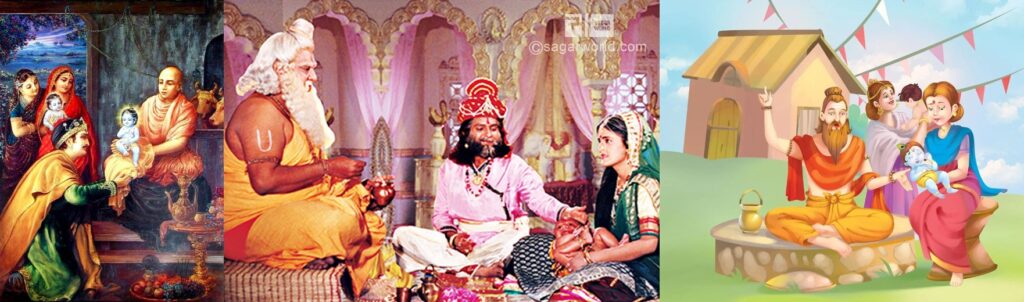
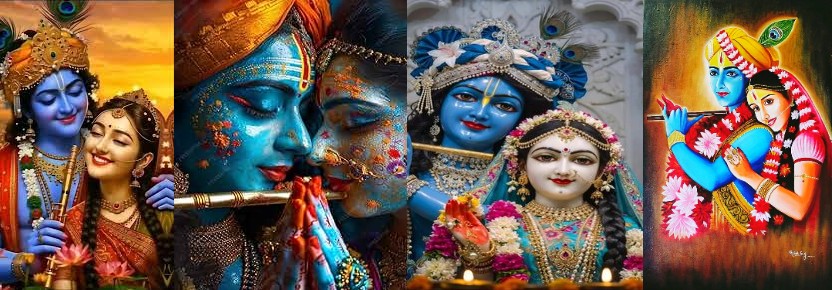
In these tense times, Sage Garga, upon receiving a letter from Rishi Sandilya, arrived swiftly at Nanda’s residence. Together, the two sages conducted the sacred naming ceremony (Nāmakaraṇa Saṁskāra) for the newborn child of Nanda and Yashoda. When the rites concluded, Nanda and Yashoda, full of eager anticipation, waited to hear the name of their divine son.
Garga spoke with serene gravity, quoting from scriptural vision:
“Dvāparānte kaler-ādau bālo ’yaṁ kṛṣṇatāṁ gataḥ
Tasmāt kṛṣṇa iti khyāto nāmnāyaṁ Nandanandanaḥ.”
“Born at the very end of the Dvāpara age, before the advent of Kali, this child shines with a dark-hued radiance—hence his name shall be Krishna, the delight of Nanda.”
The Deeper Meaning of the Name
The sage further explained that the name Krishna carried profound and layered symbolism:
• ‘Ka’ – for Kamala-Kānta, the beloved of Goddess Lakshmi.
• ‘Ra’ – for Rama, the supreme source of joy.
• ‘Ṣa’ – for the Ṣaḍguṇa-pati, the Lord dwelling in the divine realm of Śvetadvīpa.
• ‘Na’ – for Narasimha, the ferocious protector.
• ‘A’ – for the all-consuming power of Agni.
• The two dots of the Visarga – for the twin sages Nara and Nārāyaṇa.
Thus, this name itself is an embodiment of divinity. “This son,” Garga declared, “shall bring glory to your lineage, O Nanda. Yet, remember—his life shall always be under threat. Guard him with utmost care.”
With reverence, Nanda offered gifts and proper honorarium to both Sandilya and Garga, bidding them farewell.
The Meeting of Krishna and Radha
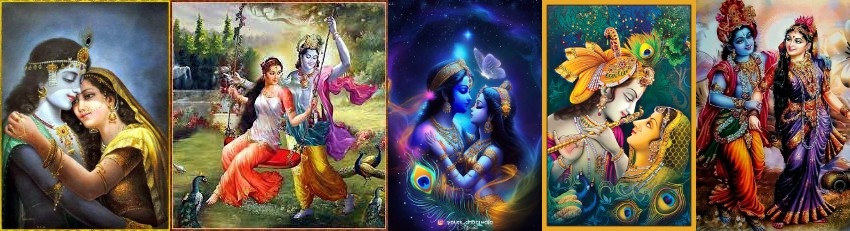
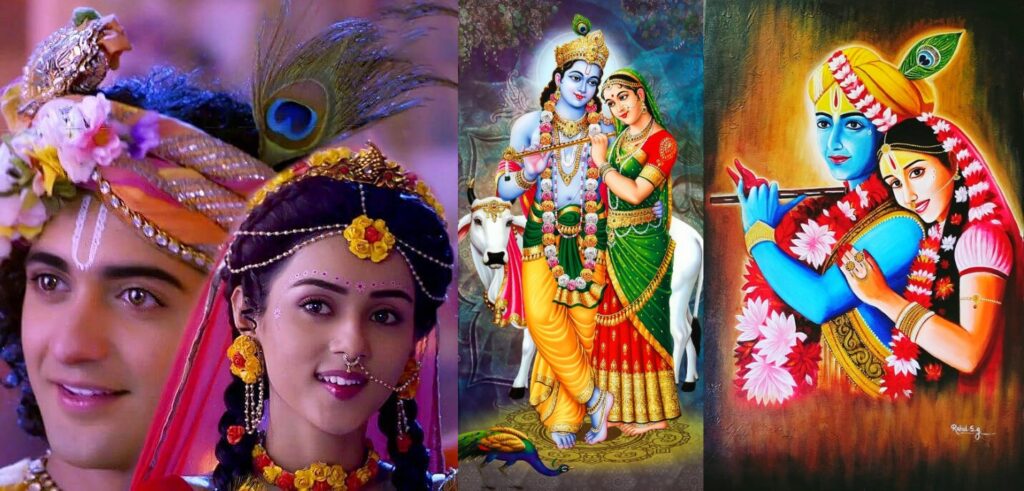
For the sacred occasion of Krishna’s naming, Vrishabhanu and his wife Kirti came to Nanda’s house, bringing with them their infant daughter, Radha. Although born earlier, Radha had never opened her eyes since birth. Yet, the very moment Kirti carried her near Krishna, Radha’s eyes opened wide—and her very first vision was of Krishna himself.
This divine incident left Vrishabhanu and Kirti astonished and overjoyed. Seeking clarity, they later invited Sage Garga to their home.
There, Vrishabhanu said, “Revered one, we have named this daughter Radha. Kindly reveal her destiny. Why did her sealed eyes open only upon beholding the son of Nanda?”
Garga meditated for a while and replied:

“O Vrishabhanu, this child is none other than Śrī Rādhikā, the eternal consort of Lord Krishna in Goloka-dhāma. You have chosen her name most aptly. She could not remain in the celestial realm while Krishna descended upon earth—thus, she too has incarnated. Out of vow and devotion, she kept her eyes closed until she could first behold her eternal beloved, Krishna. Blessed are you both, for by countless lives of pious merit, the Supreme Goddess herself has adorned your household. Know this, but keep it secret—for all of Gopa, all the cowherds and maidens, are but instruments of the Lord’s divine play upon earth.”
Humbled and overwhelmed, Vrishabhanu and Kirti prostrated before the sage and offered him due respect.
The Atrocity of Kansa’s Soldiers
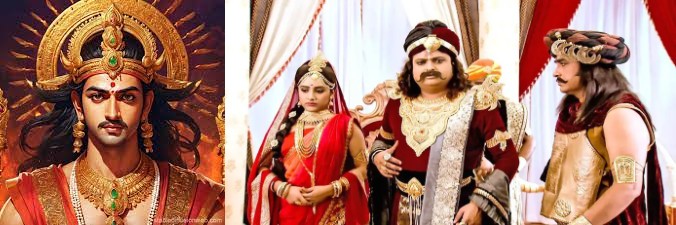
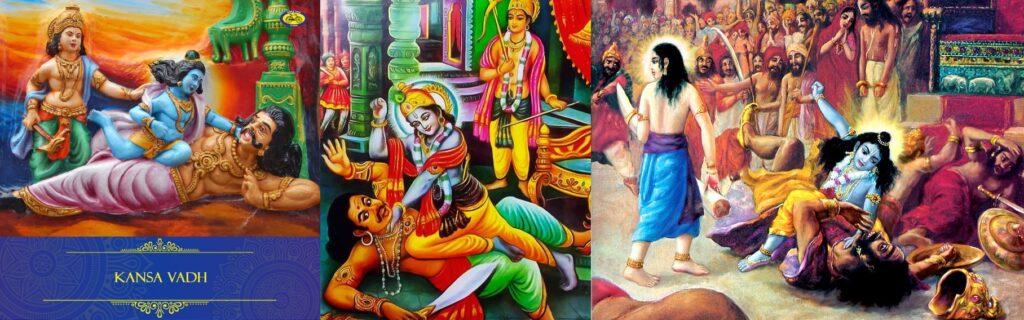
Meanwhile, the horrors unleashed by Kansa’s soldiers spread across Mathura and the neighboring villages. Thousands of infants were slaughtered in a gruesome wave of cruelty. Mothers wailing in agony had their breastfeeding infants snatched from their arms. The soldiers devised inhuman methods of killing—some infants were hurled upon spears, some cleaved with swords, others smashed against stones, or trampled under elephants. Parents who tried to protect their children were themselves slain or grievously wounded.
This demonic rampage soon reached the outskirts of Gopa-Nagara. Though a contingent of Kaṁsa’s soldiers did attempt an attack, the vigilant cowherd guards repelled them with remarkable valor. The news of this defense quickly reached Kansa’s court.
A Plan of Deception
Furious, Kaṁsa planned a larger assault. At that time, his minister Akrura spoke cautiously:
“Your Majesty, I have heard that in the house of Nanda two children reside. I cannot say exactly when they were born, but the old Nanda, blessed in his late years, is rejoicing beyond measure. Our spies report that the entire cowherd community is sworn to guard these children with their lives. They would rather abandon their homes than allow the slightest harm to befall Nanda’s offspring.”
Kaṁsa laughed scornfully:
“Destroy Gopa-Nagara entirely! Foolish Nanda dares such defiance? Let his children, his people, and his village be ground into dust!”
But Akrura, wise and prudent, interjected:
“Sire, to wipe out Gopa-Nagara would harm our own kingdom. Mathura depends on them for milk and dairy produce. If they are annihilated, the royal palace shall lack ghee, curd, and milk. The treasury too would lose the heavy taxes they provide. Worse, famine and rebellion may follow. Rather than a public massacre, let us act secretly. If only Nanda’s child is slain, your aim will be fulfilled without disruption.”
Kaṁsa pondered. Nearby sat the demoness Putana, infamous for her ability to kill infants by deceit. With a sinister smile, Kaṁsa said:
“Brother, you are right. Let it be so. Leave it to me—I shall send Putana. Tomorrow itself, she will go to Gopa-Nagara.”
(To be continued…)
Dakshinkali Temple: The Sacred Abode of Mother Kali in Nepal
Pingback: Pitru Paksha 2025 : Hindu Americans to Begin Observance on September 7 - UniverseHeaven