
A story of Dwapar Yuga in Prose : ( part-13)
By Lokanath Mishra
Shri Krishna and Balaram left Vrindavan for Mathura after their uncle, the demon king Kansa, summoned them under the guise of an invitation to a wrestling tournament, the “Dhanu Yagnya”. Akura was sent to fetch Krishna and his brother Balarama, who were then met with sadness by the people of Vrindavan. Upon arriving in Mathura, Krishna and Balarama encountered a woman named Kubja and freed her from her hunchback, a detail that shows Krishna’s compassion. They then entered the city and proceeded to confront Kansa, who was ultimately defeated and killed by Krishna, liberating Mathura from his tyranny.
The Summons from Kansa
Kansa, who had heard of Krishna’s divine powers, feared him and sought a way to eliminate him.
He orchestrated a deceptive invitation to the “Dhanu Yagnya” in Mathura, a wrestling event.
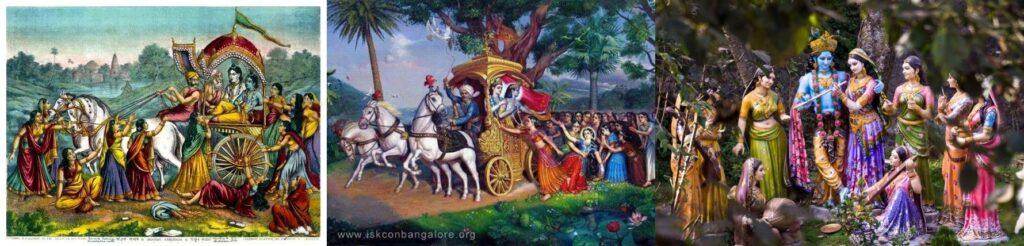
Kansa sent the Yadava minister Akura to Vrindavan to bring Krishna and his brother Balarama to Mathura under the pretense of participating in the festival.
The people of Vrindavan, particularly the cows and cowherds, were deeply saddened by Krishna’s impending departure.
They knew that Krishna was destined for a greater purpose and had to fulfill his promise to Mother Earth to eliminate demonic forces.
Akura brought Krishna and Balarama to Mathura by evening.
The brothers were amazed by the city’s beauty, its glowing palaces, and the sounds of merrymaking.
The story of Krishna and Balarama’s journey from their childhood home in Vrindavan to the city of Mathura is a turning point in their lives and a pivotal moment in the Hindu epics. It begins with the schemes of their tyrannical uncle, Kamsa, and ends with the fulfillment of a long-standing prophecy.
Kamsa’s invitation to Krishna
The cruel King Kamsa of Mathura had been warned by a divine prophecy that the eighth child of his sister, Devaki, would kill him. After killing her first six children and being outwitted on the seventh, Kamsa learned that Krishna, his eighth nephew, had been secretly raised in the village of Vrindavan as the son of the cowherd Nanda and his wife, Yashoda.
Fearing his prophesied death, Kamsa sent his trusted but devout minister, Akrura, to invite Krishna and Balarama to Mathura for a grand wrestling match and archery festival, known as the Dhanur Yagya. Akrura was ordered to bring the boys to the festival, where Kamsa had secretly arranged for them to be killed by a mad elephant and his finest wrestlers.
Akrura’s conflicted journey
Akrura, a great devotee of Vishnu, was filled with both conflict and joy. He was horrified by Kamsa’s treacherous plan but was ecstatic at the prospect of finally meeting his beloved Lord Krishna face-to-face.
As Akrura’s chariot neared Vrindavan, he saw Krishna’s divine footprints on the road and was so overcome with devotion that he leapt from the chariot and rolled in the dust. Upon reaching Nanda’s home, Akrura was warmly greeted by Krishna and Balarama. When he revealed Kamsa’s plan, the boys readily agreed to go with him, understanding it was their destiny.
The news that Krishna was leaving for Mathura spread through Vrindavan like a wildfire, and a thick cloud of sadness fell over the village.
The gopis, who cherished Krishna, gathered around his chariot and spent the night pleading with him not to leave.
Yashoda’s grief: Mother Yashoda and Nanda Baba were heartbroken at the departure of their beloved son, whose presence was the light of their lives.
Some stories describe Radha meeting Krishna to say a final farewell. With the deepest devotion, she told him that even though he was leaving physically, he would always be in her heart. Krishna promised to play his flute for her one last time before his departure, and after she left, he broke the flute and threw it into the bushes.
On the way to Mathura, Akrura stopped at the Yamuna river to perform his daily rituals. As he submerged himself in the water, he saw Krishna and Balarama sitting calmly inside the river, just as he had left them on the chariot. Akrura dove again and witnessed the brothers’ divine forms: Krishna as the supreme Lord Vishnu and Balarama as the cosmic serpent Shesha. Overwhelmed, Akrura offered prayers, affirming his devotion and understanding of their divine nature.
Krishna’s arrival in Mathura
Upon reaching Mathura, Krishna and Balarama walked the streets, causing a stir among the citizens who had suffered under Kamsa’s rule. They encountered and defeated several of Kamsa’s forces along the way.
They seized fine royal clothes from a washerman who served Kamsa and beat him for his insolence.
They healed a hunchback woman, Kubja, by straightening her body after she offered them a special sandalwood paste.
They entered the arena where Kamsa’s festival was to be held. Spotting the divine bow, which only Lord Shiva’s chosen one could string, Krishna effortlessly picked it up and broke it, signaling the beginning of Kamsa’s end.
Kamsa’s men unleashed the massive elephant Kuvalayapida at the entrance. Krishna tore out one of its tusks and used it to kill the beast.
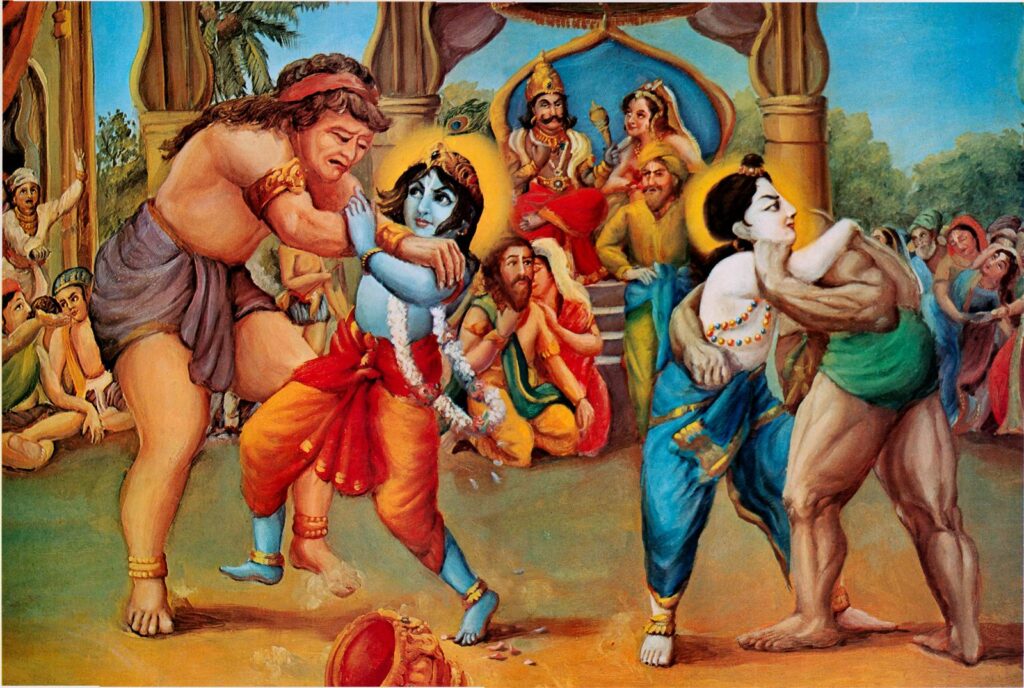
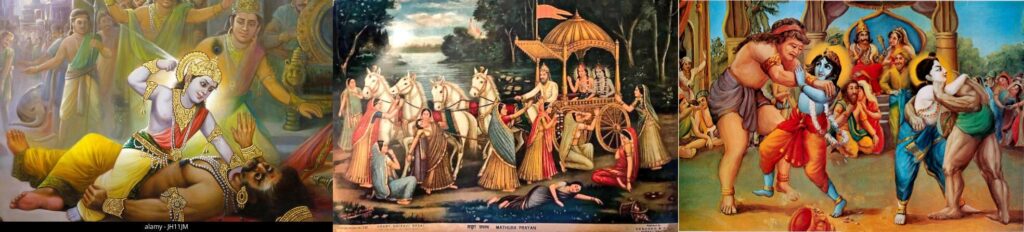
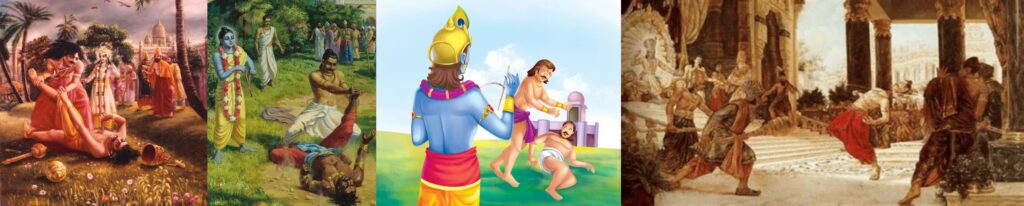
In the grand wrestling arena, Krishna and Balarama defeated Kamsa’s powerful wrestlers, including Chanur and Mushtik. A horrified Kamsa ordered his men to attack, but Krishna leapt onto Kamsa’s royal dais and grabbed him by his hair. After reminding Kamsa of his many sins, Krishna dragged his uncle to the wrestling mat and killed him with a single blow, ending his reign of terror.
Following Kamsa’s death, Krishna and Balarama released their birth parents, Devaki and Vasudeva, from prison and restored the righteous King Ugrasena to the throne. Having fulfilled his divine mission in Mathura, Krishna would never return to Vrindavan. ( to be continued)
Understanding Shraddha and Pinda Daan : A Journey of Honoring Ancestors