
A Story of Dvapar Yuga in Prose ( part-15)
By Lokanath Mishra
(Lord Krishna’s Journey for Education at Guru Sandipani’s Ashrama)
The story of Lord Krishna is filled with divine play (leela), heroic deeds, and deep wisdom. Yet, one of the most inspiring episodes from his life is not about miracles or battles, but about something very human—the pursuit of knowledge. Though Krishna was the Supreme Being himself, he too undertook the sacred duty of receiving education from a guru. This episode teaches us the importance of humility, discipline, and respect for the tradition of learning.
The Decision to Learn
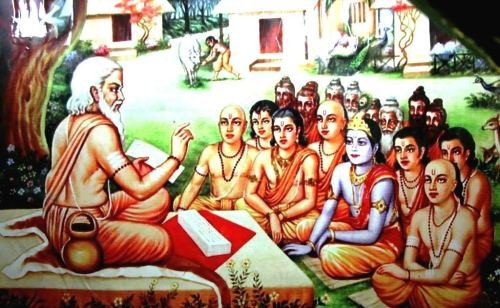
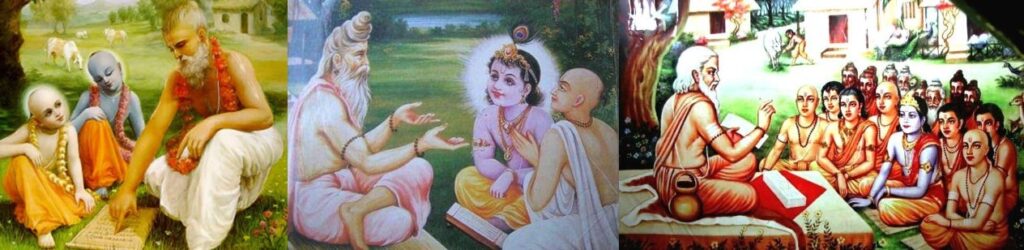
After slaying the tyrant Kamsa in Mathura and restoring peace to his family, Krishna and his elder brother Balarama were still very young. Their parents and elders felt that it was time for them to be educated, as was customary for every prince and noble child of that age. Even though Krishna was all-knowing, he accepted this with a smile. By doing so, he set a shining example that no one is above the discipline of learning, and that wisdom is best acquired from a spiritual master.
Thus, Krishna and Balarama were sent to the hermitage of the great sage Maharishi Sandipani, one of the most respected gurus of the time.
The Ashrama at Ujjain
The ashrama of Guru Sandipani was located in Avanti, the ancient holy city now known as Ujjain. This city was already famous as a center of knowledge and spirituality. In the simple surroundings of the hermitage, amidst the chanting of Vedic hymns, the crackling of sacred fires, and the rustle of trees, students from different walks of life lived together, dedicating themselves to the pursuit of knowledge.
Krishna and Balarama, princes of the Yadava dynasty, joined this humble community of learners, living as equals with other disciples.
The Intense Education
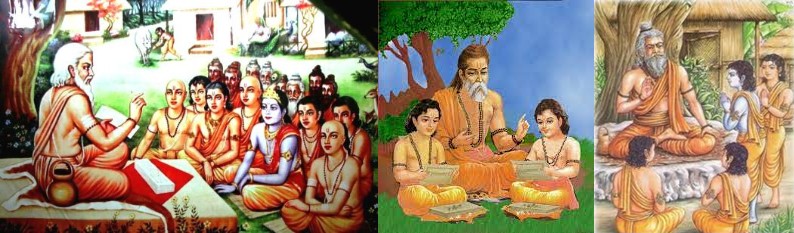
At Guru Sandipani’s ashram, Krishna and Balarama completed what would ordinarily take years of study in just 64 days and nights. During this short period, they mastered the 64 sciences and arts.
These included:
• Warfare and military strategy—the knowledge of weapons, archery, swordsmanship, and the subtle science of battle.
• Music and fine arts—singing, playing instruments, poetry, and dramatic performance.
• Sciences and crafts—astronomy, mathematics, painting, and skills like carpentry, metallurgy, and agriculture.
• Spiritual wisdom—the teachings of the Vedas, the practice of meditation, and the secrets of dharma and self-realization.
The speed of their learning was miraculous, but the humility with which Krishna and Balarama studied was even more significant. It showed that even divine incarnations respect the role of the guru.
The Purpose of Krishna’s Education
Why did Krishna, who was omniscient, need to learn from a guru? The scriptures explain that this was not for his sake, but for ours. By accepting a teacher and undergoing student life, Krishna demonstrated the eternal value of the guru-shishya tradition. He taught the world that one must approach knowledge with humility and respect, no matter how great one may be by birth or talent.
Sudama—The Beloved Friend
Among the students at Guru Sandipani’s ashram was Sudama, the guru’s own son. He was a poor Brahmin boy, but he and Krishna quickly became close friends. They studied together, shared meals, and even faced hardships as companions.
One story tells of a day when Krishna and Sudama were sent to the forest to collect firewood for a sacred ritual. A sudden storm broke out, and the two friends were lost in the darkness. Hungry and cold, they held hands and comforted each other until Guru Sandipani came searching for them. Such experiences only deepened their bond of friendship.
Years later, after Krishna had become the king of Dvaraka, Sudama remained a humble, impoverished Brahmin. Urged by his wife, Sudama visited Krishna, carrying nothing but a small bundle of parched rice as a gift. Krishna, upon seeing his childhood friend, welcomed him with open arms, washed his feet, and seated him with the highest honor. Even though Sudama felt ashamed of his simple gift, Krishna accepted it with great joy, declaring it his favorite food. Without Sudama asking, Krishna transformed his friend’s hut into a palace, blessing him with wealth and prosperity.
This story of Krishna and Sudama is one of the most touching episodes of divine friendship in the scriptures.
A Divine Example for Humanity
Krishna and Balarama’s education under Guru Sandipani was not only about acquiring worldly knowledge but also about setting an example for humankind. Krishna showed that true greatness comes not from power or wealth but from humility, devotion, and respect for dharma.
Their time in Ujjain stands as a reminder that education is not just about learning arts and sciences but about shaping character, deepening wisdom, and walking the path of righteousness.
Conclusion
The episode of Krishna’s education teaches us many lessons: the sacred bond between teacher and student, the importance of humility in learning, the value of friendship, and the blessings of knowledge. Though Krishna was divine and needed no instruction, he chose to live as a student to demonstrate that the path of learning is holy and that every human must embrace it with respect.
Thus, Lord Krishna’s journey to Guru Sandipani’s ashram is more than just a chapter from mythology—it is a timeless message for all seekers of wisdom.
⸻to be continued——
A Story of Dvapar Yuga in Prose: ( Part- 11 B)