
Puranic narration: Durga Puja: 3rd and 4th day
By Lokanath Mishra
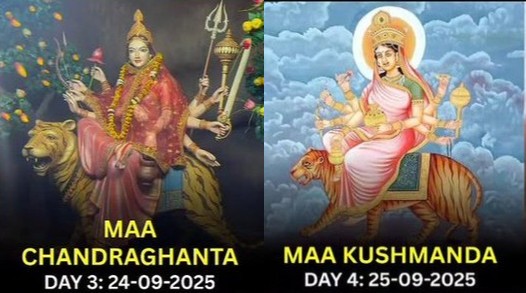
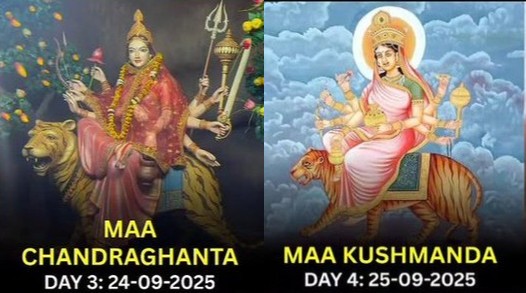
On the third day of Navaratri, the Divine Mother is adored in her resplendent form as Maa Chandraghanta. Upon her forehead shines the crescent moon in the shape of a bell, and hence she is called Chandraghanta. Seated upon a majestic lion, radiant with ten arms and three eyes, she wields weapons in eight hands and with her remaining two bestows blessings and protection upon her devotees.
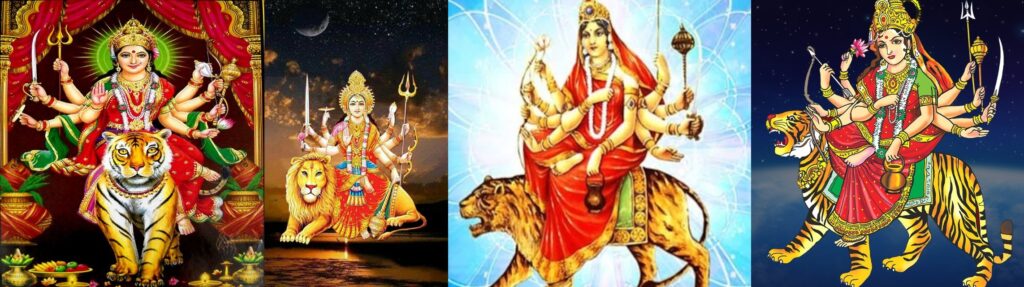
This form of the Mother is that of Parvati as the divine bride of Lord Shiva, the sacred moment of her union with the Supreme. It represents the step in a woman’s life where she surrenders all her strength and powers for higher purpose, mastering herself with discipline and devotion. Since the Moon governs the mind, the worship of Maa Chandraghanta grants mastery over one’s own mind, calming its restlessness and filling it with purity.
The Devi Purana narrates that when the tyranny of the demons spread across the earth, the Goddess manifested as Chandraghanta. The demon-king Mahishasura sought the throne of Lord Indra and desired dominion over heaven itself. Alarmed by this, all the gods approached the Holy Trinity — Brahma, Vishnu, and Maheshwara. Hearing of Mahishasura’s arrogance, Lord Vishnu grew wrathful. From the combined fiery energies of the three Lords, the Divine Mother arose. Lord Shiva offered her his trident, Lord Vishnu his discus, and all the gods and goddesses armed her with celestial weapons. Lord Indra presented her with a mighty bell, the Sun God bestowed his dazzling radiance and a sword, and granted her the lion as her mount.
Thus armed, Maa Chandraghanta advanced towards Mahishasura. At the very sight of her resplendent form, the demon realized his end had come. Yet, in desperation, he attacked the Mother. Then ensued a terrible battle between the gods and the demons. Finally, Maa Chandraghanta struck down Mahishasura, thus liberating the heavens and the earth, and restoring peace.
By worshipping this form of the Mother, devotees are blessed with fame, courage, and freedom from fear. The third day of Navaratri removes inner weaknesses and awakens divine strength within the heart.
The fourth form of Maa Durga is the radiant Maa Kushmanda. She is called so because with her gentle smile she created the cosmic egg (Brahmanda) and thus brought forth the universe. The word Kushmanda also denotes the gourd (pumpkin), which is dear to the Mother, and hence she is known by this name. Before creation existed, when darkness enveloped all directions, it was through the tender radiance of her smile that the universe was illumined. She is the Primal Creatrix, the Adi-Shakti, and her abode is within the solar sphere. Only she has the power to dwell within the blazing brilliance of the sun.
On this sacred day, the seeker meditates upon her in the Anahata Chakra (the heart center). Worship of Maa Kushmanda destroys ailments, brings health, strength, long life, and prosperity. With eight arms, she is called Ashtabhuja. In her seven hands, she holds the water vessel, bow, arrow, lotus, nectar-filled pot, discus, and mace. In her eighth hand, she holds a rosary that grants all siddhis and treasures. From the pot of nectar in her hand, she bestows longevity and divine health upon her children. Her lion mount signifies fearlessness and righteousness. Maa Kushmanda is easily pleased, even with the simplest offerings, and to the devotee who surrenders with a pure heart, she grants the highest state effortlessly.
On the fourth day of Navaratri, devotees rise at dawn, bathe, and wear garments of green, the color sacred to the day. The Mother’s image or idol — whether of clay, copper, silver, or gold — is placed upon a kalash filled with grains and decorated with leaves, symbolizing abundance. Before her, a ghee lamp is lit and tilak is offered. Of all flowers, the hibiscus is dearest to the Mother. She is worshipped with green gram, betel leaves, pumpkin, and the sweet malpua, which is especially beloved by her.
The sacred mantra “Om Kushmanda Devyai Namah” is recited 108 times. With hibiscus flowers in hand, devotees bow in reverence. Thereafter, with resolve, the Shodashopachara (sixteenfold worship) is performed with Vedic and Saptashati mantras, offering water, garments, ornaments, fragrant substances, incense, lamps, food, fruits, and arati.
The Durga Chalisa is recited, arati is sung, and Brahmins are served food in her honor. Finally, the devotee partakes of the sanctified prasad, which is then distributed among all, marking the completion of the worship.
Thus, on the third and fourth days of Navaratri, the Mother is adored as Chandraghanta and Kushmanda, who bless her children with strength, fearlessness, health, and prosperity.
The First Two Days of Navaratri – Goddess Shailaputri and Goddess Brahmacharini:
The Significance of Water Offerings in Hinduism