
A Story of Dvapar Yuga in Prose (Part-24B)
By Lokanath Mishra
First, the examiners began by asking oral questions related to weapons and warfare. Bhishma himself was a member of the examining committee. He asked Yudhishthira, “Who is called a Rathi?”
Yudhishthira replied, “One who can protect the charioteer and the horses in battle is called a Rathi.”
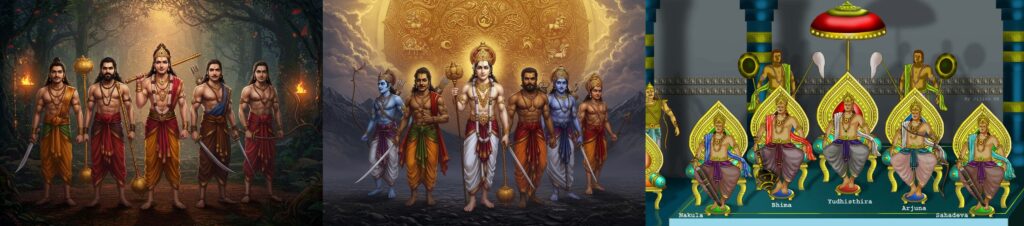
Arjuna was asked the second question: “What is the difference between a Maharathi and an Atirathi?”
He answered, “One who can protect not only the charioteer and horses but also his own army is a Maharathi. One who, in addition to all this, can fight alone against an entire Akshauhini force is called an Atirathi.”
Kripacharya then asked Duryodhana, “What do you understand by the term Sena (army)?”
Duryodhana replied, “An army consists of one hundred elephants, eleven hundred chariots, ten thousand horses, and one lakh infantry soldiers.”
For Bhima, Kripacharya asked, “What is called a Chaturangi Sena?”
Bhima replied, “A combination of two such armies forms a Chaturangi Sena.”
After many such oral questions, the candidates demonstrated their skill in handling weapons. Using swords, maces, spears, javelins, and other arms, they displayed techniques of attack and self-defense, delighting both the examiners and the spectators.
This was followed by duels. In wrestling and mace-fighting, Bhima and Duryodhana showed equal prowess. In archery, however, no one could match Arjuna. Karna was present at the examination as a spectator. By then, he had already earned considerable fame for his valor.
Duryodhana could not tolerate the praise showered on Arjuna. He urged Karna to take part in the competition. Karna, who had been waiting for such an opportunity, stepped forward—but immediately voices of protest arose. Kripacharya objected, saying, “A prince may compete only with another prince. From which kingdom is this Karna a prince?”
Bhimasena, who was among the candidates, mockingly snorted and laughed, saying, “Poor son of a charioteer! What fault is his? Is it not because the blind king’s son encouraged him that he dares to come forward?”
Yudhishthira cast a stern glance at Bhima, and Bhima restrained himself.
Insulted and humiliated, Karna stood surrounded by kings and princes in the arena of martial examination. Ashamed, he was about to return to his seat when Duryodhana called out, “Stop, Radheya! If you lack the identity of a prince, I shall give you the identity of a king. At this very moment, I crown you as the ruler of Anga, a kingdom under our control.”
Removing his own crown, Duryodhana placed it on Karna’s head and proclaimed, “Behold, King Karna of Anga!”
The other Kaurava brothers shouted, “Victory!”
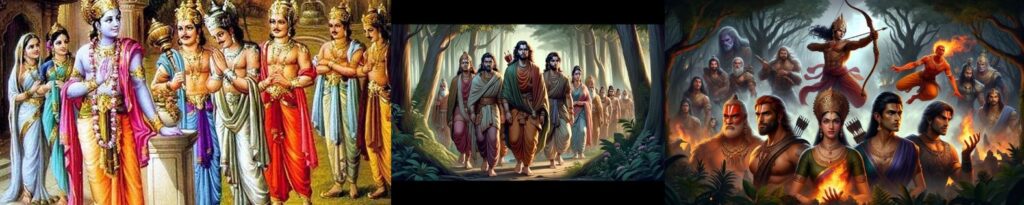
Duryodhana then said, “Grandfather, revered teachers, is there now any obstacle to his competing with Arjuna?”
But evening had already fallen. Bhishma declared, “The examination was to last only until sunset. The competition is now over.”
Duryodhana accepted this announcement with great irritation. Approaching Karna, he said, “Great warrior Karna, from today I accept you as my friend. I promise to stand by you in joy and sorrow alike.”
Karna took a similar oath: “From today until death, Karna shall remain your friend—in happiness and misery, in righteousness and unrighteousness. Before these noble people, you restored my trampled honor with courage. For this, I remain indebted to you for life. If need be, I shall repay this debt with my very life.”
Baladeva (Balarama) was seated beside Bhishma. Bhishma asked him, “Son Baladeva, what is your opinion of their training?”
Balarama replied, “They have mastered all other arts excellently, but they still need further training in mace warfare.”
At the request of the examiners, Balarama demonstrated mace combat. The rotation of his mace created a terrifying whirlwind; had he continued longer, everyone would have been swept away. Krishna placed his hand on his brother’s shoulder as a signal, and Balarama stopped.
Hoping to become Balarama’s favorite, Duryodhana expressed his desire to become his disciple. Balarama said, “On Mount Raivataka, I teach mace-fighting to interested students. You may join there.”
The Pandavas showed no interest in taking a second teacher, but the hundred Kaurava brothers accepted Balarama as their guru and trained in mace warfare for some time.
Guru Drona loved two people most in his life—his son Ashwatthama and his beloved disciple Dhananjaya (Arjuna). The day he realized Partha’s exceptional prowess, he privately warned his son that Duryodhana would never spare him and that one day Ashwatthama would face death at Arjuna’s hands.
Observing Ashwatthama constantly in Duryodhana’s company, Drona advised him: “The relationship between the Kauravas and Pandavas is strained. A time will come when they fight each other. Duryodhana will ask you to fight on his side, and then your death at Arjuna’s hands will be certain. I shall tell you how to attain immortality.”
He instructed Ashwatthama to perform severe penance by meditating upon Niranjana beneath the sacred Udala banyan tree on the banks of the Saraswati River. Later, Ashwatthama performed this penance with his maternal uncle Kripa and attained immortality.
A major episode in Dronacharya’s life is the famous story of Jara Shabara (Ekalavya), which deserves brief discussion.
When Kripi died after giving birth to Ashwatthama and her death anniversary approached, Drona asked that a rhinoceros be brought. During the search, the Kauravas behaved indecently with Jara’s wife Shriya near a pond. Hearing her cries, Jara arrived, subdued the Kauravas with arrows, and took his wife to safety.
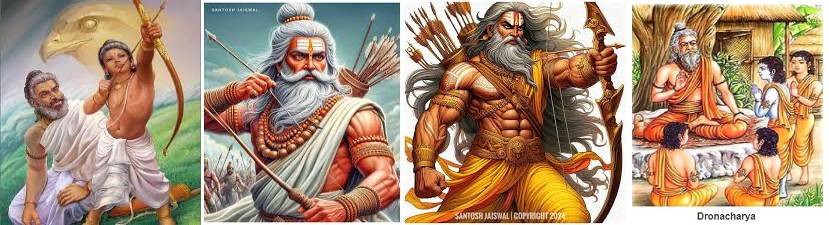
Drona sent Arjuna, accompanied by a tracking dog, to search for the Kauravas. The dog suddenly stopped barking and returned—its mouth had been mysteriously sewn shut by arrows. Arjuna, astonished, noticed huts in the distance.
Following Drona’s command, Arjuna encountered Jara, who challenged him. A fierce battle ensued, with both warriors showering arrows upon each other. The forest trembled with the twang of their bows.
Hearing the clash of weapons, Drona rushed to the spot with Bhima and saw Jara and Arjuna locked in combat. On seeing his guru, both ceased fighting. Jara narrated his entire story—how he had been rejected by the Kauravas, yet had sculpted a clay idol of Drona, accepted him as guru, worshipped him, and mastered archery through intense self-discipline.
Drona recognized him and, though ashamed, demanded guru-dakshina. He asked for Jara’s thumb. Without hesitation, the innocent tribal youth severed his thumb and offered it.
The royal preceptor of Hastinapura was consumed by shame. Arjuna reproached himself. Only the Kauravas rejoiced.
Despite losing his ultimate potential, Ekalavya etched his name in golden letters upon the pages of history.
This story of guru and disciple continues to stir human conscience across the ages, echoing the anguished cry of the innocent tribal youth:
“Gurudeva, what have you done? What have you asked for?”
(To be continued)