
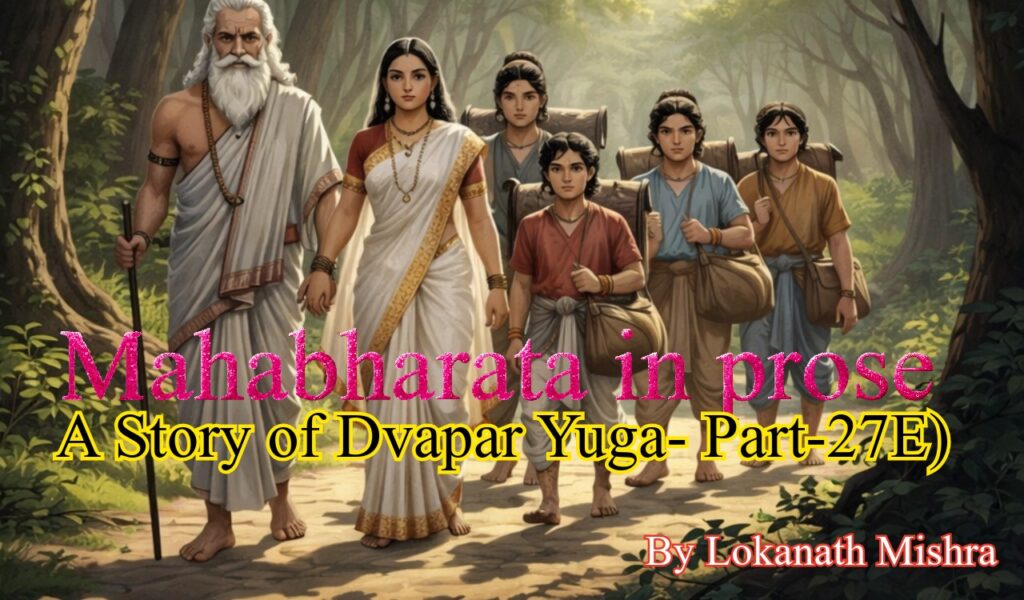
Mahabharata in prose ( A Story of Dvapar Yuga- Part-27E)
By Lokanath Mishra
Among the people appointed at the lac palace (Jatugriha), there were two professional criminals. Shakuni had given them strict instructions that after setting the fire, Purochana must not return alive. The responsibility of throwing Purochana into the blazing fire rested on those two men. How could Shakuni make the mistake of leaving behind any witness to the crime?
When the palace caught fire before the scheduled time, the craftsmen fled in terror. The two criminals appointed by Shakuni met him during the last watch of the night. As they said, “The lac palace has burned down,” their bodies trembled and their words came out indistinctly. Shakuni understood that they were trying to hide something. First, he reassured them and said, “Tell me everything clearly. Hide nothing.”
They described how Purochana had gone to sleep in the lac palace that night along with a Kirata (Nishada) family. After that, who set the fire and how it spread—they could not say. But they were certain that no one, including Purochana, had emerged alive from the burning palace.
Shakuni smiled—a crooked, sinister smile—and said, “That means you set fire to the palace. Tomorrow morning, be ready to receive the death penalty for the crime of murdering members of the royal family.” Terrified, the two men fell at Shakuni’s feet, weeping.
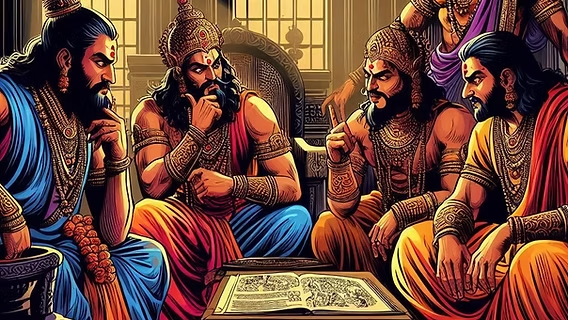
Shakuni said, “Only by fleeing can you save yourselves. If you are seen in Hastinapura, Varuna, or Indraprastha, no one will be able to protect you.” He brought some gold coins from inside the house, gave them to both men, and ordered them to escape far away immediately. He did not want Duryodhana to learn about the Kirata family.
As the two men left Shakuni’s house, Vidura’s spy followed them. On the outskirts of the city, the two entered a tavern to drink liquor. To relieve their exhaustion, they drank heavily. One said, “It’s good that Purochana burned to death himself.” The other asked, “Did all seven die?” The first replied, “How? That Kirata woman came with her five sons and slept in the palace that night. Altogether twelve.” The second laughed and said, “You can’t count. It’s thirteen—six of them, six of these, plus Purochana.”
Vidura’s spy sat nearby and heard everything. He had learned all that he needed to know and quickly conveyed the information to Vidura. Soon after, the boatman from the banks of the Ganga also arrived and described in detail how the Pandavas crossed the river and how Bhima killed the crocodile. Vidura rewarded him generously and sent him away.
Shakuni met Duryodhana and said, “There are two pieces of news—one happy and one sad. I cannot decide which to tell first.” Duryodhana said, “Tell me the happy news first.” Shakuni replied, laughing, “The crown of Hastinapura is destined to adorn your head, my child. Laugh freely! Purochana has finished the task a day early. All the thorns in your path have been removed. The poor fellow himself was also reduced to ashes in the fire.”
Duryodhana asked, “And what is the sad news?”
Shakuni said, “Not sadness—great sorrow, my nephew. Your aunt Kunti and your beloved cousins have been burned alive in the fire. From now on, shed tears loudly. Beat your forehead and wail so that the entire city of Hastinapura may witness Duryodhana’s brotherly affection.”
Within moments, the royal palace of Hastinapura was enveloped in mourning. Some wept genuinely; others indulged in deceitful lamentation to draw attention. Bhishma, Drona, Karna, Kripa, Dhritarashtra, Gandhari, Duryodhana, Bhanumati, Dushasana, and many others drenched the palace in tears.
Messages were sent swiftly to friends and relatives. At Mount Raivataka, the royal men and women of Dwaraka were celebrating the festival of Indra when a messenger from Hastinapura arrived with the tragic news. On hearing it, Lord Krishna was overwhelmed with sorrow.
Both Krishna and Balarama immediately came to Hastinapura. Sanjaya informed Dhritarashtra of their arrival. Dhritarashtra, weeping, described the untimely death of Kunti and the Pandavas. Balarama said, “Let us go and see the place where the Pandavas met such a fate.”
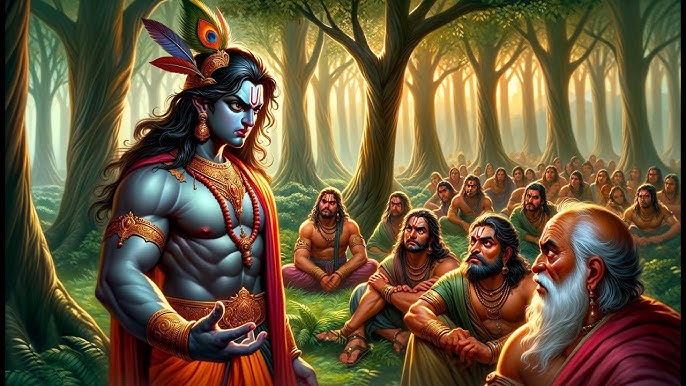
As they set out for Varanavata, Krishna privately asked Vidura, “What is the truth? This is impossible while you are present.” Vidura replied, “O Supreme Lord, everything happens through Your will. Do You not already know? They have escaped safely. Those who died were the Nishada woman who had taken shelter that night and her five sons. But what have You done? You have brought everyone here. Now they may recognize the bodies, and the secret will be revealed.”
Meanwhile, the half-burnt lac palace was still smoldering. Krishna commanded the Sudarshana Chakra, which intensified the fire so fiercely that no one dared approach the bodies. From a distance, they merely counted the corpses.
Three people knew the truth yet pretended ignorance: the scheming Shakuni, the righteous Vidura, and the wielder of illusion, Madhusudana (Krishna). Each played the role of director in his own domain. Two believed themselves to be the directors. The third was the director of the directors—remaining behind the stage, controlling the actions of the other two.
The Lac Palace Conspiracy — Deceit, Dharma, and Divine Direction**
The episode of the Jatugriha (Lac Palace) in the Mahabharata is not merely a tale of arson and escape; it is a profound study of human cunning, moral conflict, political theatre, and divine orchestration. This narrative demonstrates how evil believes itself victorious while unknowingly becoming an instrument of a greater cosmic design.
Shakuni: The Architect of Deceit
Shakuni represents cold, calculating intelligence devoid of morality. His crime is not only the planned murder of the Pandavas but also the meticulous erasure of evidence. By employing criminals and threatening them later, he attempts to ensure silence. His smile—described repeatedly as crooked—is symbolic of his inner corruption. Yet even his intelligence is limited to the material world; he fails to perceive forces beyond manipulation.
Purochana: The Disposable Agent
Purochana is a tragic figure—loyal, ambitious, and expendable. In serving adharma, he becomes its first casualty. His death illustrates a recurring Mahabharata theme: those who serve evil are never protected by it.
Vidura: Dharma in Silence
Vidura stands as the conscience of Hastinapura. He does not confront evil openly but neutralizes it through wisdom, spies, and foresight. His restraint is not cowardice but strategic righteousness. Vidura knows when truth must be spoken—and when it must be concealed to protect dharma.
Krishna: The Director of Destiny
Krishna’s role transcends morality and immorality. He allows illusion to persist because truth revealed too early would disrupt the destined course of events. By intensifying the fire and preventing identification of bodies, he preserves the secret of the Pandavas’ survival. Krishna is not merely reacting—he is orchestrating history.
Duryodhana: The Performer of False Grief
Duryodhana’s mourning is a grotesque performance. His tears are rehearsed, his sorrow calculated. This hypocrisy reflects the moral decay of Hastinapura’s throne. The city mourns, but truth is absent from its grief.
Symbolism of Fire
Fire in this episode is paradoxical. Intended as a weapon of destruction, it becomes a tool of purification and rebirth. The Pandavas emerge from the flames symbolically dead to the old world, ready for transformation and eventual triumph.
The Three Directors
The concluding metaphor is striking:
• Shakuni directs deception
• Vidura directs protection
• Krishna directs destiny
Of these, only Krishna understands the entire script. The others act within limited knowledge, believing themselves in control.
Conclusion
The Lac Palace episode teaches that evil may design the plot, but it never writes the ending. Dharma survives not through brute force but through patience, wisdom, and divine timing. The fire that was meant to annihilate the Pandavas instead forges them for the future—proving once again that in the Mahabharata, truth may hide, but it never perishes.
( to be continued)
ଜୟ ସୋମନାଥ
The actions initiated by pensioners’ associations against the validation clauses in the Finance Act.
Note on Applicability of 8th Central Pay Commission Recommendations to Existing Pensioners ( by Lokanath Mishra, the Chief Adviser, the All India Pensioners Association of CBIC)
Pingback: Mahabharata in Prose - UniverseHeaven The Lac Palace (Jatugṛha): Vyāsa’s Mahābhārata Re-Examined
Pingback: Title : The Ladder That Was Never Given - UniverseHeaven The Ladder That Was Never Given | A Powerful Moral Story