
Mahabharata in Prose ( A story of Dvapar Yuga Part: 27 F)
By Lokanath Mishra:
**The Lac Palace (Jatugṛha) Episode in Vyāsa’s Mahābhārata:
In Vyāsa’s Mahābhārata, the Jatugṛha episode occurs in the Ādi Parva, immediately after Duryodhana’s repeated failures to humiliate or destroy the Pāṇḍavas through political maneuvering. Recognizing that open violence would invite public outrage, the Kauravas—under the guidance of Śakuni—choose covert annihilation. The lac palace at Vāraṇāvata is constructed specifically to burn easily, using lac, ghee, resin, and dry reeds (jatu, ghṛta, kuśa).
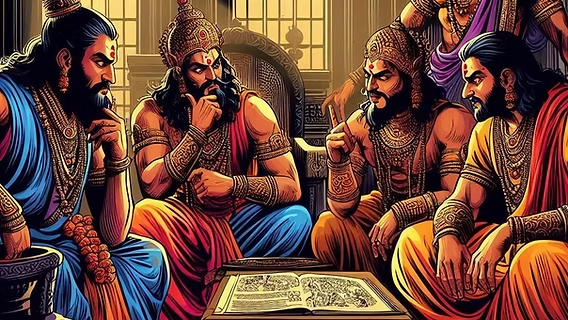
Vyāsa presents this event not as a simple conspiracy but as a clash between adharma-driven intelligence and dharma-guided wisdom.
Śakuni According to Vyāsa: Cunning Without Dharma
In the critical Mahābhārata text, Śakuni is not merely evil; he is strategically immoral. His defining trait is kūṭanīti—policy divorced from righteousness. The use of criminals, the elimination of witnesses, and the calculated manipulation of Duryodhana’s emotions all align with Vyāsa’s portrayal of Śakuni as:
“One who knows policy but not righteousness,
and therefore destroys even those he advises.”
The above passage ( part 27-E) correctly reflects this by showing Śakuni threatening the hired criminals after the act—demonstrating Vyāsa’s principle that adharma never grants security, even to its servants.
Purocana in Vyāsa: The Instrument Burnt by His Own Fire
Vyāsa describes Purocana as Duryodhana’s trusted man, skilled in architecture and obedience, but lacking discernment. Importantly, Vyāsa never portrays him as innocent. His death in the fire is poetic justice, a recurring epic motif:
“Fire consumes first the hand that lights it for sin.”
Part-27 E narrations faithfully mirrors this textual logic—Purocana becomes both executioner and victim, reinforcing Vyāsa’s karmic structure.
This
The Nishāda Woman: Textual Accuracy
In Vyāsa’s Mahābhārata, the bodies found in the ashes belong to a Nishāda woman and her five sons, who had taken shelter in the palace. This detail is often blurred in popular retellings but is explicit in the critical text.
The above passage precisely preserves this crucial fact, aligning fully with Vyāsa’s account and reinforcing the tragic cost of royal conspiracies upon the marginalized.
Vidura: Dharma Acting Through Silence:
Vyāsa presents Vidura as dharma embodied, yet politically constrained. He warns Yudhiṣṭhira through mleccha-bhāṣā (coded language), enabling escape without alerting the Kauravas. He does not expose the conspiracy publicly because:
1. Dhṛtarāṣṭra would not act
2. The Kauravas would accelerate violence
3. Dharma required survival before confrontation
The above essay’s ( part 27-E) portrayal of Vidura using spies and restraint is fully consistent with Vyāsa’s philosophy:
“When truth spoken destroys the righteous,
silence becomes dharma.”
Bhīma and the Crocodile: Vyāsa’s Proof of Survival
Vyāsa deliberately inserts the episode of Bhīma killing the crocodile while crossing the Gaṅgā. This is not ornamental—it serves as narrative proof for the attentive reader that the Pāṇḍavas are alive.
The inclusion of the boatman’s testimony aligns exactly with Vyāsa’s narrative technique: truth revealed selectively to the wise (Vidura), concealed from the blind (Dhṛtarāṣṭra).
Kṛṣṇa’s Role: Māyā and Līlā in Vyāsa
In Vyāsa’s Mahābhārata, Kṛṣṇa is not yet the battlefield charioteer; he is the silent regulator of destiny. His actions are subtle, not declarative. The intensification of the fire to prevent identification of bodies, though expressed poetically in later traditions, aligns philosophically with Vyāsa’s concept of māyā as protection of cosmic order.
Vyāsa repeatedly emphasizes:
• Kṛṣṇa never lies
• But truth is not always revealed
• Time (kāla) is His instrument
The metaphor of Kṛṣṇa as the “director of the directors” is not found verbatim in Vyāsa, but it is fully consistent with the epic’s theological framework.
Duryodhana’s Grief: Vyāsa’s Political Theatre
Vyāsa explicitly shows Duryodhana engaging in public mourning to consolidate legitimacy. This hypocrisy is intentional and contrasts sharply with Bhīṣma and Gāndhārī, whose grief is genuine. The above essay accurately captures this duality, which is central to Vyāsa’s moral critique of kingship without dharma.
Fire as Scriptural Symbol
In Vyāsa’s Mahābhārata, fire (agni) operates on three levels:
1. Physical destruction
2. Karmic purification
3. Narrative rebirth
The Pāṇḍavas’ emergence from the fire marks their symbolic death as princes and rebirth as ascetics-in-exile, a transformation necessary for the Kurukṣetra war.
Conclusion (Vyāsa-Aligned)
Vyāsa does not present the Jatugṛha episode as a victory of cleverness over strength, but as a temporary triumph of adharma permitted by kāla. Śakuni believes he has authored the ending; Vidura safeguards the protagonists; but only Kṛṣṇa understands the entire arc of destiny.
Thus, in true Mahābhārata spirit:
Adharma plans,
Dharma endures,
Kāla decides.
The lac palace burns, but dharma does not.
( to be continued)
Mahabharata in prose ( A Story of Dvapar Yuga- Part-27E)
Pingback: Title : The Ladder That Was Never Given - UniverseHeaven The Ladder That Was Never Given | A Powerful Moral Story