
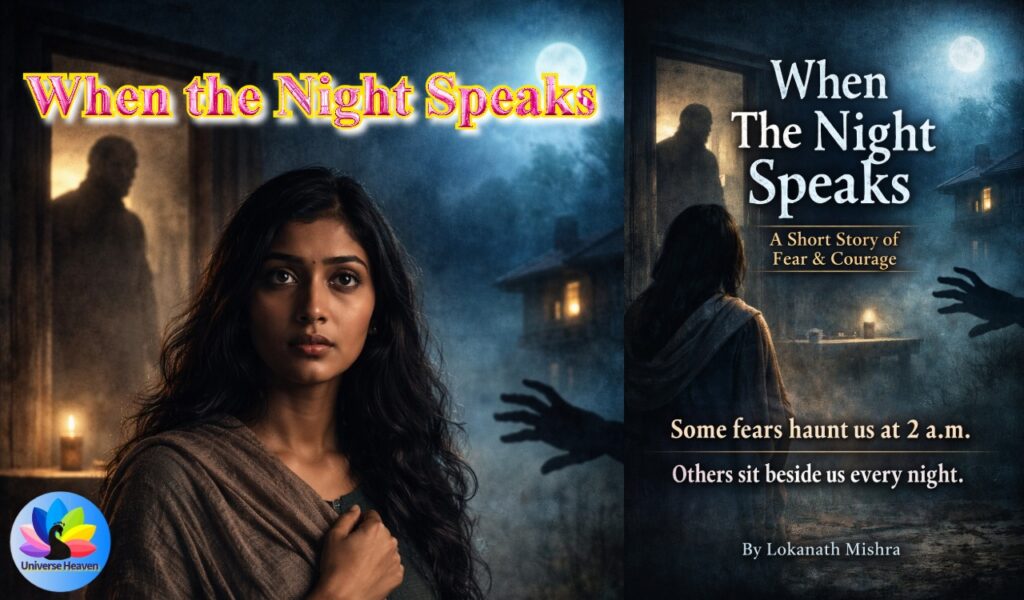
When the Night Speaks
By Lokanath Mishra
The night was unnaturally still, the kind of silence that presses against the ears until even one’s own breathing sounds intrusive. At exactly two in the morning, Kajal heard her name whispered from the darkness.
“Girl… get me some water.”
She opened her eyes, more irritated than afraid. Standing near the doorway was her grandfather—thin, familiar, his face half-lost in shadow, his voice rough with thirst. With a tired sigh, Kajal slipped out of bed and went to the kitchen. The house felt cold under her bare feet, but she brushed the feeling aside, filled a glass with water, and walked back.
His room was empty.
No cot. No blanket. No sign that anyone had ever slept there. The space looked bare, unfinished, as though it had never been occupied at all.
Her pulse quickened. Clutching the glass, she rushed to her grandmother’s room. Grandma sat upright on the bed, calm and alert, as if she had been awake for hours.
“Where did Grandpa go?” Kajal asked, her voice trembling.
Her grandmother stared at her, puzzled. “Have you lost your mind?” she said gently. “He died before you were even born.”
A strange calm washed over Kajal, heavy and numbing. Without another word, she drank the water herself and returned to her room, telling herself that exhaustion can blur reality, that the mind plays cruel tricks when sleep is broken. Somewhere between fear and logic, she drifted back into sleep.
Morning light crept into the house, soft and deceptive. At breakfast, her nani asked casually, “Who were you talking to last night?”
“I was talking to Grandma,” Kajal replied.
The color drained from her nani’s face. “Your grandmother passed away ten years ago.”
The house suddenly felt hollow, as if its walls had stretched too far apart. Kajal ran to Grandma’s room—it was empty. When she turned back, nani was gone too. Panic rising, she called out, only to be met by a maid who looked at her with concern and said softly that nani had died twelve years ago.
That was when the final truth struck her like a blow—they never had a maid.
Kajal jolted awake, gasping. Dawn was breaking. It had all been a dream.
Yet her hands still shook as she locked herself in her room, the echo of that silence lingering inside her. Then another sound cut through it—a man turning restlessly on the bed.
It was her husband.
He lay beside her, eyes fixed on the ceiling, shifting from side to side as though sleep feared him.
“What’s wrong?” she asked quietly. “Why aren’t you sleeping?”
“Nothing,” he said too quickly. “Just can’t sleep. You rest.”
But when she woke again near three, thirsty and uneasy, he was still awake. That was when Kajal understood—fear has many faces, and not all of them belong to ghosts.
She placed her hand gently on his head. “Swear on me,” she said. “Tell me the truth.”
His voice broke as he spoke. He told her about the neighbor, the loan taken on a one-year agreement, the threats, the pressure closing in on him. He spoke of long days selling fruit, of numbers that never added up, of a weight on his chest heavier than any nightmare.
Something inside Kajal hardened—not with anger, but with resolve.
She took his hand and led him out into the night. At four in the morning, she pounded on the lender’s door until lights flickered on and the neighborhood stirred. When the man finally emerged, confused and irritated, Kajal stood tall.
“You gave us money on a one-year agreement,” she said, her voice steady. “You will get it after one year. Until then, do whatever you think you can. The law is with us. And if you threaten my husband again, you will answer to me.”
The man said nothing. He didn’t need to.
Back home, Kajal told her husband to sleep. “Some fears survive only because we stay silent,” she said softly.
As he drifted into rest, the house felt lighter. The shadows retreated. Kajal realized then that ghosts may visit in the weakest hours of the night, but courage has the power to wake an entire world.
And sometimes, the scariest things are not the dead who call out at two in the morning—but the living fears we refuse to face, until someone finally stands up and says, enough.