
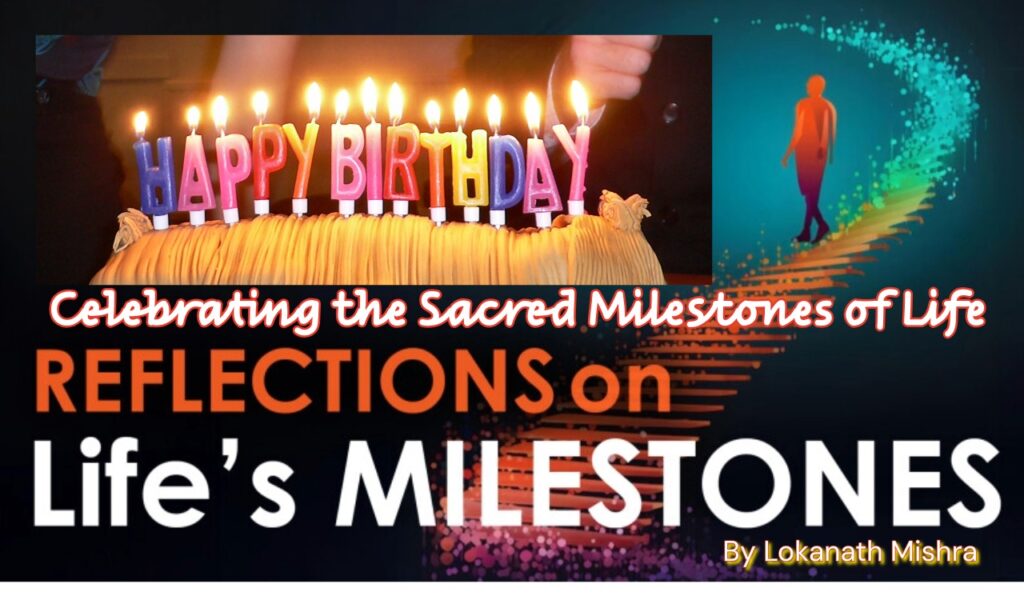
**Celebrating the Sacred Milestones of Life:
Why Ages 50, 60, 70, 80, 90, and 100 Deserve a Grand, Decade-Long Celebration**
Someone once asked me:
“Why do we celebrate certain ages—50, 60, 70, 80, 90, and 100—with such grandeur?
Are these numbers spiritual, or are they merely cultural habits?”
The answer lies not in numbers, but in human evolution of awareness, understood deeply by our sages.
The Mahabharata offers clarity through the story of King Yayati, who realized after a life of indulgence:
“Pleasure has an end, but desire does not.”
This insight revealed that life progresses through inner milestones, not just birthdays. Over time, these inner shifts came to be symbolically honoured at ages 50, 60, 70, 80, 90, and 100—each not as a single event, but as a ten-year sacred phase.
**50 to 59 – The Awakening Phase:
From Momentum to Meaning**
Fifty marks the first conscious pause.
Achievement gives way to assessment. Health, time, and purpose come into focus. You begin choosing depth over speed.
Celebrating this decade acknowledges awareness awakening—the realization that life must now be lived deliberately, not automatically.
**60 to 69 – Shashti:
From Accumulation to Understanding**
At sixty, priorities shift inward.
The urge to collect fades. The urge to comprehend strengthens. Silence becomes nourishing, and reflection becomes natural.
This decade celebrates clarity over clutter.
**70 to 79 – Bheemaratha Shanthi:
When Peace Becomes Power**
Seventy brings emotional restraint.
Arguments feel unnecessary. Relationships matter more than correctness. Peace is recognized as strength.
This decade honours inner victory.
**80 to 89 – Sathabhishekam:
When Presence Becomes Healing**
At eighty, your presence comforts more than words.
You become a living assurance that life, despite its struggles, resolves into meaning.
This decade honours silent wisdom.
**90 to 99 – Navathi:
The Gentle Dissolution of Ego**
Ninety brings humility without effort.
Judgment fades. Hurt dissolves quickly. A soft stillness settles in.
This decade honours grace without striving.
**100 and Beyond – Shatamanam:
When Life Becomes Universal**
At one hundred, the personal merges with the universal.
Life is seen as a gift—held, guided, and complete.
This celebration is reverence, not festivity.
How These Birthdays Should Be Celebrated
Equally important as why we celebrate is how we celebrate.
These milestones are not occasions for indulgence or display.
They are moments of gratitude, prayer, and togetherness.
Therefore, a gentle guidance:
- No cake cutting
These birthdays are not about asserting “I am another year older,” but acknowledging life’s grace. - Simple get-together of family and well-wishers
Presence matters more than pomp. - Deva Darshan (temple visit or prayer at home)
Begin the day by offering gratitude—to the Divine, to life, and to unseen forces that carried us this far. - Prasad Sevan, not a party feast
Sharing Prasad reminds us that life itself is received before it is enjoyed.
Such a celebration:
• Removes ego from the occasion
• Instills humility and gratitude
• Transforms a birthday into a spiritual milestone
Why This Matters
Modern celebrations focus on consumption.
Ancient celebrations focused on contemplation.
Cake cutting celebrates the self.
Prasad sharing celebrates grace.
Noise marks excitement.
Silence marks understanding.
The Essence
Our sages did not celebrate age.
They celebrated inner ripening.
- 50 – Awareness awakens
- 60 – Priorities realign
- 70 – Peace becomes strength
- 80 – Presence becomes healing
- 90 – Ego dissolves gently
- 100 – Life reaches wholeness
Aging is not loss.
It is refinement.
Growing older does not mean life is shrinking.
It means life is becoming simpler, softer, and sacred.
And such sacred moments are best honoured
not with cake and candles—
but with gratitude, prayer, and Prasad.