
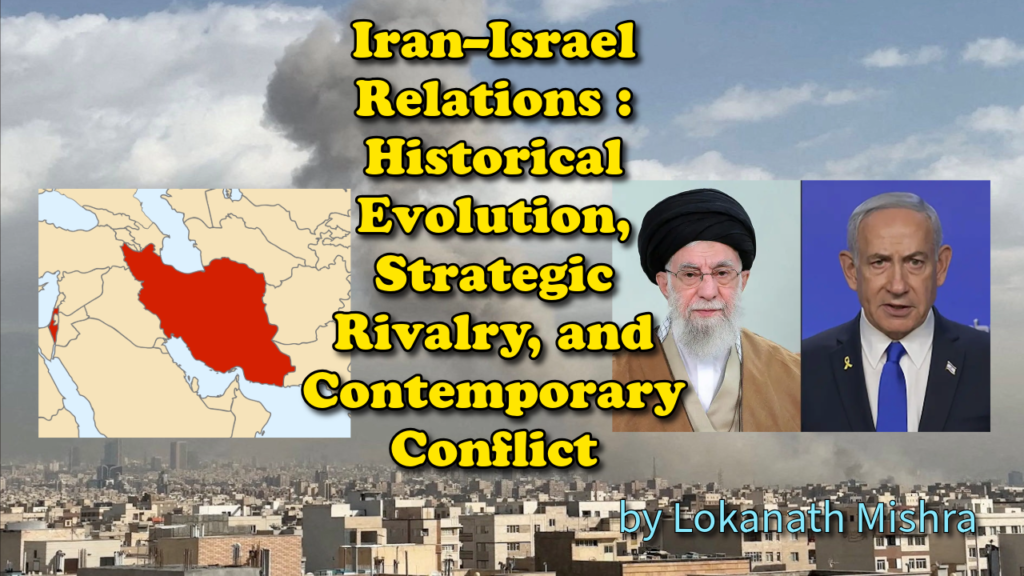
Iran–Israel Relations : Historical Evolution, Strategic Rivalry, and Contemporary Conflict
by Lokanath Mishra
Abstract
Relations between Iran and Israel have evolved from pragmatic cooperation during the early decades of Israel’s existence to deep ideological hostility following the 1979 Iranian Revolution. This transformation has significantly shaped the geopolitical landscape of the Middle East. While Iran initially recognized Israel and maintained close economic and military ties with the Israeli state during the reign of Shah Mohammad Reza Pahlavi, the Islamic Republic adopted a fundamentally antagonistic position toward Israel after the revolution. Since the 1980s, Iran and Israel have engaged in an extensive strategic rivalry characterized by proxy wars, covert operations, cyber warfare, and political confrontation. Iran’s support for militant organizations such as Hezbollah and Palestinian factions has intensified Israeli security concerns, particularly in the context of Iran’s nuclear ambitions. Conversely, Israel’s military and intelligence operations targeting Iranian nuclear infrastructure and military assets have further escalated tensions. In recent years, the rivalry has expanded into direct military confrontation, culminating in the large-scale conflict between the two states during the mid-2020s. This research paper examines the historical development of Iran–Israel relations, the ideological and geopolitical factors shaping the rivalry, and the implications of the conflict for regional stability and global security.
Keywords
Iran–Israel relations, Middle East geopolitics, Iranian Revolution, proxy warfare, nuclear diplomacy, regional security

- Introduction
The relationship between Iran and Israel represents one of the most complex and consequential rivalries in modern international relations. While both states once maintained pragmatic cooperation during the early decades of Israel’s existence, political transformations within Iran fundamentally altered the trajectory of their bilateral relations. The establishment of the Islamic Republic in 1979 introduced an ideological dimension to Iran’s foreign policy that rejected Israel’s legitimacy and positioned the Palestinian cause at the center of Iranian regional strategy.
Over the past four decades, tensions between the two states have expanded beyond diplomatic hostility into military, intelligence, and cyber domains. Israel views Iran’s nuclear program and its support for militant organizations across the Middle East as existential threats. Iran, in turn, frames Israel as a colonial entity supported by Western powers and portrays resistance to Israel as a central component of its revolutionary ideology.
This paper explores the historical roots and contemporary dynamics of Iran–Israel relations. It traces the evolution of the relationship from early cooperation to confrontation and analyzes the strategic motivations that have shaped both states’ policies. In doing so, the study seeks to understand how ideological narratives, regional power competition, and security concerns have produced one of the most persistent conflicts in the Middle East.

- Historical Background: Jews and Persia
The historical relationship between Jewish communities and Persian civilization dates back more than 2,500 years. Jewish presence in the region began after the Assyrian and Babylonian conquests of the ancient Kingdoms of Israel and Judah. Following the Babylonian exile in the sixth century BCE, the Persian ruler Cyrus the Great allowed Jewish exiles to return to Jerusalem and rebuild their temple.
This event holds great significance in Jewish historical memory and reflects the relative religious tolerance practiced within the Achaemenid Empire. Jewish communities remained in Persia for centuries, developing a distinct cultural and religious identity while coexisting within Persian society.
The long history of Jewish life in Persia demonstrates that hostility between modern Iran and Israel is not rooted in ancient religious animosity but rather in modern political developments.

- Iran and Israel Before the Islamic Revolution (1947–1979)
3.1 Iran’s Position During Israel’s Creation
During debates surrounding the future of Palestine in the late 1940s, Iran initially opposed the United Nations Partition Plan. Iranian leaders argued that dividing Palestine into separate Jewish and Arab states would intensify regional conflict. Despite these concerns, Iran eventually adopted a pragmatic policy toward the newly established State of Israel.
In the early 1950s, Iran became the second Muslim-majority country to recognize Israel after Turkey. This recognition reflected broader geopolitical considerations during the Cold War.
3.2 Strategic Partnership Under the Shah
Under the leadership of Shah Mohammad Reza Pahlavi, Iran developed close economic and strategic ties with Israel. Both states shared several interests:
• Alignment with Western powers
• Opposition to Arab nationalist movements
• Concern about Soviet influence in the Middle East
Israel regarded Iran as a key partner in the so-called “periphery doctrine,” which sought alliances with non-Arab states surrounding the Arab world.
Economic cooperation flourished during this period. Iran supplied Israel with significant quantities of oil, while Israeli engineers and firms participated in infrastructure projects within Iran. The two countries also engaged in covert military cooperation, including joint missile development initiatives.
By the late 1970s, the partnership had become one of the most significant strategic relationships in the region.

- The Impact of the Iranian Revolution
4.1 Ideological Transformation
The 1979 Iranian Revolution dramatically altered Iran’s foreign policy orientation. The overthrow of the Shah and the establishment of the Islamic Republic under Ayatollah Ruhollah Khomeini replaced Iran’s pro-Western monarchy with a revolutionary regime committed to resisting Western influence.
Israel quickly became a central target of Iran’s ideological rhetoric. The new Iranian leadership rejected Israel’s legitimacy and declared support for Palestinian resistance movements. Diplomatic relations were severed, and the Israeli embassy in Tehran was handed over to the Palestine Liberation Organization.
4.2 Strategic Contradictions
Despite the ideological hostility expressed by Iranian leaders, pragmatic considerations occasionally produced unexpected cooperation. During the Iran–Iraq War (1980–1988), Israel secretly supplied arms and military equipment to Iran. Israeli leaders believed that preventing Iraqi dominance in the region served their strategic interests.
This episode illustrates the complexity of Iran–Israel relations, where ideological opposition sometimes coexisted with pragmatic geopolitical calculations.

- Emergence of Proxy Conflict
5.1 Hezbollah and Iranian Strategy
One of the most important developments in the Iran–Israel rivalry has been Iran’s support for Hezbollah in Lebanon. Established in the early 1980s with Iranian assistance, Hezbollah became a powerful military and political force capable of challenging Israeli power in the region.
Iran’s support for Hezbollah included:
• Military training
• Financial assistance
• Advanced weaponry
• Ideological guidance
Through Hezbollah, Iran developed a strategy of indirect confrontation with Israel.
5.2 Palestinian Groups
Iran has also provided support to Palestinian militant organizations such as Hamas and Palestinian Islamic Jihad. These groups oppose Israel’s existence and have engaged in armed conflict with Israeli forces.
Such support has intensified Israeli perceptions that Iran seeks to surround Israel with hostile armed groups.

- Nuclear Rivalry and Covert Warfare
Iran’s nuclear program has become one of the central issues in the Iran–Israel conflict. Israeli leaders argue that a nuclear-armed Iran would pose an existential threat to Israel’s security.
In response, Israel has reportedly conducted numerous covert operations aimed at slowing Iran’s nuclear development. These operations have included cyber attacks, sabotage, and targeted assassinations of nuclear scientists.
One of the most notable incidents involved the Stuxnet cyberattack, which disrupted Iranian nuclear facilities and demonstrated the increasing importance of cyber warfare in modern geopolitical conflict.

- Regional Proxy Wars
The Iran–Israel rivalry has also unfolded through conflicts across the Middle East.
Syrian Civil War
In Syria, Iran supported the government of Bashar al-Assad while Israel conducted airstrikes against Iranian and Hezbollah positions to prevent the establishment of permanent Iranian military infrastructure near Israeli borders.
Lebanon
Hezbollah’s military capabilities, supported by Iran, have made southern Lebanon one of the most volatile fronts in the Iran–Israel confrontation.
Yemen
Iran’s support for the Houthi movement in Yemen has further expanded the regional dimension of the rivalry.

- Escalation to Direct Confrontation (2024–2026)
During the early 2020s, the longstanding shadow war between Iran and Israel began transitioning toward direct military confrontation. Rising tensions related to the Gaza conflict, Iran’s regional influence, and concerns regarding its nuclear program intensified hostilities.
Missile strikes, drone attacks, and targeted assassinations increased in frequency. In 2025, Israeli military operations targeting Iranian nuclear facilities triggered a major armed confrontation between the two states.
By 2026, coordinated military operations involving Israel and allied forces targeted Iranian military infrastructure, marking one of the most direct and large-scale conflicts between the two countries in modern history.

- Implications for Regional and Global Security
9.1 Regional Alliances
The Iran–Israel rivalry has reshaped alliances throughout the Middle East. Several Arab states have moved closer to Israel due to shared concerns about Iranian influence.
9.2 Nuclear Proliferation
Iran’s nuclear ambitions raise concerns about potential nuclear proliferation in the region, as neighboring states may seek similar capabilities.
9.3 Proxy Warfare
The conflict has demonstrated how modern geopolitical rivalries often manifest through proxy forces rather than direct state-to-state warfare.
9.4 International Involvement
Global powers, particularly the United States, have played a significant role in shaping the dynamics of the Iran–Israel rivalry, increasing the risk of broader international escalation.
- Conclusion
The evolution of Iran–Israel relations reflects broader transformations in Middle Eastern politics over the past century. From pragmatic cooperation during the Cold War to ideological hostility following the Iranian Revolution, the relationship between the two states has been shaped by shifting political, strategic, and ideological factors.
Over time, the rivalry expanded into a multifaceted conflict involving proxy warfare, cyber operations, and regional power competition. Recent escalations demonstrate the continued volatility of this relationship and its potential to influence global security.
Understanding the historical roots and geopolitical dynamics of Iran–Israel relations is essential for analyzing the future trajectory of Middle Eastern politics. Whether the conflict continues to escalate or eventually gives way to diplomatic engagement remains one of the most important questions in contemporary international relations.
References (Sample Academic Sources)
Ben-Ami, Shlomo. Scars of War, Wounds of Peace: The Israeli–Arab Tragedy. Oxford University Press.
Parsi, Trita. Treacherous Alliance: The Secret Dealings of Israel, Iran, and the United States. Yale University Press.
Takeyh, Ray. Guardians of the Revolution: Iran and the World in the Age of the Ayatollahs. Oxford University Press.
Axworthy, Michael. A History of Iran: Empire of the Mind. Basic Books.
Keddie, Nikki R. Modern Iran: Roots and Results of Revolution. Yale University Press.