
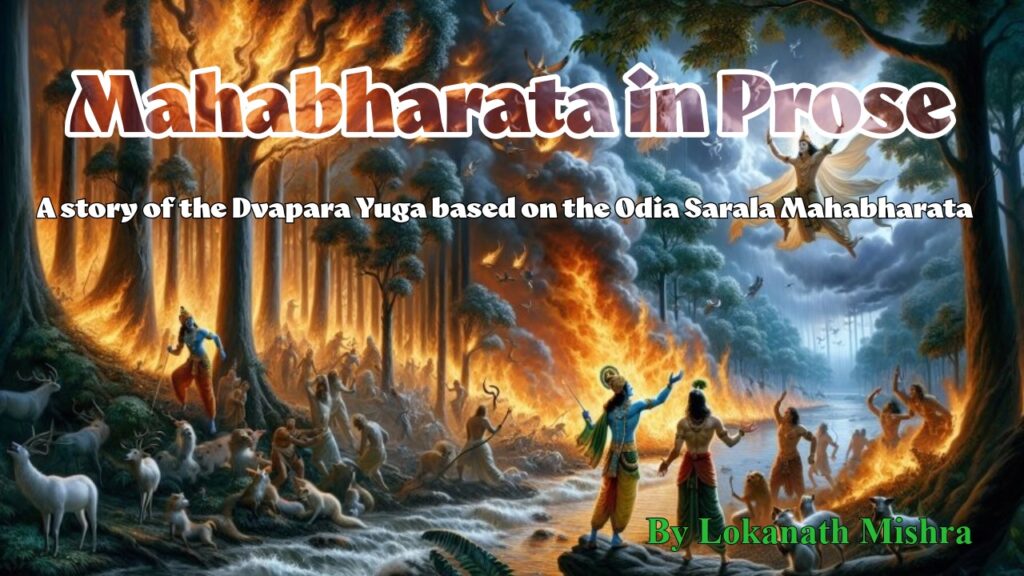
Mahabharata in Prose – Part 36-D
A story of the Dvapara Yuga based on the Odia Sarala Mahabharata by Lokanath Mishra
At the command of Puruhuta (Indra), the apsaras withdrew. The music and dance came to a halt. Addressing Narada, Indra said,
“My garden guards were present. Did they not stop this?”

Narada replied,
“They have all fallen unconscious. Some hero from the mortal world is helping Agni.”
Purandara (Indra) asked,
“That mortal hero must have a name, O Devarshi! It is not possible that you do not know him. Why are you not telling me?”
Narada said,
“Do not blame me later for creating discord between father and son. The middle Pandava, Arjuna, has come as the protector of Agni. Whoever tries to obstruct him is either enchanted or driven away by his Vayavya weapon.”
Indra then sent his son Chitrasena with a message to Arjuna. Arjuna saluted Chitrasena and said,
“I have given my word to Agni. I am helpless. Please convey this to your father.”
Chitrasena delivered Arjuna’s message to Indra and said,
“Arjuna has, in a way, disobeyed you. Give us the command. We shall fight him with the celestial army, capture him, and bring him before you.”
Surapati (Indra) said,
“We possess mighty clouds capable of extinguishing even the fiercest fire within moments. Why not employ them first?”
At Indra’s remembrance, the clouds appeared. By his command, they drew water from the seven seas and poured it in torrents over the Khandava forest. But Arjuna, with a continuous shower of arrows, created a strong canopy over the forest, and not a single drop of water could penetrate it.
When the clouds failed, Indra himself mounted Airavata and came before Arjuna.
Arjuna descended from his chariot Nandighosha, bowed respectfully, and wished for his father’s well-being. After exchanging affection, they turned to the matter at hand.
Indra said,
“My son, Agni is suffering this punishment due to his own fault. Had he exercised restraint during his consumption, he would not be in this condition. Should I now allow this forest—meant for the welfare of the entire creation—to be burned for the sake of one deity?
This forest contains medicinal trees capable of curing even incurable diseases—such as Vishalyakarani and Mrita Sanjeevani. Some plants grant offspring to the childless. Others cure severe diseases like leprosy. There are flowers here that remain ever fresh. From the fragrance rising with the flames, one can realize how many precious trees are being destroyed.
These trees have not grown in a day, my child. They have flourished through years of care. Enough now, Arjuna—you have kept your word. Agni has already consumed most of the forest. Let me extinguish the fire.”
Arjuna replied,
“When Agni sought my help, he asked for the entire Khandava forest, Father. Forgive me—I cannot go back on my word.”
Indra’s patience broke. He said angrily,
“If you were not here, this weak Agni could never have attacked my protected forest. For three ages he suffered from his ailment and still never dared such an act. You are not my son—you are my enemy!”
He continued in rage:
“If you step aside this very moment, the clouds will extinguish the fire instantly. Seeing your face has clouded my judgment. In great anger I say—if a son is wicked and foolish, slaying him is no sin. Today, O Pandava, your time has come!”
In extreme fury, Indra struck with his Vajra (thunderbolt). But Arjuna possessed counter-weapons for all celestial arms. Indra rained arrows, and Arjuna successfully repelled them all.
Arjuna said,
“Why do you unnecessarily show enmity towards your own son, Father? Agni has almost consumed everything.”
Yet Indra continued to hurl powerful weapons. Finally, compelled, Arjuna released a mind-piercing arrow. Under its effect, Indra lost consciousness and fell. Airavata carried the unconscious Indra away to a distant place.
⸻
(To be continued)