
A Story of Dvapar Yuga in Prose ( part-21)
By Lokanath Mishra
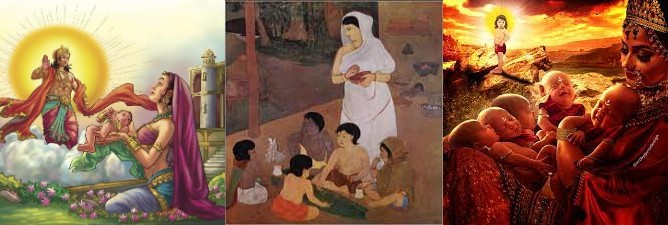
After the births of Yudhishthira and Bhima, Queen Kunti prayed to Lord Indra, the king of the gods, for another son. In answer to her devotion, she gave birth to a handsome and radiant child born of Indra’s divine essence. At the time of his birth, the sage Brihaspati (the preceptor of the gods) and the seer Sunasira were present. Because he was born in a forest filled with trees (aranya), the child was named Arjuna. Upon examining the astrological signs, Brihaspati noted that the child was born under the Uttara Phalguni constellation and therefore also gave him the name Phalguni.
Kunti lived with Madri, the second wife of King Pandu. Seeing that Madri was still childless, Kunti felt concerned for her co-wife. One day, she shared with Madri the divine garland and mantra that the sage Durvasa had once gifted her. Kunti told her to invoke any deity of her choice using the mantra and ask for sons. After advising her thus, Kunti went away with her children for some time.
Madri then meditated upon the Ashwini Kumaras, the twin celestial physicians. Through their grace, she was blessed with two sons, named Nakula and Sahadeva.
Meanwhile, Sage Vyasa, upon calculating the birth signs of Duryodhana and his hundred brothers, warned that they were born under ominous constellations and would grow up with evil and destructive tendencies. He foretold that Duryodhana, the eldest, would become arrogant, cruel, and oppressive, and that his wickedness might one day bring ruin upon the entire Kuru dynasty. Hearing this prophecy, Queen Gandhari was filled with sorrow.
Around this time, Sage Durvasa visited Hastinapura once more. Gandhari approached him and poured out her grief, saying,
“Even after giving birth to a hundred sons, my heart is not at peace. Please, O sage, bless me with a daughter.”
Durvasa gave her a holy basil (tulsi) leaf, sanctified by his mantra, and instructed her to eat it. Through its power, Gandhari soon gave birth to a daughter, whom she named Duhshila.
When Kunti heard of Duhshila’s birth, she decided to visit Hastinapura with all her sons to pay respects to Dhritarashtra and Gandhari, and to introduce her children to their cousins. She also hoped to strengthen the bond between the two families. Before leaving, she warned Madri repeatedly to be careful and cautious during her absence.
But fate had other plans.
One night, Madri could not sleep. Memories of her time with her husband Pandu flooded her mind. She had forgotten that she still wore the enchanted garland given by Sage Durvasa — the one that could summon the presence of any deity or person she thought of. The moment she thought of Pandu, he appeared before her, overwhelmed by passion. Madri tried to dissuade him, reminding him of the curse that condemned him to death if he ever approached a woman with desire. But Pandu, lost in emotion, could not resist.
In that fateful moment, both Pandu and Madri faced a terrible dilemma — if they refrained from union, Pandu’s life would fade in agony; if they yielded, death would claim them both. Madri, with devotion and love, chose to share her husband’s fate, considering it nobler to die with him than to live on in grief.
As they united, a divine arrow from the heavens — the manifestation of the sage’s curse — struck them both down. Thus, Pandu and Madri died together in that forest.
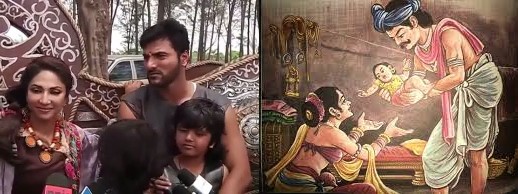
Far away in Hastinapura, ominous signs began to appear around Kunti — flickering lamps, howling winds, and strange cries of birds. Her heart filled with dread, for she knew the tragedy she had long feared had come to pass. Accompanied by Bhishma, Vidura, and Sanjaya, she hurried to Mount Shatasringa, where she found the bodies of Pandu and Madri, pierced and lifeless. After a period of deep mourning, the royal couple’s bodies were brought back to Hastinapura with great honor, and their funeral rites were performed with full royal dignity.
By then, Duryodhana and his brothers had grown into strong youths. The young princes often played together, but their games frequently turned into quarrels. One day, they decided to play a game similar to modern kabaddi, which they called Jhimiti. Yudhishthira and Duryodhana took the lead positions, while the others divided into two teams.
During the game, Duhshasana complained that his side was losing unfairly. In response, Bhima said,
“We five brothers will stand together on one side. Let your side have Duryodhana, Karna, Shalya, Ashwatthama, and a few others. Then we shall see who wins!”
The Kauravas agreed.
As the game began, Duhshasana lunged forward, pretending to tag Yudhishthira, but in doing so, he struck him violently. Yudhishthira fell to the ground, his face bleeding.
When Bhima saw his beloved elder brother — whom he revered above all — lying injured and bleeding, rage consumed him. Though Bhima would never disobey Yudhishthira under any circumstance, this sight blinded him with fury. As the other Pandavas tended to Yudhishthira, Bhima attacked with overwhelming strength. Duryodhana, Duhshasana, and their allies — Karna, Shalya, and Ashwatthama — were all badly beaten and bloodied by Bhima’s wrath.
The elders — Bhishma, Vidura, and Sanjaya — rushed to the scene and put an end to the brawl. They scolded the princes, calmed them down, and brought them back to the palace. Royal physicians treated the injured Kaurava princes.
( to be continued)
A Story of Dvapar Yuga in Prose (Part-16 A)
A Story of Dvapar Yuga in Prose (Part-20)