
A Story of Dvapar Yuga in Prose( Part-24)
By Lokanath Mishra
Krishna returned to the battlefield of Mathura. His plan had succeeded for some time. Seeing that Jarasandha’s army had chased the soldiers of Kalayavana into Mathura and become scattered, they were astonished. Before they could react, the soldiers of Kalayavana began attacking them. They could not identify the banner of Mathura or of Jarasandha. They assumed that the Mathura army was attacking them from behind. Both armies became engaged in fierce carnage.

Krishna secretly entered the city of Mathura and, taking the waiting Balarama with him, came out again. Both armies saw them. Krishna and Balarama, on the empty path before them, proceeded toward Dwaraka. Jarasandha stopped the battle and, taking his soldiers with him, began pursuing Krishna and Balarama. After travelling a great distance, when he saw Krishna and Balarama alight upon a mountain called Pravarshana, Jarasandha ordered his soldiers to set fire all around the mountain. Before the fire could encircle the entire mountain, Krishna and Balarama, unknown to anyone, had already left it. But Jarasandha became convinced that both had been burnt alive.
In this expedition he had also brought with him his three disciples—Rukmi, Shishupala, and Dantavakra. Before them he boasted arrogantly and laughed loudly. He said, “The scriptures say that the enemy must be utterly destroyed. Today my purpose has been fulfilled because my disciples are with me. Those two cowherd boys have been burnt to death.” Rejoicing loudly, they returned to Magadha.
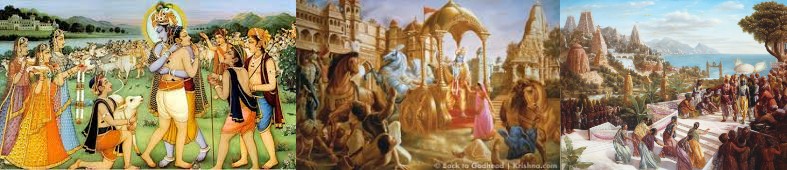
Rama-Krishna reached the newly constructed city near the holy region of Prabhasa. Observing the magnificent and beautiful architecture of that splendid city, both praised highly the craftsmanship of Vishwakarma. Even before they entered the city, they heard divine acclamations. The gods were showering flowers. Narada and the other deities had already named the city before the Lord entered. Narada said, “Lord, you will spend the remainder of your time here. This is like heaven upon earth. Let this city be named Dwaraka, meaning ‘Gate of Heaven’.” With a gentle smile, Sri Krishna raised his hand and said, “So be it.” The gods, in one voice, exclaimed, “Victory to the Lord of Dwaraka!” Expressing their delight, they offered obeisance and departed.
Krishna remembered Garuda. Krishna and Balarama entrusted the entire city to Vishwakarma and returned to Mathura on the back of the mighty bird Vinataya. On his command, Uddhava arrived from Gokula, bringing Nanda, Yashoda, and Rohini. Krishna assured Uddhava that the other gopas and gopis would be brought later in due course.
“Lord Rama-Krishna commanded King Ugrasena:
‘All must make ready at once, for we are to depart and not flee.
O Yadavas of the Satvata lineage, prepare quickly,
For we must go to Kushasthali, decrees the king of gods.
Let each prepare according to his means;
Do not miscount the elephants, chariots, horsemen, and infantry.’”
Vasudeva, Nanda, Yashoda, Devaki, Rohini, and the other elders were seated on Garuda’s back, and Rama-Krishna took them with him. The others departed for Dwaraka on chariots, carts, horses, elephants, and some on foot. After everyone arrived in Dwaravati, each was allotted a designated residence.
“Vasudeva lived peacefully, with Kamapala as guardian;
He appointed Anadhṛṣṭa as night commander.
All twelve artisan castes dwelt there,
Engaging in trade and commerce.
Farmers cultivated the land;
And the provider of yellow garments established each according to livelihood.”
Because aged Ugrasena refused to assume responsibility for the throne of Dwaraka, all the Yadava chiefs together appealed to Balarama. But Balarama said, “I cannot undertake these duties. Let Kanhaiya sit on the throne.” Thus Sri Krishna was enthroned as the Lord of Dwaraka.
A few peaceful days passed. After Krishna had lived in Gokula, Nanda and Yashoda had reached advanced age. After coming to Dwaraka, a son was born to Nanda and Yashoda. He was named Satyaki. Later, a daughter was born and she was named Subhadra.
Near Kushasthali-Dwaraka lay the kingdom of Raivata. He had a hundred sons and a beautiful and virtuous daughter named Revati. Dwaraka had already attained the status of a kingdom, and the fame of Krishna and Balarama was spreading. Raivata desired to marry his daughter Revati to Krishna. He sent a letter through his priest, summoning Dwaraka’s presiding priest, Garga. After hearing the proposal, Garga said:
“Since the elder brother Balarama is present, a marriage with Krishna is impossible.
The Yadu clan will never consent. Moreover, it is contrary to scripture:
‘Give the daughter to Rama, with due respect;
Never wed the younger before the elder.
If the younger becomes groom while elder stands aside,
Misfortune will befall the girl, or the groom dies within the year.’
Besides this, Balarama too is in no way inferior in beauty or virtue.”
King Raivata then sent the proposal to Vasudeva through his own priest. It is needless to say that soon auspicious conches resounded throughout Dwaraka. After many days, the people of Dwaraka had the chance to enjoy a joyful festival. Revati, the bride of the Yadu dynasty and the consort of Kamapala, entered Dwaraka. Sri Krishna, who had spent many years absorbed in conflict and diplomacy, also felt joyful at gaining a sister-in-law who would bring laughter and ease to his life. After some time, a son was born to Revati.
At that time, many events were unfolding around Hastina, shaping the future of the entire Aryavarta and clearing the path for the future endeavors of the wielder of the Sudarshana Chakra. There were many such characters destined to play important roles in the great drama soon to unfold on the Indian subcontinent. Among them was one such figure—the Brahmin sage, Drona, son of Bharadwaja.
At that time, Drona lived simply as a Veda-knowing Brahmin. His meeting with Drupada, king of Panchala, occurred in unusual circumstances. Once, the ruler of Karnataka, Kirataraja, attacked Panchala and seized it. Drupada was defeated and fled with a few loyal attendants. Along the route of his escape lay the spacious residence of Drona. Drona lived in comfort. He had married Kripi, the sister of Kripacharya. As a ritual Brahmin, he was well renowned, and people from distant lands invited him to conduct rites, marriages, and ancestral rituals. Drupada sought refuge with Drona. With joy, Drona arranged for him and his attendants to stay in his residence. Their friendship deepened. Since both their names began with “Dra–,” they considered each other close friends.
After some days, another king named Darada attacked Karnataka. To defend his realm, Kirataraja left Panchala and went to Karnataka. Drupada seized the opportunity and regained his kingdom. He invited Drona to accompany him, but because Kripi was pregnant, Drona could not go.
There was no one at home to help. Kripi’s health deteriorated. Drona could no longer go out to perform ritual duties. No offerings or fees came. Without earning, survival became impossible. Day by day, Drona sank into poverty. Misfortune never comes alone; it brings kin along with it. After giving birth to a son, Kripi passed away. Drona became occupied with caring for the motherless infant. A time came when even food and clothing became grave concerns. Then he remembered his friend, King Drupada. Taking his small son in his arms, he went to the capital of Panchala.
Seeing his impoverished appearance in the royal assembly, some courtiers curled their noses in disdain. Drupada, intoxicated with wine, not only refused to recognize him but commanded the guards, “Cast this beggar Brahmin out by the neck.” With a shove from the guard, the infant son, Ashwatthama, fell from Drona’s chest and landed some distance away. Drona himself was thrown to the ground. The guard once again seized Drona by the hair, handed the crying child to him, and threw him out of the royal hall, pushing him repeatedly. Behind him echoed the loud laughter of the courtiers.
Drinking the bitter poison of extreme humiliation and immense anger, helpless and forsaken, Drona left Panchala. Feeling polluted by the touch of the wicked guard, he went to the Triveni Sangam to purify himself. There he laid his child upon the bank and bathed. Rising from the waters and chanting the Vedas, tears streamed unceasingly from his eyes.
Nearby sat Parashurama. Seeing Drona’s condition, he consoled him and asked his identity. Drona recognized Parashurama and said:
“O blessed one, I know you—the son of Jamadagni,
The great being who emptied the earth of Kshatriyas twenty-one times!
I am Dronacharya, son of sage Bharadwaja of the Pāṭha lineage.
“Many insults have I suffered, O Rama;
Restore my honor, O lord of righteousness.”
Dronacharya then described in detail the kindness he had shown Drupada and the disgrace he had received in return…
⸻( to be continued)
Pingback: A Story of Dvapar Yuga in Prose (Part-24A) - UniverseHeaven