
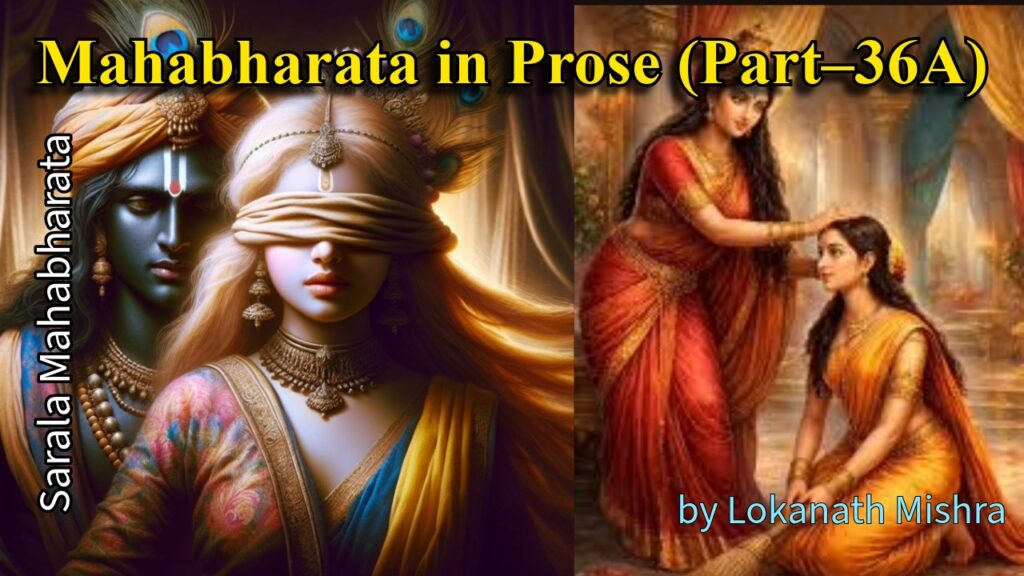
Mahabharata in Prose (Part–36A) A story of the Dvapara Yuga in prose based on the Odia Sarala Mahabharata
By Lokanath Mishra
Soon after entering Hastinapura, Yudhishthira took Draupadi to Gandhari’s chamber. Draupadi knelt down and touched Gandhari’s feet in reverence. Yudhishthira said,
“Mother, Draupadi is bowing to you. Will you not look upon the face of this new bride of ours? Please open the blindfold once and see her.”

Gandhari replied,
“When Bhanumati came into this house, Duryodhana also made the same request to me. Even then I did not open my sealed eyes. My son, do not ask me to break my vow today either. With the eyes of my mind I can see Panchali. I can feel that she is extraordinarily beautiful. May you all be blessed. Live happily.”
At one end of Hastinapura, arrangements were made for the Pandava family to reside. Though it was not as magnificent as a royal palace, the spacious and pleasant mansion accommodated the newly married Draupadi, the five Pandava brothers, and their mother Kunti in separate chambers.
Now it became necessary to establish certain rules regarding Draupadi’s physical relationship with her five husbands. Yudhishthira seated his brothers privately and discussed the matter. He said:
“There will be a firm rule among us regarding living with Yajnaseni. According to the order of seniority—from the eldest to the youngest—each of us will spend one night at a time in Panchali’s chamber. While one of us is with her, a sign will be placed at the door. If anyone else enters the chamber during that time, he must go into exile in the forest for twelve years.”
This arrangement was conveyed to Draupadi. Yajnaseni agreed to their proposal. However, in her mind she resolved that she would never allow any husband to enjoy a body that had already been shared by another. After every night of intimacy she would symbolically bathe in fire. Emerging from the fire with a renewed body, she would offer herself to another husband on the following night.
As the verse says:
“Thinking always of preserving her chastity,
Each day the goddess purified her body in fire.
From the flames she emerged with a renewed form,
And then offered her body to her husbands.”
Thus several days passed.
One day, according to his turn, Yudhishthira was in Draupadi’s chamber. The two were absorbed in the pleasures of love in complete privacy. At that moment, the fire god Agni arrived at the Pandavas’ residence disguised as a Brahmin. Hearing the chanting of Vedic hymns, Arjuna went out to meet him.
The Brahmin—who was actually Vaishvanara (Agni)—told him that a band of thieves was forcibly driving away his herd of cows. He asked Arjuna to quickly accompany him and rescue the cattle.
Arjuna’s weapons were kept in a chamber connected to Draupadi’s room. That day there was a possibility that Yudhishthira might be in that chamber. Arjuna noticed that there was no sign placed at the door. As he passed by the room, he inadvertently saw Yudhishthira and Krishnaa (Draupadi) in an intimate and unrestrained state. Immediately lowering his head in embarrassment, he walked away.
Yudhishthira soon followed him out, adjusting his clothes. With great sorrow he said,
“What have you done, O Bibhatshu? Have you forgotten the rule we had established among ourselves?”
Arjuna replied,
“Some thieves are taking away the cattle of a Brahmin. I went to bring my weapons in order to help him. There was no sign at the door, so I did not know you were inside.”
Yudhishthira then noticed that the pair of sandals he had placed at the doorway was no longer there. When he stepped outside, he saw a dog on the road biting and tearing apart his leather sandals with its teeth. There was no Brahmin at the door anymore. The task of Agni had already been accomplished, and he had disappeared.
Angered by the dog, Yudhishthira cursed it:
“O ignorant creature! Because of you I have been shamed—
Another has seen my act of love.
May your mating be seen by people everywhere in the world—
In streets, markets, and riverbanks alike.
People will cry out ‘Drive it away! Beat it!’
And they will say it is the curse of the Pandavas.”
(In some other accounts, it is said that Draupadi pronounced this curse.)
Yudhishthira and Partha searched everywhere for the Brahmin but could not find him. Arjuna then said,
“He seemed to me like some kind of illusionist. Without reason he made me appear guilty before you and then disappeared. Whatever it may be, I have broken our rule. Therefore, I must go into exile in the forest for twelve years.”
Not only Kunti, Draupadi, and the Pandavas were saddened by this news; even Bhurishrava, Bhishma, Drona, Kripa, and the Kaurava brothers expressed their sorrow upon hearing it.
Vidura then asked Sahadeva,
“You know everything. Tell me—who was that Brahmin? Why did he come, and where did he go after sending Arjuna away?”
[To be continued]