
A Story of Dvapar Yuga in Prose (Part-24A)
By Lokanath Mishra
Drona’s Life, Appointment as Guru, and the Training of the Princes
(Mahabharata: Adi Parva, Sambhava Parva, Chaitraratha–Dronaparva traditions)
After suffering humiliation and hardship, Acharya Drona went to Kripacharya, his brother-in-law, and narrated the story of his misfortune. Kripa’s wife Sulakshana lovingly embraced her son Ashwatthama, and Drona found peace and refuge in their household. Staying there for some time, Drona regained mental strength and devoted himself daily to the rigorous practice of weapons in the nearby forest.
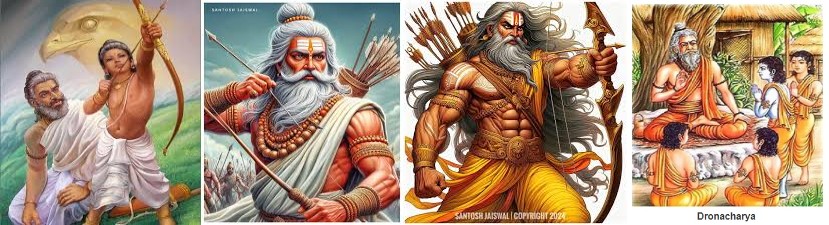
It was then that Drona realized the true extent of the knowledge he had received from Bhagavan Parashurama, the great Brahmin-warrior and destroyer of the Kshatriyas (Mahabharata, Adi Parva). That divine instruction had transformed him into an unparalleled master of arms.
At this time, Kripacharya arranged Drona’s second marriage, and at Kripa’s request, Drona accepted another wife named Harita—a detail preserved in later regional and puranic retellings associated with the Mahabharata tradition.
The Well Episode and Bhishma’s Recognition
(Mahabharata: Adi Parva, Sambhava section)
One day, Drona and Kripacharya visited the vicinity of the royal palace of Hastinapura. Nearby, the princes of the Kuru dynasty were engaged in a game of ball. Suddenly, the ball fell into a deep well. Seeing that the well was too deep to retrieve it by ordinary means, the princes stood helpless.
Observing their distress, Drona approached the well and asked the boys to bring him several ring-shaped Guguchia. One by one, he dropped them into the well, skillfully connecting each piece by sheer precision and mantra-infused technique. When he pulled the final ring, the ball emerged intact.
This astonishing display of applied martial intelligence left the princes spellbound.
At that time, Bhishma Pitamaha, the grandsire of the Kurus, was responsible for overseeing the princes’ education. Hearing the boys praise Drona’s extraordinary skill, Bhishma personally met him and, following due rites, appointed Drona as the Rajguru and Acharya of the Kauravas and Pandavas
(Mahabharata, Adi Parva, Sambhava Parva).
The Gurukul: Ashwatthama, Karna, and Ekalavya
(Mahabharata: Adi Parva, Chaitraratha Parva)
In Drona’s gurukul, the Kauravas and Pandavas were trained together in the science of weapons (Dhanurveda). Along with them studied Ashwatthama, Drona’s own son.
Karna, burning with ambition, also came seeking instruction. However, believing Karna to be a suta-putra (son of a charioteer), Drona denied him admission. This rejection led Karna later to seek instruction from Parashurama, concealing his true identity
(Adi Parva).
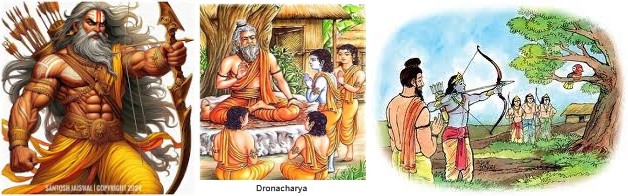
Another boy, Ekalavya, a prince of the Nishada (Kirata/Shabara) tribe, also sought training. Denied formal admission due to his birth, he nevertheless learned archery by secretly practicing before a clay image of Drona. Through sheer determination, Ekalavya surpassed many royal princes—an achievement that later compelled Drona to demand his right thumb as guru-dakshina, leaving an eternal moral stain on Drona’s legacy
(Adi Parva, Chaitraratha Parva).
The Famous Archery Test on the Mountain
(Mahabharata: Adi Parva, traditional gurukul episodes)
After one year of instruction, Drona decided to test his disciples. He chose a mountain nearby and arranged an intricate target:
• a tree on the mountain peak,
• a pillar fixed upon it,
• a small platform on the pillar,
• a grain of rice upon the platform,
• a tiny wheel above the grain,
• and atop it, a single mustard seed.
Calling the disciples one by one, Drona asked each what they could see.
• Yudhishthira saw the mountain, tree, pillar, and platform.
• Duryodhana saw up to the platform.
• Dushasana described clouds around the mountain.
• Bhima saw the pillar.
• Ashwatthama saw the grain of rice.
Finally, Arjuna stepped forward.
When asked what he saw, Arjuna—called Partha and Sabyasachi—replied in poetic precision that he saw only the mustard seed, nothing else. When instructed to split it without dislodging it, Arjuna released his arrow, perfectly executing the command.
This moment established Arjuna as the supreme archer among the Kuru princes
(Adi Parva).
Drona embraced Arjuna and declared:
“By obtaining a disciple like you, my life has been fulfilled.
As long as the sun and moon endure, the world will know me as the Guru of Arjuna.”
Completion of Training and Public Exhibition:
(Mahabharata: Adi Parva, Sabha Parva – Prelude)
After the completion of the princes’ education, Drona approached Bhishma and requested that a public exhibition of their skills be arranged. With Bhishma’s approval, invitations were sent to allied kings.
Messengers were dispatched to Dwarka, and Krishna and Balarama arrived and stayed at Indraprastha. Other kings and dignitaries were accommodated in guest houses across Hastinapura.
( to be continued)
A Story of Dvapar Yuga in Prose :(Part-24)
A Story of Dvapar Yuga in Prose (Part 23-C)