
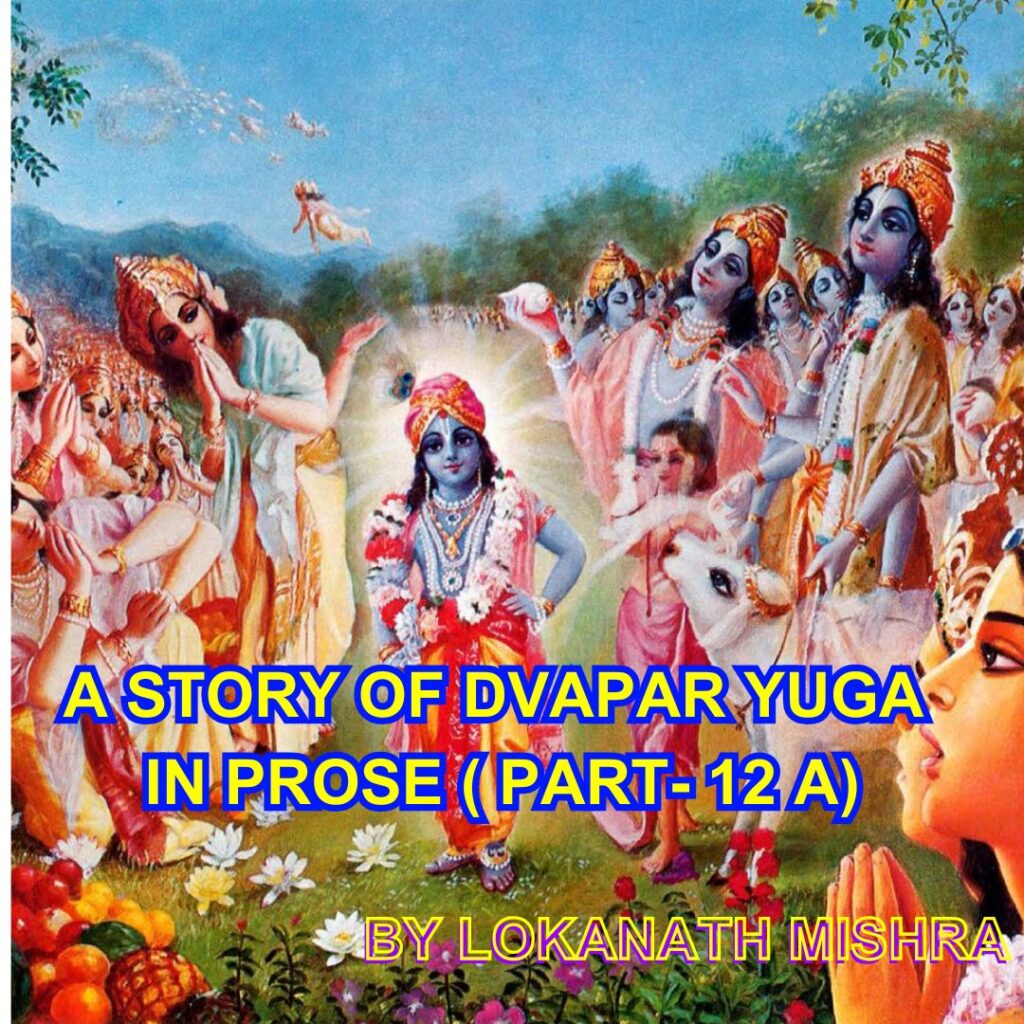
A Story of Dvapar Yuga in Prose ( Part- 12 A)
Radha’s Longing and the Kaliya Episode: A Tale from Vrindavan
By Lokanath Mishra
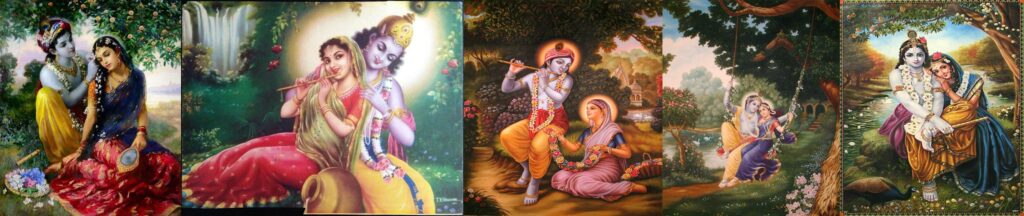
In the pastoral land of Braj, amidst groves of kadamba trees and the flowing waters of the Yamuna, blossomed the eternal play of love and divinity. At the heart of this play was Radha, the cherished daughter of King Vrishabhanu. Though raised in comfort and grace, and always attended by her dearest companions Lalita and Vishakha, Radha seemed strangely restless.
For days she had been hearing the hauntingly sweet notes of a flute, drifting through the air, stirring her soul with an ache she could not name. One day, unable to contain her feelings, she confessed to her friends:
“Sakhi, whenever that flute sounds, my mind grows restless. Who is this player that unsettles my heart so? Take me to him.”
Lalita, with knowing eyes, replied, “That melody belongs to Nanda’s son, Krishna. Yet beware! Once you behold Him—crowned with peacock feathers, garlanded with kadamba blossoms, clad in yellow silks—your heart will never again be your own. Your father would not allow you to wander to Vrindavan, though perhaps during the Holi festival, when Nanda’s family visits, you may glimpse Him.”
But Radha’s longing could not wait. “Then paint for me His image,” she pleaded. Lalita and Vishakha, who had often seen Krishna, sketched His likeness. When Radha beheld the portrait, her face lit up like the full moon. She pressed it to her bosom, withdrew to a quiet place, and showered it with kisses.
At that very moment in Vrindavan, Krishna, while playing with His friends, suddenly pressed His cheeks with both hands, feeling an unseen shower of kisses upon His face—the mystical bond between divine lover and beloved, transcending space itself.

Krishna Among the Cowherds
Life in Vrindavan flowed in joy and simplicity. At noon, Krishna, Balarama, and their cowherd friends would gather with their herds under shady trees. The boys pooled together their modest meals—fruits, curds, rice cakes, and sweets—and ate from each other’s hands, laughing and teasing. “Here, Kanha,” they cried, “taste this guava—it is the sweetest! Try this orange, or this dish my mother prepared.” Yashoda’s darling tasted everything, His laughter filling the air.
This tender scene bewildered even Brahma, the Creator. Watching from afar, he wondered: “Can this dark cowherd boy, who grazes cattle and eats the leavings of other children, truly be the Supreme Narayana, Lord of the cosmos?”
Doubt and pride clouded his heart. To test Krishna, Brahma used his divine power to steal away all the calves and the cowherd boys, hiding them in his celestial abode. When the children did not return, Balarama grew uneasy. But Krishna, knowing Brahma’s trick, calmly expanded Himself—manifesting as each calf and boy, identical in every feature, voice, and mannerism. For a full year, Vrindavan continued as before, mothers cherishing their sons, cows licking their calves, unaware that all were but forms of Krishna Himself.
When Brahma returned, expecting chaos, he was astounded to see life in Vrindavan unchanged. Perplexed, he hurried back to Brahmaloka, only to find the stolen calves and boys still there. Returning again to Vrindavan, he beheld them once more with Krishna. His pride shattered. Realising his folly, Brahma fell at Krishna’s lotus feet, confessing:
“Forgive me, O Lord. You, who appear as a simple cowherd, are in truth the eternal Narayana, the source of all creation.”
Krishna, smiling in compassion, forgave Brahma and restored the stolen calves and boys.
The Serpent Kaliya
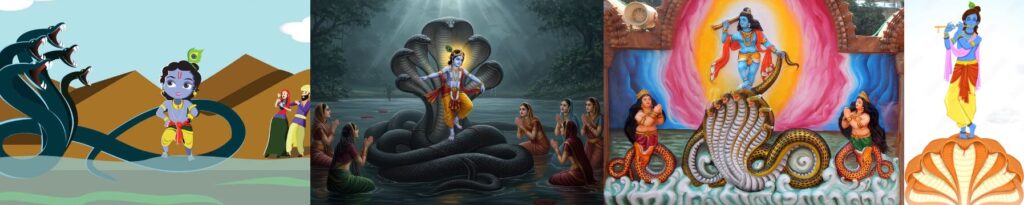
While such divine pastimes delighted Vrindavan, a darker tale was unfolding on the banks of the Yamuna. Long ago, from the rivalry of Sage Kashyapa’s wives, Kadru and Vinata, were born the serpents and Garuda, their eternal enemy. Garuda, mighty and fierce, would devour serpents unless appeased. To survive, the Nagas offered him tribute, but once the arrogant serpent Kaliya defied him. A great battle followed, and though Garuda struck him down, Kaliya survived and fled.
Narada guided him to the Yamuna’s Kalindi Lake, cursed by a sage that forbade Garuda’s approach. There, safe from his predator, Kaliya made his lair. But his presence poisoned the waters—fish died, birds fell lifeless mid-flight, and even the air grew toxic.
One day, as Krishna and His companions grazed their herds nearby, the boys grew thirsty. Unaware of the danger, they drank the lake’s water. Some collapsed unconscious, their lips turning blue. Seeing His friends stricken, Krishna, the protector of all, revived them with His glance.
Then, beholding the poisonous lake, He resolved to end Kaliya’s reign of terror.
Kaliya-Damana: The Subduing of the Serpent
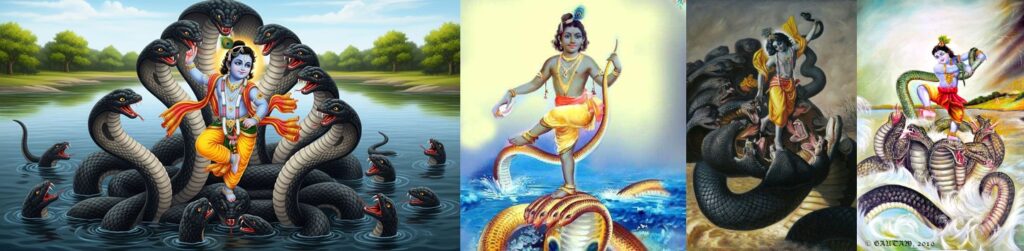
Krishna climbed a kadamba tree by the lake’s edge and, with fearless joy, leapt into the swirling waters. The impact sent waves crashing to the shores. Enraged, Kaliya rose, coils upon coils, hissing venom, his thousand hoods flaring like storm clouds. He wrapped Krishna in his coils, intent on crushing Him.
But Krishna, the Lord of all beings, remained serene, smiling within the serpent’s grip. From the banks, the cowherd boys and gopis cried out in terror. Nanda and Yashoda rushed there, their hearts breaking at the sight. Yet Krishna, with effortless grace, burst free from Kaliya’s coils and began to dance upon his hoods.
Each time Krishna’s lotus feet struck a hood, it sank under His weight. With divine rhythm, He danced upon one head, then another, dazzling the heavens with His play. The celestial beings showered flowers; the Gandharvas sang hymns. Kaliya’s wives, the Nagapatnis, wept and prayed:
“O Lord, forgive him. Though our husband is wicked, You are merciful. Spare him, for he has now surrendered.”
Moved by their plea, Krishna ceased His dance. Bruised and humbled, Kaliya bowed before Him. Krishna commanded him to leave the Yamuna and return with his family to the ocean, never again to trouble the people of Vrindavan.
From that day, the Yamuna flowed pure once more. The people rejoiced, praising Krishna, their beloved Kanha, who had turned the terror of poison into a lila of beauty.
Eternal Lessons of Vrindavan
These intertwined tales—Radha’s yearning for the unseen flute-player, Krishna’s playful meals with His friends, Brahma’s humbled pride, and the subduing of Kaliya—reveal the essence of Jagannath and Krishna traditions. They teach that the Lord, though infinite and supreme, delights in the simplest of human bonds: friendship, love, and play. They remind us that arrogance yields only to humility, and that even venom, when touched by divine grace, becomes harmless.
For the people of India and the world, these lilas are not mere stories but living truths—eternal reminders of faith, compassion, and the mystery of God who walks among us as one of our own.
⸻( to be continued) ——
The Divine Journey of Lokanath Mishra
A Story of Dvapar Yuga in Prose: ( Part- 11 B)
A Story of Dwapar Yuga in Prose: ( part-14)
Pingback: Shri Jagannath Temple and the Evolution of Religious Traditions in Odisha ( part-1) - UniverseHeaven