
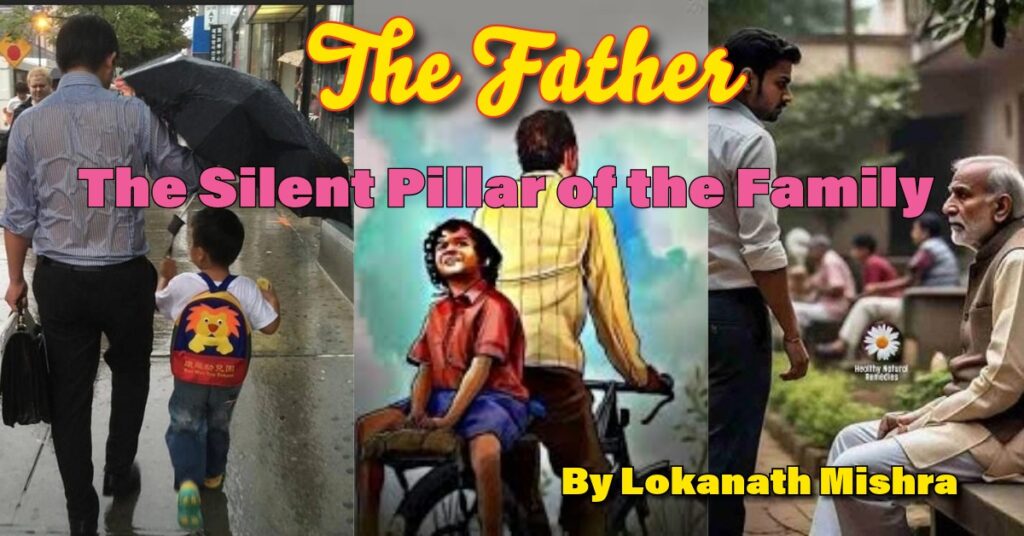
The Father : The Silent Pillar of the Family
By Lokanath Mishra
In many families today, the role of the father is slowly being ignored or misunderstood. While society speaks often about independence and personal freedom, it forgets the quiet strength that made such freedom possible. A father rarely speaks of his sacrifices, but his entire life is built upon responsibility, restraint, and duty.
The father stands as the silent pillar of the family. He carries burdens without complaint and worries without expression. His love is not always shown through words or affection, but through effort, protection, and lifelong commitment. He works not for praise, but to ensure safety, stability, and dignity for his family.
The Father’s Sacrifice
A father often gives up his personal dreams so that his children can fulfill theirs. He accepts stress, fatigue, and hardship so that his family can live in comfort and security. Many fathers spend their strongest years working, planning, and worrying, while receiving little recognition in return.
Unlike visible acts of care, a father’s sacrifices are hidden. They appear in long hours of work, sleepless nights, financial pressure, and emotional restraint. His strength lies in endurance, not display. His silence is not distance—it is responsibility.
To ignore or disrespect such sacrifice is to forget the foundation on which one’s life stands.
The Father as a Moral Guide
A father is the first teacher of discipline and moral conduct. Through his behavior, children learn honesty, patience, courage, and respect for rules. Even when he appears strict, his intention is protection, not control.
A father teaches by example. He shows how to face difficulties without losing dignity, how to stand firm in truth, and how to fulfill duties even when they are uncomfortable. These lessons shape character far more deeply than spoken advice.
When children and their spouses dismiss or challenge a father’s guidance, they weaken the moral structure of the family itself.

Respect Toward the Father in Marriage
Marriage does not end a child’s responsibility toward the father. When a person marries, respect toward parents must grow—not shrink. A spouse who encourages respect toward the father strengthens the family bond. A spouse who creates distance or disrespect breaks emotional harmony and invites long-term unrest.
A father deserves honor not only from his children, but also from those who join the family through marriage. Respect shown to the father is respect shown to family values, stability, and unity.
Disrespect toward the father often leads to regret later, when wisdom arrives but time is gone.
The Father as a Living Root
The father is the living root of the family tree. When the root is neglected, the branches weaken. A family that forgets its father loses direction, stability, and inner strength.
Age does not reduce a father’s worth. When his body grows weak, his experience becomes more valuable. His words may be fewer, but his understanding is deeper. To dismiss him because of age is not progress—it is moral failure.
Listening to a father is not submission. It is recognition of lived experience.
The Consequences of Disrespect
Disrespect toward the father creates emotional imbalance within the family. It leads to inner conflict, guilt, broken relationships, and loss of moral grounding. Many people realize the value of their father only after his absence—when correction is no longer possible.
Respect given while the father is alive becomes a lifelong blessing. Respect denied becomes a lifelong regret.
True Respect for the Father

Respect for the father does not mean blind obedience. It means:
• Speaking with humility
• Listening with patience
• Caring in old age
• Protecting his dignity
• Honoring his presence
• Valuing his experience
Serving a father in his later years is not a burden—it is a privilege earned through life.
Final Reflection
A father may not ask for love, praise, or recognition—but he deserves all three. His life is a quiet offering made for the growth of his family. Children and their spouses must understand that honoring the father is not tradition alone—it is a moral duty.
A society that forgets its fathers forgets its foundation.
Respect the father while he lives. Gratitude delayed is often gratitude denied.