
A Story of Dvapar Yuga in Prose (Part-25 B)
By Lokanath Mishra
The Divine Evening at Dwaraka and the Sacred Bond of Krishna and Rukmini
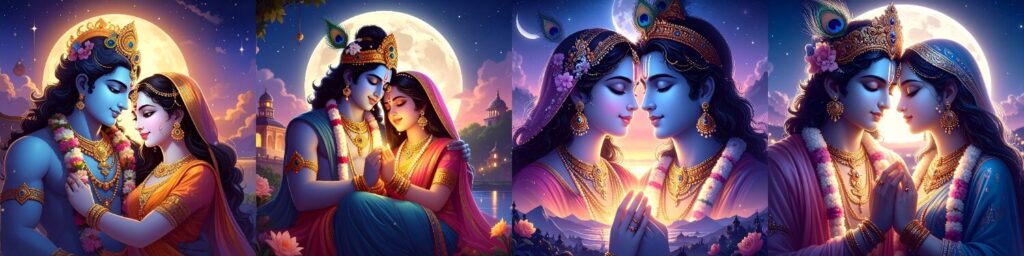
In the royal palace of Dwaraka, atop a magnificent and exquisitely adorned mansion, Śrī Krishna sat upon a jeweled throne. Evening was slowly giving way to night. The bearer of the Sudarśana Chakra waited quietly for his newly wedded bride. Beside him stood another throne, still vacant, silently awaiting its queen.
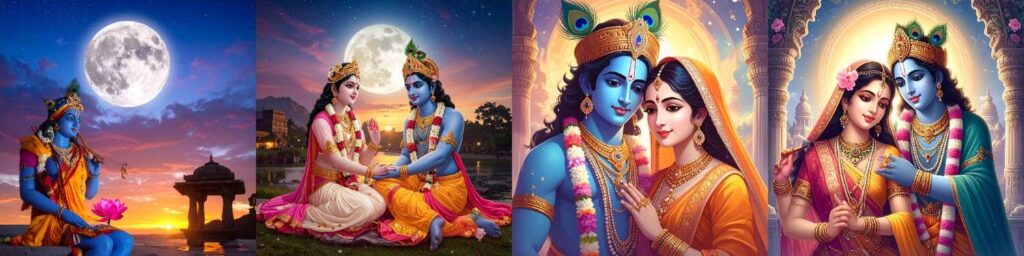
At that moment, Rukmini entered, holding a vessel filled with milk. Her face glowed with the tender radiance of a bride who had crossed oceans of destiny to reach her beloved. Offering the vessel into her husband’s hands, she seated herself gracefully upon the adjoining throne. Krishna took the vessel and began to drink the milk.
The reflection of the moon shimmered upon the surface of the milk.
Suddenly, Krishna paused, startled. Turning to the princess of Vidarbha, he asked,
“Is today not Vinayaka Chaturthi?”
Rukmini nodded gently and replied,
“Yes. Why do you ask, my Lord? What troubles you?”
A shadow crossed Krishna’s face.
“Alas, my beloved,” he said softly, “some misfortune now awaits me. Perhaps a false accusation, or an undeserved slander.”
Concerned, Rukmini asked,
“What is the cause of such apprehension, my Lord?”
Krishna replied,
“On the day of Ganesh Chaturthi, one must not behold the moon. Yet I have seen its reflection in this vessel of milk.”
Rukmini’s Curiosity and the Ancient Tale
Desiring to understand the reason behind this belief, Rukmini—also revered as Mother Padmalaya—requested Krishna to explain. Smiling gently, Krishna narrated a tale from the age of Satya Yuga.
On a day of grand celebration dedicated to Lord Ganapati, devotees offered countless laddus, knowing well the elephant-headed Lord’s fondness for sweets. Yielding to delight, Vinayaka ate more laddus than ever before. Even while returning home in the evening, he carried some in his hands.
His belly, already large, felt unusually heavy that day. As he walked unsteadily beneath the sky, the moon shone brightly above. In those times, the moon was always full—there was neither waxing nor waning.
Suddenly, Ganapati stumbled and fell. The laddus scattered upon the ground. Embarrassed, he looked around to see if anyone had witnessed his fall. No one was there—except the moon, who laughed aloud from the sky.
Enraged, Ganapati exclaimed,
“When someone falls, should one laugh instead of helping? Is it pride in your beauty that has made you so arrogant?”
In his anger, he cursed the moon:
“You shall no longer remain visible in the sky!”
Terrified, the moon begged forgiveness.
“O Gajanan, O foremost among the worshipped, forgive my offense!”
After much pleading, Ganapati’s anger subsided. He said,
“I cannot fully revoke my curse, but I shall lessen its severity. Your form shall now wax and wane. One day each month you shall be invisible—this shall be called Amavasya. From then on, your form shall gradually grow, attaining fullness after a fortnight. However, on the evening of my sacred day, whoever beholds you shall inevitably face disgrace—whether deserved or undeserved.”
Krishna’s Acceptance of Mortal Destiny
Rukmini asked anxiously,
“Does that mean you too must suffer this fate, my Lord?”
Krishna answered calmly,
“To assume a human body in the mortal world is to accept both fortune and misfortune alike.”
The Syamantaka Jewel and the Shadow of Slander
In Dwaraka lived a prominent Yadava named Satrajit, who possessed the priceless Syamantaka jewel—obtained through penance to the Sun God. Each day, the jewel yielded eight measures of gold. Krishna had advised Satrajit to deposit it in the royal treasury for the welfare of the people, but Satrajit refused.
One day, Satrajit’s brother Prasanjit wore the jewel around his neck and rode into the forest for hunting. There, he was killed by a lion. Later, Jambavan—the mighty bear king from the Treta Yuga—killed the lion and took the jewel into his subterranean palace, placing it around the neck of his foster daughter, Jambavati.
When Prasanjit did not return, suspicion arose. Knowing the jewel had been with him, Satrajit falsely accused Krishna of killing his brother out of greed. Thus, an unfounded slander spread throughout Dwaraka.
Krishna’s Trial and Triumph
To clear his name, Krishna ventured into the forest, traced the events, and entered the cave of Jambavan. There ensued a fierce battle lasting eighteen days—first wrestling, then combat with fists, stones, and trees.
At last, recognizing Krishna as the Supreme Lord whom he had once served as Rama, Jambavan surrendered, fulfilled in spirit. He offered both the jewel and his daughter Jambavati in marriage.
Return to Dwaraka and Sacred Marriages
Krishna returned to Dwaraka with Jambavan and Jambavati. The city rejoiced. Once again, auspicious wedding hymns echoed through the streets. Krishna returned the Syamantaka jewel to Satrajit.
Ashamed of his actions, Satrajit sought redemption by offering his daughter Satyabhama in marriage to Krishna, adorning her with the jewel. Krishna accepted the bride but refused to keep the jewel, returning it to Satrajit.
The Eternal Union of Krishna and Rukmini
Yet among all these events, the bond between Krishna and Rukmini shone with singular radiance. Rukmini—the embodiment of devotion—had written to Krishna, surrendering her very soul. Krishna, answering her call, had rescued her from an unwanted marriage and united with her according to divine will.
Their marriage was not merely a royal union—it was the meeting of Bhakti and Bhagavan, devotion and divinity. Rukmini became the queen of Dwaraka, the gentle yet powerful consort whose love softened even the Infinite.
The Eight Principal Queens
After Rukmini, Jambavati, and Satyabhama, Krishna married five more noble women:
Kalindi, Mitravinda, Satya, Bhadra, and Lakshmana.
Together, these eight queens are revered as Krishna’s Ashta Patarani—the Eight Principal Consorts, each embodying a unique divine virtue.
( to be continued)