
Mahabharata ( A Story of Dvapar Yuga in Prose) Part- 34-C
By Lokanath Mishra
Lakhabindha : When the Swayamvara Turned into a Battlefield:
(Based on Sarala Mahabharata)
The tense exchange between Shakuni and Arjuna did not go unheard. Dushasana, listening from nearby, was inflamed by the humiliating words hurled in the assembly. Unable to tolerate the insult, he seized his mace and rushed forward to attack Arjuna. King Drupada tried to stop him, but Dushasana shoved the aged king aside, sending him crashing to the ground.
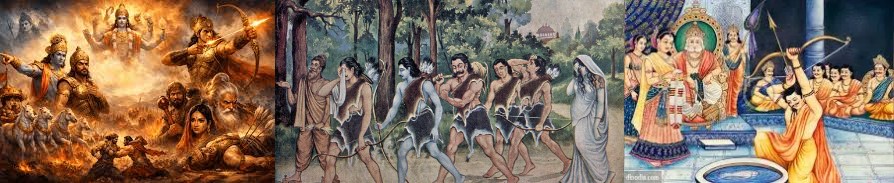
Seeing his father fall, Dhrishtadyumna lifted him up and advanced with the Panchala forces to resist the outrage. Shikhandi urged Arjuna, “Take Panchali inside the palace. It seems a great battle is about to erupt.” Draupadi too pleaded in the same vein. Yet when they saw Arjuna standing unmoved, calm and resolute, they were both astonished—and anxious.
“Do not fear,” Arjuna said firmly. “Watch what I do to them now.” Taking up King Drupada’s bow and quiver, Arjuna prepared himself for combat. Again Shikhandi requested Draupadi to retire to the inner chambers, but she refused to leave Arjuna’s side.
As Dushasana advanced toward Draupadi, the Panchala soldiers surrounded him. Enraged by this, Duryodhana too charged forward, mace in hand. The righteous kings present did not support him. However, Naraka, Jarasandha, Rukmi, Shishupala, Dantavakra, and others conferred among themselves and decided, “This Brahmin must not be allowed to take the princess away.”
When the Brahmins saw these kings preparing to wield weapons unjustly, they rose in fierce protest. Enraged, they grabbed whatever lay at hand—sacrificial ladles, wooden seats, water pots, staffs—and rushed forward to fight. Yudhishthira grew alarmed, fearing senseless slaughter of Brahmins. Raising his hand, he pleaded, “Peace, peace! Sit down.”
He addressed them gently: “O revered Brahmins, do not think lightly of this Brahmin who has pierced the impossible target of lacquer. He alone is sufficient. Be patient and wait.”
Yudhishthira had been watching Bhima, who was repeatedly trying to rise. He realized that the situation now demanded Bhima’s intervention. With a trembling body he called out, “Bhima , should you go?” Who else could restrain Bhima once unleashed?
With a thunderous roar—“Arey! Arey!”—Bhima leapt forth, as if the very earth had overturned. At that moment Dushasana had reached Draupadi and was trying to drag her away. Bhima struck him from behind with a crushing blow, sending him sprawling face-first into the ground. Snatching Dushasana’s mace, Bhima began to strike down enemy soldiers and kings with terrifying force.
Granting Bhima permission, Yudhishthira immediately felt remorse. He knew well the consequences of unleashing the long-contained wrath of the son of the Wind. Fearing disaster for the Kauravas, he sent Nakula to restrain Bhima. Nakula, ever obedient, rushed forth—his vow proving stronger than Bhima’s fury. Seeing Nakula also take up arms, Yudhishthira panicked and turned to Sahadeva:
“One becomes two, two have become three. Is Duryodhana determined to lose his body today? Is this worth it—for a woman, to kill brothers? No, no, Draupadi deserves no such carnage. Go, Sahadeva, bring them back.”
Even before his words ended, Sahadeva too rushed forward and joined his brothers.
Jarasandha, Shishupala, Naraka, and Rukmi incited the wicked kings to rise together. Balarama exclaimed in astonishment, “O Jagannatha, what kind of exploits of Arjuna are these!” Surrounded by innumerable kings intent on taking the bride, Panchala itself seemed on the brink of ruin.
Krishna smiled and said, “Brother, you have not truly measured Arjuna’s valor. He alone can defeat all these kings. And even if that were not so, is Sudarshana not here? How can you imagine the Pandavas coming to be harmed in my presence? Watch—watch—the play of subduing the wicked has begun.”
Balarama stood still, beholding Bhima’s form of destruction. Like Narasimha tearing apart Hiranyakashipu, Bhima whirled, his arms moving like blazing discs. Many warriors fled in terror, abandoning their banners. Yet Bhima’s single focus was Duryodhana. Weapons rained upon him from all sides, but he paid them no heed. He snatched weapons from his foes and struck them down with their own arms.
Yudhishthira struck his forehead in despair. “What have I done? I have sent them all, one by one. Today the Kaurava lineage will find no good end.”
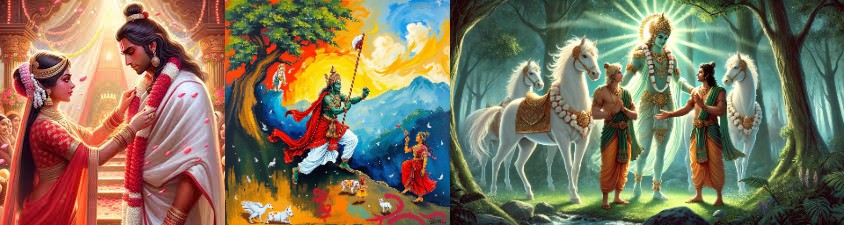
Seeing the wicked kings launch a combined assault, Bhima uprooted a massive pillar from the palace and smashed it down upon them. Some kings were crushed beneath it; others lost all courage to advance. From Arjuna’s bow poured an unceasing rain of arrows, felling countless archers. Nakula fought Dantavakra; Sahadeva battled Shakuni. Bhima lifted Karna’s chariot and hurled it upon Ashwatthama’s, forcing both warriors to leap away to save their lives.
Cries of “Strike! Seize!” shook the hall. The swayamvara had turned into a battlefield.
Who could behold the joy of Devarshi Narada? “Well done! Well done!” he cried, shaking his matted locks. Unsatisfied, he descended from the heavens, rebuking the Kshatriya kings: “With so many warriors present, how can you allow a beggar Brahmin to take the maiden away?”
Turning to the Brahmins, he proclaimed, “See how one among you has illuminated the faces of Brahmins and smeared soot upon the faces of Kshatriyas. These kings commit injustice—will you endure it?” Calling out the Pandavas by their secret names, he incited the Brahmins to surround and strike the Kshatriyas.
Then he turned to the Kauravas and taunted them: “Why do you hesitate in battle? Kill the Brahmins owith your swords and take the maiden if you dare!”
Thus, the episode of Lakhabindha becomes not merely a contest of skill, but a thunderous collision of pride, dharma, fury, and destiny—where a swayamvara blazes into war, and the true measure of heroes is laid bare.
( to be continued)