
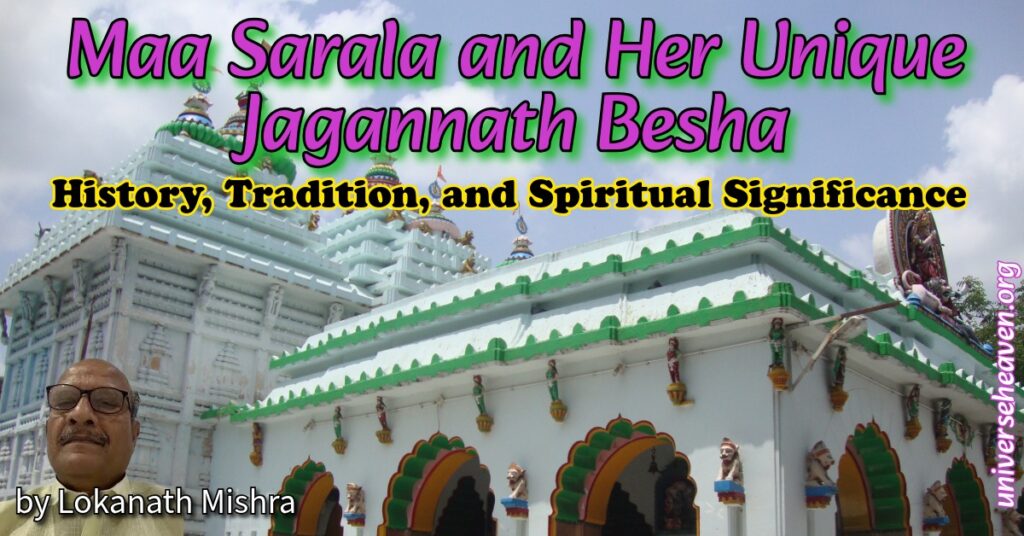
Maa Sarala and Her Unique Jagannath Besha: History, Tradition, and Spiritual Significance
By Lokanath Mishra, Jenamath Lane, Puri
Introduction
Among the many sacred traditions of Odisha, the worship of Maa Sarala stands out for its deep philosophical meaning and unique rituals. One of the most fascinating practices is the “Jagannath Besha” (attire of Lord Jagannath) that the Goddess assumes on every Ekadashi. This rare ritual beautifully expresses the unity of Shakti (Divine Feminine) and Brahman (Supreme Reality)—a concept deeply rooted in Indian spiritual thought.
History of Maa Sarala Temple
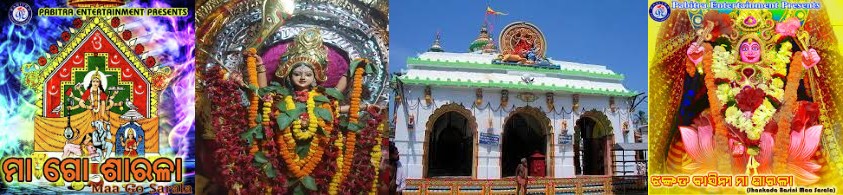
The Maa Sarala Temple, located at Jhankad in Jagatsinghpur district of Odisha, is one of the most revered Shakti shrines in eastern India.
• The temple is believed to have ancient origins, though the present structure was developed during the medieval period.
• Maa Sarala is worshipped here as a form of Durga, yet she holds a distinct identity as the presiding deity of knowledge, power, and wisdom.
• Unlike many classical temples, Maa Sarala’s idol is unique—she is worshipped in a somewhat abstract form rather than a conventional anthropomorphic idol.
Historically, the region around the temple was a center of Tantric worship, which explains the Goddess being revered as a Mahavidya (one of the ten cosmic wisdom forms of the Divine Mother).
Sarala Das and the Rise of Her Worship
No discussion of Maa Sarala is complete without mentioning Sarala Das, the great 15th-century Odia poet.
• Sarala Das is widely regarded as the “Adikavi” (first poet) of Odia literature.
• He composed the Odia Mahabharata, Vilanka Ramayana, and Chandi Purana under the divine inspiration of Maa Sarala.
• Tradition holds that he was not formally educated but received divine blessing from the Goddess herself, who granted him poetic wisdom.
According to legend, Sarala Das would visit the temple regularly, and the Goddess guided him spiritually. His works not only popularized Odia language but also firmly established Maa Sarala as a cultural and spiritual force in Odisha.
The Tradition of Jagannath Besha:
One of the most unique aspects of worship at the temple is the Jagannath Besha observed on every Ekadashi.
What Happens During the Ritual?
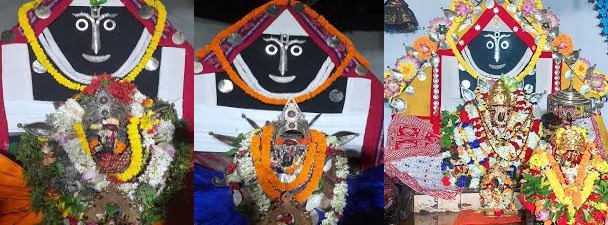
• Maa Sarala, usually worshipped in her Mahavidya form, is adorned in the attire of Lord Jagannath.
• The Aajnamala (sacred garland) from Lord Jagannath is ceremonially placed on the Goddess.
• A silver representation of Lord Jagannath is fixed above the crown (kirita) of the Goddess, symbolizing His presence.
• The Goddess then accepts Mahaprasad, traditionally associated with Lord Jagannath, in the form of Vishnu Maya.

Philosophical Significance
This ritual is not merely decorative—it carries profound spiritual meaning:
• Unity of Shakti and Vishnu: It shows that the Goddess (Shakti) and Lord Jagannath (Vishnu/Brahman) are not separate.
• Nirguna to Saguna: Maa Sarala, who is beyond attributes, manifests in a form filled with qualities.
• Prakriti–Purusha Concept: The ritual symbolizes the inseparable nature of Prakriti (Nature) and Purusha (Cosmic Consciousness).
• Tantric and Vaishnavite Synthesis: It beautifully merges two major spiritual traditions—Tantra (Shakti worship) and Vaishnavism (Jagannath worship).

Kamada Ekadashi and Special Observance
The ritual becomes especially significant during Kamada Ekadashi, an auspicious day in the Hindu calendar:
• Devotees believe that observing this day removes sins and fulfills desires.
• Maa Sarala in Jagannath Besha is worshipped as the grantor of liberation and blessings.
• Thousands of devotees visit the temple to witness this rare form.
Cultural and Spiritual Importance
The Jagannath Besha of Maa Sarala is more than a ritual—it is a living philosophy:
• It reflects Odisha’s inclusive spiritual culture.
• It bridges different schools of thought into a single unified vision.
• It preserves ancient traditions while remaining relevant to modern devotees.
Conclusion
The tradition of Maa Sarala’s Jagannath Besha is a powerful reminder that divinity is one, though worshipped in many forms. From the poetic devotion of Sarala Das to the deeply symbolic rituals of Ekadashi, the temple stands as a beacon of spiritual harmony.
✿❣️ Jai Maa Sarala ❣️✿