
Mahabharata in Prose A Story of Dvapar Yuga in Prose (Part-27-D)
By Lokanath Mishra
If a fire were to break out, or if there was a need to escape after setting a fire, the route had already been prepared. Yet Bhima’s mind was not at peace. He remained dissatisfied all the time. Many times he felt like asking, “Why? Why this escape? Where to, and for how long? What is to be gained by abandoning the kingdom instead of claiming the throne of Hastinapura?” That day Purochana was not present. The five brothers sat together with their mother and discussed the matter. Bhima could restrain himself no longer. All the questions in his heart burst forth at once.
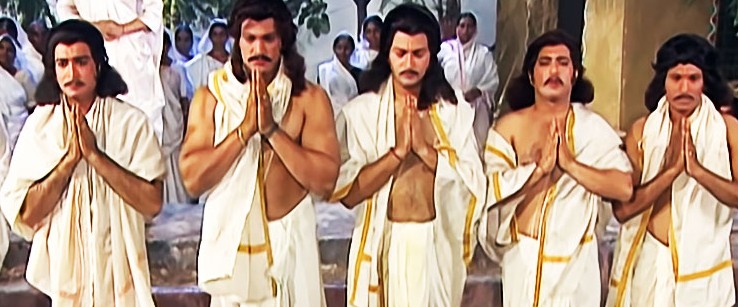
Yudhishthira said, “The truth that Uncle Vidura told me in private, I had not shared with you. Otherwise, Vrikodara would have shown disrespect to our eldest father. Even now, if he learns the full truth, he may grow even more violent. Still, the questions he has asked must also be arising in your minds. Therefore, today I shall reveal that harsh truth. Our eldest father, the king, has a strong desire to crown his own son Duryodhana as king of Panchala. But because of the people’s affection for me and the support of several well-wishers of the Pandavas, he has been unable to act on that desire. Behind the conspiracy of Duryodhana and our maternal uncle Shakuni to destroy us root and branch lies his covert support. Grandfather Bhishma, the elder Bhurishrava, and Guru Drona, bound by loyalty to the throne, have become helpless. In such a situation, only when the injustice of the Kauravas is exposed will our position become strong. Public opinion will stand by us. The members of the assembly will then come forward to demand that our rightful claim be given to us.”
Bhima said, “What if we seize the throne by force…?”
Sahadeva replied, “The first to oppose us would be Grandfather Bhishma. Besides, we have neither an army nor the resources to fight for us. Brother, Uncle Vidura is extremely wise and farsighted. Our welfare lies in following the path he has shown. Moreover, I feel that behind this so-called escape and concealment, some divine purpose is surely going to be fulfilled. For now, let the Kauravas enjoy a little happiness. Let the people know that our death is the result of their conspiracy. Let the residents of Panchala see the color of deceit in their reactions. Tomorrow is the new-moon night. In my opinion, we should escape from here tonight itself. Before leaving, if we set fire to the lac house, everyone will believe that we have been burnt to ashes. The fire should be set when Purochana goes out for dinner at night.”
All agreed.
Bhima’s hatred for Purochana was boiling within him. In his mind he had prepared a different plan for leaving the lac house. The man who had conspired to poison their food and kill the entire family, even though a Brahmin, did not deserve to be spared—this conviction had settled in his heart. Keeping his plan to himself, he waited for the right moment. He knew well that Yudhishthira would never permit him to carry out such a plan.
“In the village of Anubhav lived a Kirata,
His wife Jayanti, with five sons beside her.
That day the sky poured torrents of rain,
Thunder and lightning struck again and again.
A deadly bolt fell upon their dwelling place,
The Kirata named Aja met his end in that blaze.
Their hut too was burnt to ashes outright,
Jayanti fled with her five sons that night.”
Kirata woman Jayanti, seeking shelter with her five sons, happened to meet Purochana Pandit at a potter’s shed. He promised to give them shelter for the night in the lac house, honoring her request, but told them to wait in the shed and that he would bring them in after the Pandavas had fallen asleep.
The night grew late. The Pandavas’ chambers became dark and silent. Purochana brought Jayanti and her sons and made them sleep on the floor of his own room. Exhausted and worn out, they soon fell asleep. Purochana too finished his dinner and went to sleep.
In the darkness, the five brothers, along with Mother Kunti, removed the covering from the mouth of the tunnel and entered it. Bhima escorted them to the other end of the tunnel opening by the riverbank and then returned. A fire was burning in a potter’s shed nearby; all the artisans were fast asleep. From there he took a burning brand. Silently, he locked the only exit of the lac house from outside and entered through the tunnel. Near the mouth of the passage he set the fire and hurried back through the tunnel—but the raging flames chased after him.
“When the lac house caught fire,
It burned fiercely like the fire of doom.
As Bhima fled with great speed,
He fervently praised the Supreme Yogi.
Bhimasena praised the Fire-god,
‘Do not destroy us in this hour of peril.
Protect me this once, O Agni,
I shall offer you a hundred sacrifices.’
Thus praised by Bhimasena,
The beloved of Svaha grew calm.”
The fire was extinguished within the tunnel. Vrikodara emerged, sealed the tunnel’s mouth with a massive rock like a mountain, and rejoined his brothers. Standing on the riverbank, they watched the fiery spectacle of the burning lac house. People rushed from the potters’ quarters. Cries of men and women could be heard from inside. Thinking that Purochana himself had earlier set the fire, they did not make special efforts to extinguish it. They had no means to put out such a terrible blaze.
Inside his self-made lac house, Purochana ran frantically from room to room, screaming in agony, trying to save his life. The exit was blocked. Death itself, in the form of fire, came leaping toward him with flaming tongues. He had no time even to repent for his deeds. The demon-like Purochana was burnt alive, piece by piece, in a gruesome manner. Along with him, the innocent Kirata family too suffered the consequences—whether of this life or of sins from a previous birth.
From the burning lac house, terrifying flames rose skyward, lighting up even the riverbank with their crimson glow. The roar of the fire could be clearly heard at the river’s edge. Yudhishthira said, “Before dawn, we must travel far from here.”
At that moment, the boatman appointed by Vidura arrived. He brought out the boat he had kept submerged in the river and made it ready. First Mother Kunti boarded, followed by Yudhishthira and the four brothers. As soon as Bhima boarded holding his two maces, the boat nearly sank. Bhima jumped back into the water. On the boatman’s advice, everyone sat toward the rear, while Bhima alone tried to sit at the front. Still the boat seemed about to sink. At Sahadeva’s suggestion, Bhima threw the two maces into the river. Now the boat floated steadily.
The boat drifted across the broad expanse of the Ganga. Suddenly, a huge crocodile appeared from nowhere and shook the boat. The boatman said, “I had heard that a monstrous crocodile lived here, but I forgot. If it doesn’t get someone to eat, it will overturn the boat and all our lives will be in danger.”
Yudhishthira looked at Bhima. Bhima said, “In my opinion, Sahadeva should be given to the crocodile. He is the weakest. He will be of no use in battle. He has one fault—he knows everything but won’t speak unless asked. What use is he?”
Yudhishthira replied, “First of all, he is Mother Madri’s last child. If ever I become king, he would be the most suitable minister. With his knowledge of past and future and his sharp intellect, he will help us greatly.”
Bhima then looked at Nakula and said, “What use is he? So delicate that even a fly won’t dare sit on him. He needs sandal paste, silk bedding, and camphor to sleep. Who will give him such comforts in the forest? He will die anyway. Why not throw him in?”
Kunti drew Nakula into her lap and said, “Madri entrusted him to me. As long as I live, I will not let any danger come to Nakula.”
Bhima said, “I think keeping Phalguna (Arjuna) with us is of no use. One day we must fight the Kauravas. He will hesitate, speaking of kinship, and won’t raise his bow. By the time he decides who is armed or unarmed, we’ll have lost the war.”
Yudhishthira replied, “He is the greatest archer among us—Guru Drona’s favorite disciple, Krishna’s friend, Indra’s son. Is it right to throw him to the crocodile and incur the wrath of Keshava and Vasava?”
Bhima said, “Mother Kunti cannot walk with us in the forest. Sometimes we must climb hills, sometimes flee at a run. Because of her, we will all be endangered. Besides, she is growing old. So I think—”
Yudhishthira interrupted, “Bhima, how foolish you are! Did your mother give birth to you to hear such words? How can such thoughts even enter your mouth?”
Bhima said, “I cannot throw you to the crocodile, so I won’t go myself. As for this boatman—if you hand me the oar, I can row the boat.”
Yudhishthira replied, “Bhima, I see you have no sense of righteousness or unrighteousness. This poor man has come to help us, staying awake night after night. To endanger a benefactor is to invite hell until the end of time. What would Uncle Vidura think if he heard this?”
Kunti finally spoke, “While we argue, the boat is about to sink. Where will we go now, disguised as Brahmins, begging to live? Sometimes we will eat, sometimes fast. He won’t be able to bear hunger or control his anger.”
“Because of him, Dhritarashtra’s heart burned;
This wicked Bhima respects neither guru nor honor.
He cannot bear hunger even for a meal,
If his belly isn’t full, he suffers greatly.
He will never beg for alms;
If given little, he won’t accept it.
If someone says ‘Go away, Brahmin,’
He will uproot the hut and strike him.”
Unable to restrain himself, Bhima exclaimed, “Yes, yes, I am everyone’s burden! Because of me, you all go half-fed. I create all the trouble…” Saying this, he leapt into the river. The moment he hit the water, the crocodile swallowed him.
Yudhishthira and the other brothers began to mourn Bhima’s loss. Yudhishthira got down from the boat and, remembering Bhima’s valor, wept bitterly. The others too shed tears. Kunti said, “Look, we have no time to grieve. Dawn is near. Hurry, move on.”
Yudhishthira said, “What kind of mother are you? Don’t you have even a little affection for my Bhima?”
Kunti smiled gently and said, “I am that kind of mother. Your Bhima is very mischievous. He has gone—let him go. You move on.”
They walked, glancing back again and again, but Kunti remained calm.
Bhima easily tore open the crocodile’s belly and emerged. He swam back to the boat, slapped the boatman, and said, “When they talked of throwing me to the crocodile, you were nodding eagerly, weren’t you? Now I’ll settle accounts with you. But for Uncle Vidura’s sake, you are spared. Remember—do not tell anyone except him.”
The boatman trembled with fear, fell at Bhima’s feet, and promised to obey. Leaving him, Bhima ran swiftly in the direction his mother and brothers had gone.
Hearing the footsteps, Yudhishthira said, “What sound is this? Has some demon come to attack us? We gave Bhima to the crocodile—who will save us now?”
Kunti laughed and said, “This is no demon. Your brother has killed the crocodile and is coming from the river.”
Indeed, Bhima soon reached them, bowed to his mother and elder brother Yudhishthira, embraced the others, and narrated the tale of slaying the crocodile.
[Kunti knew well what her son was capable of and how great his strength was. Therefore, she had signaled Bhima to go to the crocodile. The dialogue on the boat is meant only to entertain the readers. In reality, Bhima would never have allowed his mother or any brother to be offered to the crocodile.]