
Mahabharata in Prose – Continued (Part 34-A)
By Lokanath Mishra, Jenamath Lane, Puri
Based on the Oriya Mahabharata by Sarala Das ( A story of Dvapar Yuga in Prose)
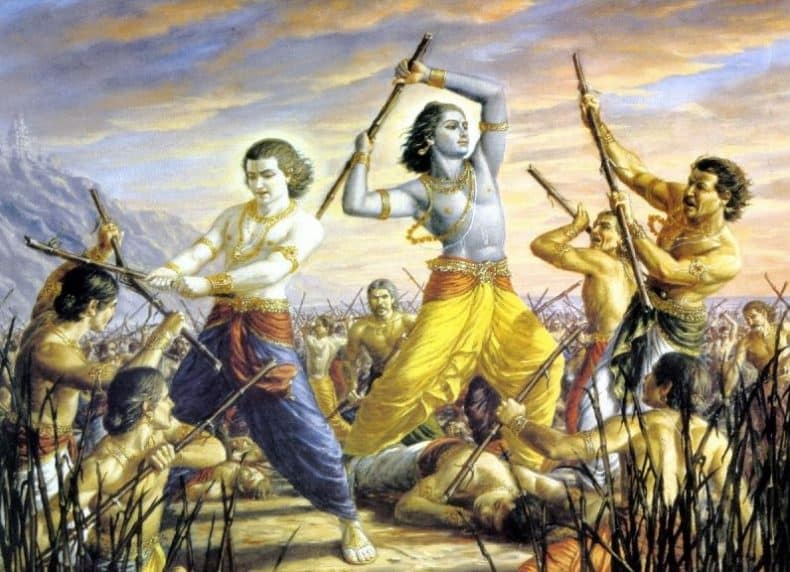
Gradually, the battle between Arjuna and Balarama assumed a fierce and terrifying form. When ordinary weapons failed to bring victory, both warriors began to employ divine weapons (astra) and counter-weapons in rapid succession. Balarama discharged powerful arrows from his mighty arms, and in response, Arjuna released his mystical blue arrows. The invincible force wielded by the wielder of the plough (Balarama) was neutralized by Partha (Arjuna) through the use of the formidable Brahmastra.
The brilliance and energy of these divine weapons were so intense that many soldiers on both sides fell unconscious, unable to withstand their radiance. Meanwhile, Pradyumna was engaged in a fierce duel with Duryodhana. Elsewhere on the battlefield, Bhima fought with Karna, Shakuni battled Sahadeva, Bhishma confronted Akrura, and Kripa clashed with Nakula.
Bhimasena struck Karna’s chariot with his mace, smashing it to pieces. In another encounter, Bhishma was hurled violently against Drona’s chariot, causing both great warriors to lose their chariots and withdraw temporarily from the battlefield. Bhima then hurled his mace at Duryodhana’s elephant, striking it with tremendous force. As Duryodhana fell to the ground, Ananga seized him by the hair and raised his sword, ready to behead him.
Seeing Duryodhana in such a plight, Yudhishthira immediately abandoned his weapons and rushed forward. Addressing Pradyumna, he said with compassion, “He is my brother and dear companion—do not kill him.” Earlier, Krishna had introduced his sons—Pradyumna, Samba, and Gada—to Yudhishthira. At Yudhishthira’s request, they released Duryodhana, sparing his life.
As defeat loomed near, Kamapala assumed a terrifying cosmic form, manifesting the universal (Vishvarupa). The sight of this dreadful form spread fear across heaven and earth. People trembled, crying out in terror, fearing total destruction.
Finding no other solution, the divine wielder of the discus, Lord Krishna, infused his own divine energy into Arjuna’s body.
“Seeing Arjuna radiant with divine brilliance,
Balarama beheld in him the very form of Krishna.”
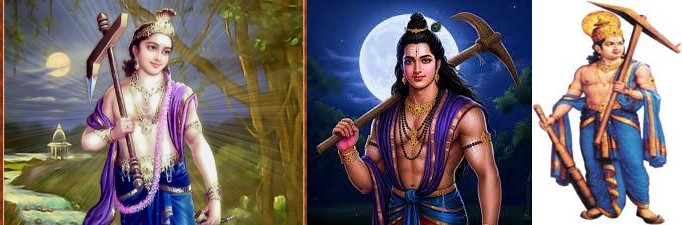
In the entire universe, if there was anyone whom Balarama loved most, it was his brother Krishna. Upon seeing Krishna’s form reflected in Arjuna, his anger subsided. He realized inwardly that Arjuna was none other than a second Krishna. Immediately, he laid down his weapons, descended from his chariot, and approached Arjuna.
Arjuna and Subhadra also came down from their chariot and bowed at the feet of Balarama (the beloved of Revati), seeking his blessings and forgiveness for their actions. Krishna too, with folded hands, humbly addressed his elder brother:
“Please permit your sister Subhadra to be united in marriage with her chosen companion. Will you not grant my request, dear brother?”
Krishna’s face shone with earnest appeal. Enchanted by his divine charm and sincerity, Kamapala’s heart melted instantly. He blessed Subhadra and Arjuna wholeheartedly and forgave the Yadava commanders who had fought against his orders in support of Arjuna.
This sudden change in Balarama’s attitude brought great joy to the Yadava camp. However, for the Kauravas, the pain of defeat and the humiliation of rejection was far more agonizing than their physical wounds. Shakuni bitterly remarked to Duryodhana, “Do you see, my nephew? Even Prince Shishupala did not suffer such humiliation when he came seeking marriage. All this is the scheme of that wielder of the discus (Krishna). Have you also noticed the deep brotherly affection among the five Pandavas? Does it not remind you of Draupadi’s marriage? Who won the bride, and who bore the humiliation? Today, the same scene has been repeated. A princess for Arjuna—and for us…”
“Enough, uncle!” roared Duryodhana in anger. “I have not forgotten the insult at Panchala, nor will I forget today’s humiliation. One day, I shall avenge all these insults. Now let us withdraw our army.”
Thus, the Kuru forces, who had arrived expecting to attend a wedding feast, returned wounded, exhausted, and humiliated after an unexpected battle.
Meanwhile, Balarama and Krishna took Subhadra back to the royal city. Forgetting the horrors of war, the Yadavas began preparations for the wedding under Balarama’s command. The Pandavas rested on Mount Raivata, accompanied by Vidura.
Yudhishthira, however, felt the emotional pain of the Kauravas. He said to Vidura, “Please go and persuade them to return. Without them, this wedding will not be complete. It is our duty, according to tradition.” Krishna added, “Tell them that both of us brothers also request their presence.”
On the way, Vidura met the Kauravas resting on Mount Manabhanga and conveyed the invitation. But Shakuni, Karna, and Dushasana turned away in resentment. Bhishma advised them wisely, “We should go. Arjuna has returned from exile with immense divine powers. It is not wise to make him a lifelong enemy. The marriage will proceed even without you, but by attending, you may restore some honor and dignity, and maintain cordial relations with Krishna and Balarama.”
Despite this counsel, Duryodhana, after private consultation with Shakuni, made his final decision to return to Hastinapura, refusing the invitation.
(To be continued)