
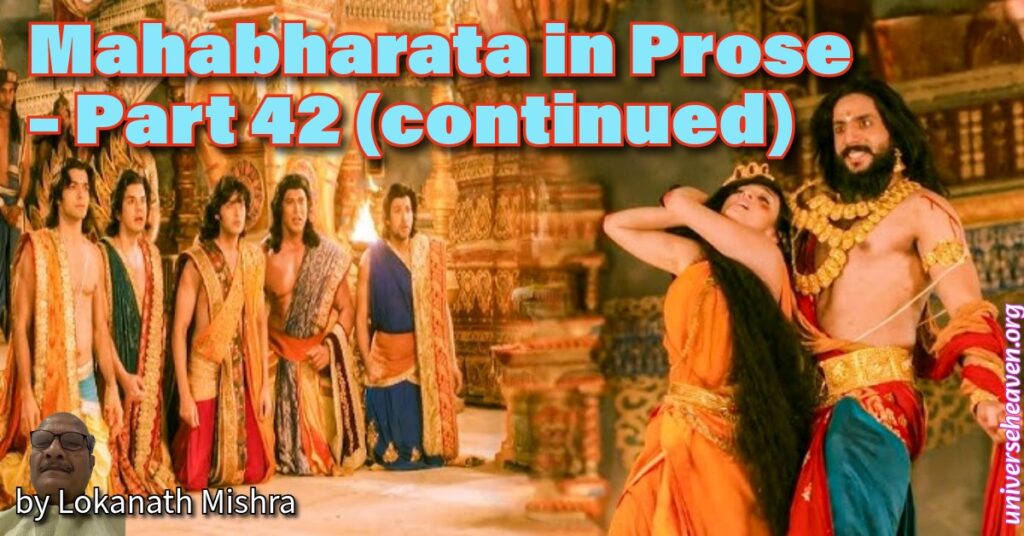
Mahabharata in Prose – Part 42 (continued)
A story of the Dvapara Yuga based on the Odia Sarala Mahabharata
by Lokanath Mishra, Jenamath Lane, Puri
A heavy stillness gripped the royal court of Hastinapura after the आदेश of Duryodhana rang out. The सभा, filled with kings and elders, seemed to lose its voice. None rose to question the धर्म of what had just transpired, though many felt its weight pressing upon their hearts.
At Duryodhana’s command, his brother Dushasana rose eagerly. With cruel intent, he strode toward the inner chambers where Draupadi resided, unaware of the fate that had been cast upon her.
Entering her quarters, Dushasana spoke harshly,
“Come, Draupadi! You have been won in the game of dice. You are now a दासी of the Kauravas. The king commands your presence in the court.”

Draupadi, startled and filled with disbelief, stepped back.
“What do you say?” she asked, her voice trembling yet firm. “How can a man who has lost himself stake another? Ask in the सभा—did Yudhishthira lose himself before or after he staked me?”
Her question was profound, rooted in dharma itself. But Dushasana, blinded by arrogance, paid no heed.
When she refused to come, he seized her by the hair—the same hair that had been sanctified during the Rajasuya—and dragged her toward the court.
The sight that followed shook the very foundations of righteousness.
Draupadi was brought into the सभा, her dignity assaulted, her eyes blazing with anguish and fury. She looked around—at the elders, the kings, the guardians of dharma.
She saw Bhishma, bound by his vow; Drona, silent in conflict; Kripa, watching in unease; and Dhritarashtra, seated upon the throne, blind not only in sight but in action.
Her voice rang out, strong despite her suffering.
“O महान elders, answer me! Can a man who has already lost himself stake his पत्नी? Am I won justly, or is this अधर्म?”
Her question echoed through the सभा, yet no clear answer came.
Bhishma, torn between duty and righteousness, spoke with difficulty,
“Dharma is subtle… I cannot determine it with certainty.”
These words, though honest, failed to protect her.
Meanwhile, Karna, driven by old grievances, spoke harshly.
“She has been won fairly. A woman with many husbands has no honor to claim. Treat her as a servant.”
His words deepened the wound.
Duryodhana, intoxicated with power, struck his thigh and mocked her, inviting her to sit upon it. The insult was unbearable.
At this, Bhima trembled with rage. Bound by the loss of the dice, he could not act, yet his voice thundered,
“I swear, Duryodhana, I will one day break that very thigh you have dared to display!”
Still, the cruelty had not reached its peak.
At Duryodhana’s signal, Dushasana stepped forward once more.
“Let us strip her of her garments,” he declared, “so that all may see the fate of those who are won.”
A gasp of horror spread across the सभा.
As Dushasana began to pull at her sari, Draupadi, helpless before men who had abandoned dharma, closed her eyes and lifted her hands in surrender—not to the सभा, but to the divine.
“O Krishna,” she cried in her heart, “protector of the helpless, save my honor!”
And in that moment, a miracle unfolded.
As Dushasana pulled at her garment, it did not end. Cloth after cloth emerged, unending, inexhaustible. The more he pulled, the more it grew.
His strength began to fail, his breath grew heavy, yet the sari continued without limit.
The सभा watched in stunned silence as the divine protection of Krishna manifested before their eyes. Draupadi stood untouched, her dignity preserved by grace beyond human power.
Exhausted and defeated, Dushasana collapsed.
A profound silence followed. The arrogance of the Kauravas faltered, and fear crept into their hearts.
At last, Dhritarashtra, sensing the danger of divine wrath and the destruction that such अधर्म could bring upon his lineage, spoke with urgency.
“O noble Draupadi,” he said, “forgive this grave injustice. Ask for boons, and I shall grant them.”
Draupadi, her composure restored, chose wisely.
“Let Yudhishthira be freed,” she said first.
“It shall be so,” Dhritarashtra replied.
“For my second boon, let my husbands be released from bondage.”
Again, the king granted her wish.
Though offered a third boon, Draupadi refused.
“Greed destroys dharma,” she said. “I seek no more.”
Her restraint shone brighter than any victory.
Thus, the Pandavas were freed, and the सभा slowly dispersed, burdened by the memory of what had occurred. Yet the wound inflicted that day would not heal easily.
The humiliation of Draupadi, the silence of the elders, and the cruelty of the Kauravas had sown seeds of inevitable destruction.
And though peace seemed to return for the moment, destiny had already turned its wheel—toward a future where vows would be fulfilled, and justice would be claimed upon the battlefield of Kurukshetra.
(Continued in Part 43…)