
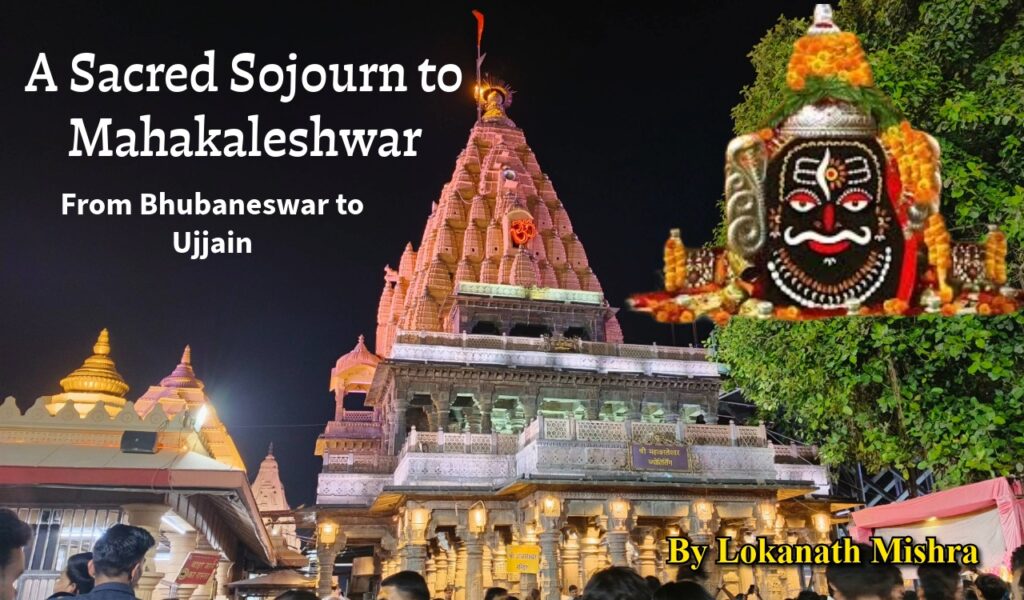
A Sacred Sojourn to Mahakaleshwar : From Bhubaneswar to Ujjain
By Lokanath Mishra
On the morning of 4 February 2026, our much-anticipated spiritual journey began. Accompanied by my wife, her two close friends, and their husbands, I boarded an early morning flight from Bhubaneswar to Indore, hearts filled with devotion and minds eager for an experience we had long cherished—the darshan of Shri Mahakaleshwar Jyotirlinga at Ujjain.

The flight was smooth, and the shared excitement among our group made the journey feel shorter than it was. Conversations revolved around faith, past pilgrimages, and the unique glory of Mahakal—the only Jyotirlinga believed to be Swayambhu and facing south, symbolising the eternal cycle of time and liberation. Upon landing at Indore, we proceeded by road to Ujjain, the ancient city that breathes spirituality in every corner. The drive itself was soothing, gradually detaching us from worldly concerns and drawing us closer to the divine.
By evening, we reached Ujjain and headed straight towards the Mahakaleshwar Temple. As dusk settled, the temple complex came alive with chants, ringing bells, and the steady flow of devotees from all walks of life. The atmosphere was electrifying yet deeply serene. We were fortunate to witness the evening Aarti of Mahakala, an experience that words can scarcely capture. The rhythmic chanting, the glow of lamps, the fragrance of incense, and the collective devotion of thousands created a moment of spiritual transcendence. Standing before Mahakal during the evening aarti felt like time itself had paused—an overwhelming reminder of the Lord’s omnipresence and power.

After the darshan, we returned with peaceful minds and grateful hearts, knowing that the most awaited moment of our pilgrimage was yet to come. The night passed quickly, anticipation keeping us awake more than rest ever could.
In the early hours of 5 February 2026, long before dawn, we prepared for the most sacred ritual associated with Mahakaleshwar—the Bhasma Aarti. This aarti, performed only once a day in the Brahma Muhurta, holds immense spiritual significance. By divine grace and proper arrangements, we had obtained a protocol pass, allowing us to participate in this rare and revered ceremony.
As we entered the sanctum in the stillness of early morning, a profound silence enveloped the temple, broken only by Vedic chants. The ritual, in which sacred ash (bhasma) is offered to the Lord, symbolises the ultimate truth of life—that everything merges back into ash, and only the divine remains eternal. Witnessing the Bhasma Aarti up close was deeply humbling. It was not merely a ritual, but a spiritual awakening, reminding us of impermanence, detachment, and surrender to Mahakal, the Lord of Time.
When the aarti concluded and we had darshan of Mahakaleshwar in the calm light of early dawn, a deep sense of fulfillment settled within us. The fatigue of travel vanished, replaced by inner peace and gratitude. For all of us, this pilgrimage was not just a journey across cities, but a journey inward—a moment of connection with faith, tradition, and the eternal.
Our visit to Ujjain, though brief, left an everlasting imprint on our hearts. The darshan of Mahakala, especially the rare blessing of the Bhasma Aarti, will remain one of the most cherished spiritual experiences of our lives—a reminder that when devotion is sincere, the divine always finds a way to call you closer.
Mahabharata ( A Story of Dvapar Yuga in Prose) Part-33
Mahabharata ( A Story of Dvapar Yuga in Prose) Part-33 A