
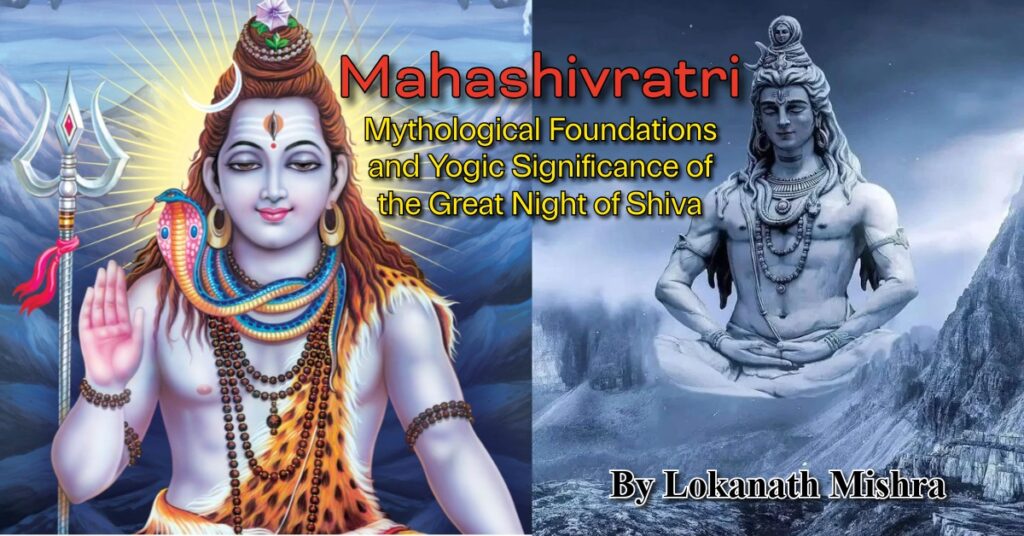
Mahashivratri: Mythological Foundations and Yogic Significance of the Great Night of Shiva
By Lokanath Mishra
Mahashivratri, celebrated annually on the fourteenth night of the waning moon in the month of Phalguna, is one of the most profound spiritual observances in the Indian civilizational tradition. Rooted in ancient mythology, Puranic literature, and yogic science, the festival represents both a cosmic event and an inner spiritual possibility. This article explores the mythological origins, scriptural references, and yogic interpretations of Mahashivratri, highlighting its enduring relevance as a night of transformation, inner stillness, and realization of unity.
Introduction
Among the numerous festivals of India, Mahashivratri occupies a unique position due to its inward-focused character. Unlike celebratory festivals marked by social festivity, Mahashivratri emphasizes austerity, wakefulness, and contemplative silence. It is dedicated to Lord Shiva, revered not only as a deity but also as the supreme yogi and Adi Guru, the first teacher of spiritual sciences. The observance of this night reflects a synthesis of mythology, cosmology, and yogic psychology.
Mythological Origins and Scriptural Citations
Indian scriptures present multiple narratives explaining the sanctity of Mahashivratri, each addressing different dimensions of spiritual life.
According to the Shiva Purana, Mahashivratri commemorates the sacred marriage of Lord Shiva and Goddess Parvati. This divine union symbolizes the integration of consciousness (Shiva) and energy (Shakti), suggesting harmony between worldly life and spiritual aspiration. For householders, this narrative underscores balance, devotion, and responsibility within domestic life.
Another prominent account, found in both the Shiva Purana and the Skanda Purana, associates Mahashivratri with the episode of Samudra Manthan (the churning of the cosmic ocean). During this cosmic event, the deadly poison Halahala emerged, threatening all creation. Lord Shiva consumed the poison and held it in his throat, earning the epithet Neelkanth. This act represents supreme renunciation, compassion, and mastery over destructive forces. Mahashivratri thus symbolizes the transcendence of ignorance and negativity through inner strength and awareness.
A third yogic narrative describes Mahashivratri as the night when Shiva attained complete stillness and became one with Mount Kailash. This legend, particularly significant for ascetics and yogis, portrays Shiva as the embodiment of absolute silence (mauna) and dissolution of ego. In this context, Mahashivratri is viewed as the night of inner absorption rather than ritualistic celebration.
Yogic Interpretation and Cosmic Alignment
From a yogic perspective, Mahashivratri is not merely a commemorative event but a scientifically observed phenomenon. Yogic traditions note that on this night, planetary positions in the northern hemisphere facilitate a natural upward movement of energy within the human system. According to teachings popularized by Isha Foundation, this alignment enhances the possibility of spiritual awakening when the body is kept awake and the spine erect.
The prescribed practices of fasting, night-long vigil (jagaran), mantra chanting, and meditation are therefore functional tools rather than symbolic acts. They temporarily alter the rhythm of the body and mind, allowing heightened receptivity and awareness. In yogic philosophy, this inward movement of energy is essential for experiencing unity within existence.
Mahashivratri and the Concept of Oneness
At its philosophical core, Mahashivratri represents the realization of non-duality. Shiva, in yogic understanding, is not a personality but a state of boundless consciousness. To observe Mahashivratri is to consciously align with this possibility. The night signifies the victory of light over ignorance and knowledge over illusion, reminding seekers that liberation is attainable through inner stillness and self-awareness.
Contemporary Observance and Cultural Continuity
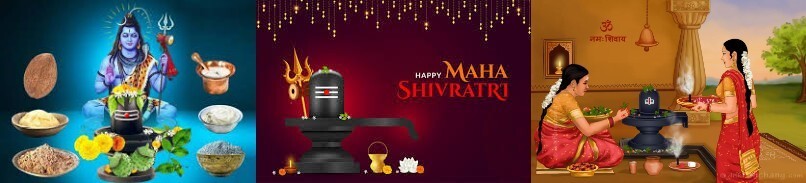
In contemporary India, Mahashivratri continues to be observed with deep reverence. Devotees across the country engage in rituals such as abhishekam, Vedic chanting, and meditation, while major spiritual centers and temples witness night-long observances. Despite regional variations, the central theme remains consistent—self-discipline, awareness, and inner transformation.
Conclusion
Mahashivratri stands as a timeless spiritual observance that seamlessly integrates mythology, cosmology, and yogic science. Through its diverse narratives—from divine union and cosmic sacrifice to yogic stillness—it addresses the spiritual needs of householders, seekers, and ascetics alike. More than a festival, Mahashivratri is a conscious reminder of humanity’s potential to transcend limitation and experience unity with existence. In an age marked by external distractions, the Great Night of Shiva continues to offer a pathway inward, toward silence, awareness, and liberation.
⸻
References
1. Shiva Purana, various chapters on Mahashivratri and Neelkanth narrative.
2. Skanda Purana, accounts of Samudra Manthan and Shaiva observances.
3. Teachings and publications of Isha Foundation on Mahashivratri and yogic science.