
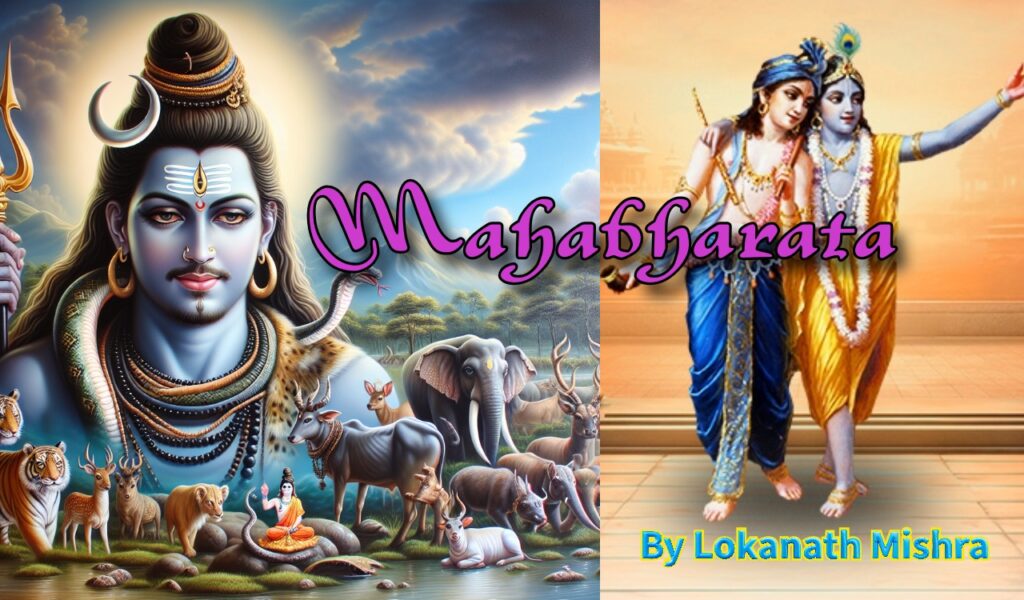
Mahabharata, (A Story of the Dvapara Yuga in Prose – Part 34G, based on the Odia Sarala Mahabharata)
By Lokanath Mishra
The Marriage of Panchali
After Indra was defeated, Shachi sat on the bank of the celestial river Akash Ganga and wept bitterly. At that time Shiva and Parvati were passing along that path. The sound of Shachi’s crying reached their ears. Parvati stopped the bull (Nandi) and said to her husband, “Someone is crying. Let us stop for a moment and understand her sorrow.”
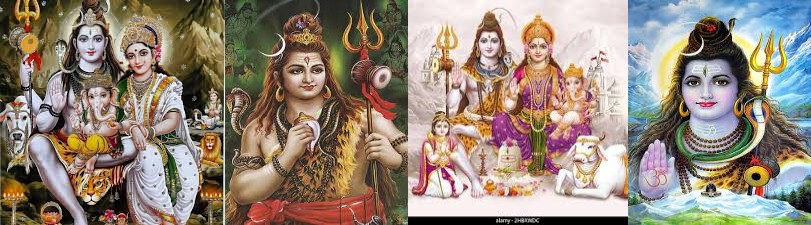
Bholenath replied, “There can be many problems in offering help without being asked. Are you about to invite some danger upon yourself?”
Girija answered, “Lord, the duty of a woman says that if one woman sees another woman crying, she must certainly console her. Even if that woman is crying because of quarrel, conflict, or violence, still one should understand the reason for her grief and try to ease it. Those women who pass by without considering this duty are born as tree frogs again and again in their next lives.”
Hearing Parvati’s thoughts about the duty of womanhood, Mahadeva was pleased. Both of them approached Shachi. Parvati gently placed her hand on Shachi’s head and asked the reason for her sorrow.
“Who are you? Whose wife are you? You appear like a celestial woman. What is the cause of your suffering?”
In reply to every question, Shachi, with a voice choked with tears, could only say, “My husband… my husband… my husband.”
Shiva then asked, “Who is your husband? What has happened to him? Tell us everything in detail so that we may help you.”
Shachi raised her head and saw that the fair-complexioned Lord Shiva, the embodiment of compassion, was standing with Goddess Bhavani beside him. She bowed to them with reverence. But as she continued repeating “husband, husband,” Shiva said:
“You have uttered the word ‘husband’ five times. Therefore, may you obtain five husbands.”
Wiping the tears from her eyes, Shachi asked in astonishment, “O Lord Bholenath, Mother Parvati, what kind of boon have you given your daughter? Is this a blessing or a curse? I wanted only my husband.

Why should a single woman have five husbands?
How could you give such an order, O Lord Pashupati?”
Mahadeva replied, “Do not be disturbed, child. These words did not come from my mouth unknowingly. Before his death, your husband placed his soul in five different places. In the Dvapara Yuga, those five parts of his soul will take birth in human form. You too will emerge from a sacrificial fire and become the wife of those five men. When you understand that each of them is a part of your husband himself, you will not feel the burden of unchastity.”
After saying this, Shiva and Parvati departed for Kailasa.
Now that very Shachi has been born from the sacrificial fire as Yajnaseni (Draupadi). From the portion of Indra—known here as Askanda—the five Pandavas have taken birth. Those whom you and your son had insulted as poor beggars are none other than Dharmaraja Yudhishthira, the mighty Bhima (Vrikodara), the incomparable archer Dhananjaya (Arjuna), the graceful prince Nakula who bears the sword, and Sahadeva, the wise knower of past and future.

“They are now living with their mother in this humble potter’s house. Do you wish to see its true form?”
Before Vyasa could finish speaking, a celestial city resembling Amaravati appeared with all its splendor. Beside Shri Krishna stood Haladhara (Balarama).
King Drupada and his two sons prayed for forgiveness for their mistakes. The Pandavas, along with their mother Kunti, were reassured when they realized that everything had been ordained by destiny.
To comfort Draupadi, Vyasa said, “I believe the memory of your previous birth has now returned to you. Yet your consent is necessary for this marriage. Tell us your opinion.”
Until that moment Panchali had not looked properly at them. She lifted her veil and carefully observed the five brothers. Then she said, “Each of them appears to me like my husband from my previous birth. Therefore I have no objection to marrying these five brothers.”
King Drupada immediately ordered preparations for the wedding. In the palace of Panchala, the continuous sound of conches and auspicious musical instruments announced the marriage of Panchali.
It was decided that the wedding would take place in the celestial city, because in another sense it was the marriage celebration of Indra and Shachi themselves. The gods and celestial women were also to attend this wedding. Kings from neighboring states of Panchala arrived with invitations. The Yadavas came from Dwaraka.
Between the Panchala palace and the celestial city a magnificent decorated pavilion was constructed. From the palace the queen and her companions brought Draupadi back to the royal chambers. There she was adorned with the sixteen bridal ornaments (Solah Shringar). When she was brought to the celestial city, the capital echoed with music, conch sounds, and festive ululations.
Gandharvas and Apsaras expressed their joy through dance and song. The goddesses of Amaravati also sat around Draupadi invisibly to ordinary people.

Many learned Brahmarishis and Maharishis took their seats around the sacred wedding altar. At the altar sat the bride’s parents, King Panchalesh (Drupada) and Queen Padmavati. Sage Vyasa performed the role of the groom’s father.
After the auspicious invocation, the sacred vow was taken and the deities and the serpent clans were invoked. The chanting of mantras by the priest Dhaumya along with other sages and Brahmins filled the air and the sky.
Accompanied by celestial maidens, the Yadava women, and other companions, and moving gracefully to the rhythm of auspicious music, the enchanting Krishnaa (Draupadi) stepped onto the wedding altar. The spectators stood spellbound. Such a magnificent sight they had neither seen before nor imagined they would see again.
The ritual bindings were then performed:
The ceremonial thread was tied on the hands,
Sacred grass bonds and the sacred thread placed on the shoulder.
Sprigs of sacred grass and leaves were arranged,
And the waist ornaments of the bride and groom were fastened.

Draupadi’s right hand was joined with the five Pandavas in a symbolic manner:
her thumb with Yudhishthira’s hand,
her index finger with Bhima’s hand,
her middle finger with Arjuna’s hand,
her ring finger with Nakula’s hand,
and her little finger with Sahadeva’s hand.
Thus the five fingers were joined with the hands of the five Pandavas,
And priest Dhaumya tied the sacred knot with mantra and kusa grass.
After the binding ceremony, amid the chanting of Brahmins, Drupada formally offered his daughter to each of the five brothers one by one.
Priest Dhaumya filled a right-turning conch with water and sesame seeds and placed it in Drupada’s hands, asking him to present the dowry. Drupada and Queen Padmavati humbly declared that by obtaining these great personalities—intimate companions of Lord Vasudeva Krishna—as their sons-in-law, they already felt blessed. What gift could be worthy enough for them?
However, this was only the king’s modesty. The dowry he actually gave was so immense that the Pandavas could have built an entirely new capital with it.
According to custom, the royal couple prayed that the bride’s ten faults be forgiven. After all the rituals were completed, the royal family honored the newlyweds. The Laja Homa and other ceremonies were performed.
The Pandavas distributed the vast wealth they had received as dowry among the poor and the helpless.
After all ceremonies ended, everyone honored the newly married couple. Krishna and Balarama, along with their families, took leave of Drupada and departed for Dwaraka. The Pandavas remained there until the Ashtamangala ceremony and participated in the post-wedding rituals.
The five brothers stayed in five different chambers, and Draupadi fulfilled her duties as a wife with each of them in turn. After the Ashtamangala, the Pandavas returned with Kunti to the potter’s house.

On the return journey, Balarama said to Krishna, “Kanhaiya, in my opinion the Kauravas should also have been present at this wedding. But circumstances took a different turn. Still, on our way we should inform Dhritarashtra and advise him on the appropriate course of action.”
Krishna agreed. Both of them went to Hastinapura and met Dhritarashtra. After hearing the entire account, Dhritarashtra anxiously asked, “Why has Duryodhana not returned yet?”
Krishna replied, “Many soldiers who went with them have been killed. Many others are wounded and injured. But do not worry, O King. We are certain that your sons are safe. Because of Yudhishthira’s intervention, the mighty Bhima (Vrikodara) could not inflict even a single wound on them.”
Though hurt by Vasudeva’s sarcasm, Dhritarashtra felt relieved to know that his sons were still alive.
(To be continued)