
A Story of Dwapar Yuga in Prose : ( part-12)
By Lokanath Mishra
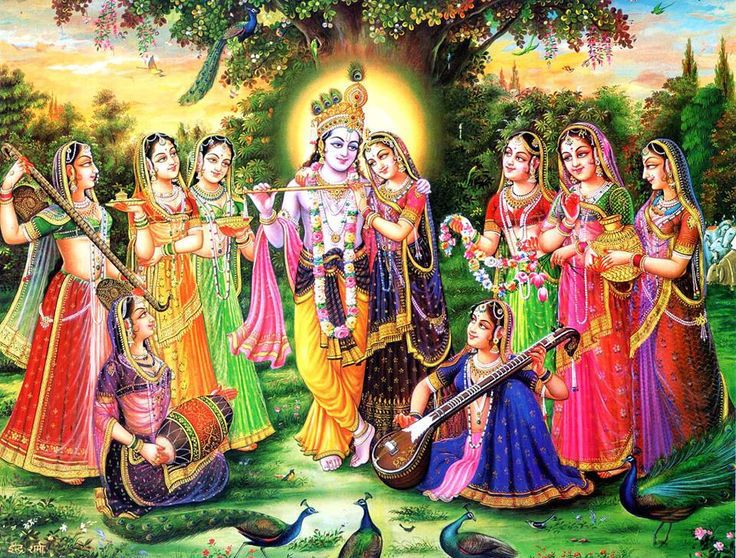
If you get a chance to go through the Vedic literature you may find that if there is one relationship that continues to mesmerize the heart of every seeker, it is the ethereal love between Shree Radha and Shree Krishna. Yet, to call it merely a love story would be to limit the boundlessness of what “Gopi Prem” truly signifies. It is a divine phenomenon—an eternal flame of devotion that burns without expectation, ego, or desire. The gopis, and especially Srimati Radharani, are not celebrated because they longed for Shree Krishna, but because they longed for nothing but his happiness, even in his absence. Their pain in separation, their ecstatic union, and their unwavering surrender stand as the ultimate expression of bhakti. Through the sacred narration of the Shrimad Bhagavatam and Vedic tradition, it is offered an intimate glimpse into leelas that often remain unheard, unspoken, or misunderstood. This is their story—not of loss or longing—but of the highest spiritual love ever revealed to mankind.
There is a story :
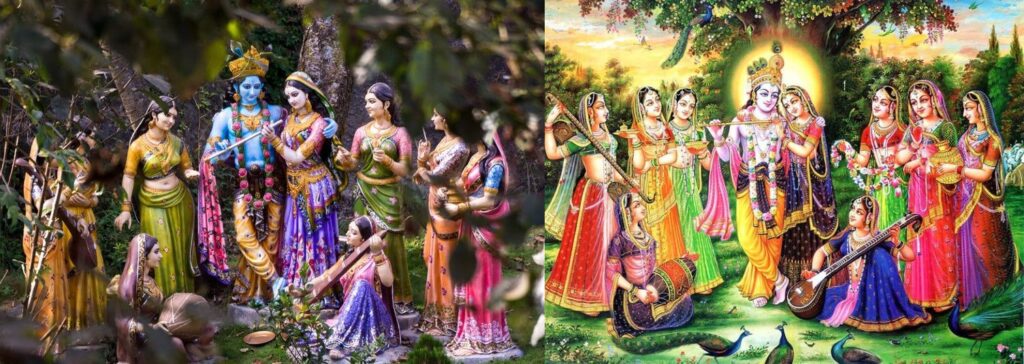
“Devotees gather at the sacred lake in Kurukshetra during a solar eclipse, echoing the divine reunion of Shree Krishna, Radha, and the Gopis after separation.”
More than 5,000 years ago, the sacred city of Kurukshetra witnessed a rare astronomical and spiritual alignment. A solar eclipse was about to take place, and as was customary in that era—and even today—more than one lakh of people gathered near the sacred lake at Kurukshetra to bathe during this event. Eclipses were not mere celestial events for ancient Indians; they were believed to be windows of heightened spiritual potency. It was a time when karma accelerated, and even a simple dip in a holy lake was said to cleanse lifetimes of sins. On this occasion, Shree Krishna himself journeyed to Kurukshetra, accompanied by his clan—the mighty Yadus—and his 16,108 queens.
But this pilgrimage was far more than a traditional ritual. Unknown to most present, something far more momentous was about to unfold. From the distant forests of Braj, after a separation , Shree Radha and the Gopis also made their way to Kurukshetra. They had not seen Shree Krishna for a long period not in form, not in speech—yet their love had neither faded nor faltered. If anything, it had ripened into the sweetest nectar of devotion, distilled through years of internal union and external separation.
“In every chore, their hands served the world—but their hearts belonged to Shree Krishna.”
It seems paradoxical: why would Shree Krishna, who loved the Gopis more than anyone else, leave them behind and never return to Vrindavan? Why would he not call them to Mathura or Dwarka? The answer, though difficult to grasp at first, reveals one of the most powerful truths of spiritual life: separation intensifies love. In worldly relationships, distance can lead to fading emotions. But in divine relationships, viraha (separation) does not dilute love—it refines it.
“It is in separation that love becomes more intense and more selfless.” The pain of longing, the ache of absence—these purify love from all contamination of expectation. The Gopis never asked Shree Krishna for anything. They did not even ask for his return. Their only desire was his joy, his leela, his freedom. Even in his absence, their chitta (consciousness) remained merged in him.
This level of devotion reflects the deep yogic principle revealed in the Bhagavad Gita.
“Thus, with a serene, fearless, and unwavering mind, and staunch in the vow of celibacy, the vigilant yogi should meditate on Me, having Me alone as the supreme goal.”
The Gopis were such yogis. They may not have sat cross-legged or practiced pranayama, but their minds were perpetually anchored in Shree Krishna. Their every thought, every breath, every heartbeat was an offering.
Love Without Ego: Why the Gopis Didn’t Visit Shree Krishna in Mathura ?
When Shree Krishna moved permanently to Mathura, just 12 kilometers away from Vrindavan, the Gopis still didn’t go to meet him. This was not due to pride or hurt feelings. It was because they never put their emotions above his will. They believed:
“If Krishna wanted to meet us, he would come himself. We will tolerate infinite pain, but we will never disrupt his leela for our own joy.”
This seemingly small decision reveals the deepest form of selflessness. Unlike worldly lovers who pine for attention or recognition, the Gopis’ love was devoid of ego. They didn’t need to be seen, heard, or acknowledged. Their only fulfillment was in his fulfillment.
“Even if hell awaits, let Krishna’s pain end—this is the Gopis’ love.”
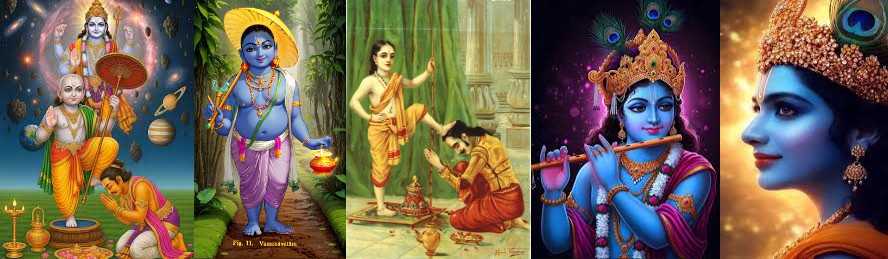
To make the Gopis’ exalted love known to the world—and to his own queens—Shree Krishna enacted a divine leela. One day, he began screaming with an unbearable headache. The queens rushed to find cures: herbal oils, ancient remedies, everything they knew. Nothing worked. When Narad Muni arrived, Shree Krishna, with divine cunning, said:
“Only one thing will help. If I can drink water mixed with the dust from the feet of one of my devotees, I will be cured.”
Shocked, Narad turned to the queens. But they refused.
“We cannot give our foot dust to God! That would send us to hell.”
Even Narad, despite being a celestial sage, hesitated. But when he arrived in Vrindavan and shared Shree Krishna’s agony, the Gopis didn’t think twice. They extended their feet and said:
“Take what you want. Even if we go to hell for eternity, it is worth it if Krishna’s headache goes away.”
Here lies the highest form of bhakti. They were not worried about their own salvation, their sins, or even the cosmic consequences. Their only thought was: “Can our Krishna feel better?”
This is the living embodiment of Bhagavad Gita:
“Abandon all varieties of dharma and just surrender unto Me alone. I shall deliver you from all sinful reactions; do not fear”.
The Gopis didn’t just renounce the world—they renounced heaven itself, just for Krishna’s smile.
“Shree Krishna’s feet blistered from Radha’s love, revealing a divine truth—He dwells where devotion is deepest.”
After the divine episode with the foot dust, Shree Krishna’s queens became more curious—and perhaps slightly insecure—about the Gopis. Despite their own beauty, refinement, and proximity to Shree Krishna, they began to sense that there was something more in the Gopis’ devotion, something they could not grasp. Why, they wondered, did our husband—God Himself—become so lost in the thought of these simple, illiterate cowherd girls? What made them so special?
In another significant event, the queens extended an invitation to Shree Radha and the Gopis to visit their royal camp. Despite the vast difference in lifestyle and social background, the Gopis accepted the invitation with grace. While the queens offered hospitality, a subtle condescension lingered in their hearts. In a careless moment, they offered scalding hot milk to Shree Radha without checking the temperature. Shree Radha, immersed in divine etiquette and selfless love, drank the milk without hesitation or complaint and returned to her camp quietly.
That night, as Rukmini massaged Shree Krishna’s feet, she was horrified to see blisters and boils forming on His divine soles. She asked, shaken, “My Lord, what happened to your feet?”
Krishna responded with a depth of emotion rarely seen from Him:
“You offered hot milk to Radha. But my feet always reside in her heart. So when her heart burned, my feet were scorched.”
This was no metaphor. It was the spiritual reality of divine intimacy. Shree Radha’s love was not poetic sentiment—it was so real, so embodied, so complete, that Shree Krishna literally lived in her heart. And anything that affected her body or mind, affected Him directly.
This intense oneness is echoed in Bhagavad Gita :
“Amongst these, I consider them to be the highest, who worship Me with knowledge, and are steadfastly and exclusively devoted to Me. I am very dear to them and they are very dear to Me.
It is this exclusive devotion that sets Radha and the Gopis apart—not their actions, words, or rituals, but their complete absorption in Shree Krishna.
The First Ratha Yatra: A Journey from Majesty to Simplicity:
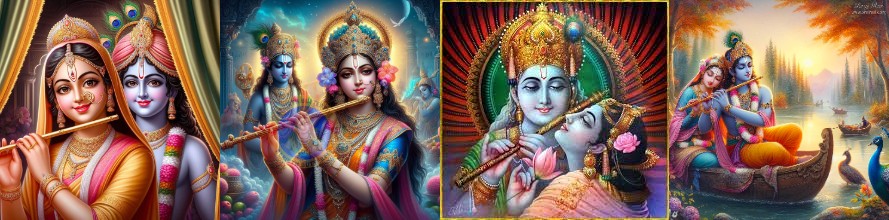
““Ratha Yatra is not just a journey—it’s love pulling God back into the heart of Braj.”
When in Kurukshetra, the Gopis pleaded to Shree Krishna. “You are the same Shyam Sundar,” they said, “and we are the same gopis—but the environment is different. Here, you are majestic, royal, formal. We miss the Shree Krishna who used to steal butter, who used to play the flute in the forests of Vrindavan. Please, come back to Braj with us.”
Shree Krishna, moved by their heartfelt appeal, agreed. The Gopis prepared a chariot, and Shree Krishna, along with Balaram and Subhadra, sat inside. As they began to pull the chariot toward Braj, Shree Krishna was overcome with such ecstasy, such overwhelming love, that He entered a state of Mahabhav Samadhi—a trance of divine union.
This, was the first Ratha Yatra.
Today, in Jagannath Puri, when Shree Krishna, Balaram, and Subhadra are placed on grand chariots and pulled through the streets by devotees, we are reenacting this divine moment. What began as a spontaneous outpouring of love in Vrindavan has become one of the most important festivals in the world.
The Gopis didn’t just bring Shree Krishna home—they pulled Him out of royalty and formality, and back into playfulness and intimacy. They reawakened in Him the joy of Braj, the simplicity of true love.
“When Krishna couldn’t understand Radha’s love, He became Chaitanya to feel it Himself.”
Despite being the Supreme Personality of Godhead, Shree Krishna found himself perplexed. The love of Shree Radha was so vast, so pure, that even He could not fully comprehend it. And so, He asked three divine questions—questions that would shape one of the most mysterious and profound chapters of Vedic history:

What is the nature of Shree Radha’s love for Me?
What is it in Me that attracts her so much?
What bliss does she experience in loving Me?
To find these answers, Shree Krishna realized He would have to do something unimaginable: become Shree Radha. Not just imitate her, but actually take on Shree Radha’s mood, her heart, her devotion, and experience Himself as she experiences Him.
This desire led to the appearance of Chaitanya Mahaprabhu—Shree Krishna, in the mood and sentiment of Shree Radha. He wept for Shree Krishna, sang Shree Krishna’s name, and danced in a madness of divine love. As Chaitanya, Shree Krishna tasted the sweetness of Shree Radha’s bhav, and through Him, the path of bhakti was made accessible to the world. ( to be continued)
A Story of Dwapar Yuga in Prose : ( part-10 A)