

The Telegraph of Courage
By Lokanath Mishra
The morning of January 15, 1932, rose quietly over Kendrapara, wrapped in winter mist and the slow rhythm of rural life, as if the world had decided to remain indifferent to the suffering of one child. Fourteen-year-old Sabita stood at the threshold of that indifference, her frail body draped in a worn saree, her eyes heavy with fear and yet burning with an unusual determination. Seven months pregnant, she carried not just a child within her, but the unbearable weight of betrayal. Her father had sold her to a man nearly four times her age—a bidi factory owner named Raghu Behera—and in that transaction, her childhood had been erased. The village had watched, some with sympathy, most with silence, because silence was safer than truth. But on that morning, Sabita had chosen to defy silence.

She had walked miles barefoot, her steps unsteady but unwavering, until she reached the small telegraph office—a modest building that few villagers truly understood, yet one that connected distant places with invisible threads of urgency. Inside, Dinabandhu Rath, a forty-year-old telegraph operator, sat at his desk, translating human words into coded signals that raced along wires across towns and districts. It was a routine day for him, filled with routine messages, until Sabita entered. He looked up, noticing immediately that something was wrong. There was desperation in her posture, urgency in her breath, and a trembling courage in her voice as she said, “Babu… I want to send a message.”
He gestured for her to continue, still unaware that the next few minutes would change not only her life but his own. Sabita began dictating, her voice faltering yet firm: “URGENT: 14 YEAR OLD GIRL 7 MONTHS PREGNANT SOLD BY FATHER TO 54 YEAR OLD MAN STOP NEEDS IMMEDIATE HELP STOP ADDRESS TO COMMISSIONER CUTTACK…” The words hung in the air, heavier than any message Dinabandhu had ever received. His fingers paused over the telegraph key as he looked at her again—not merely as a customer, but as a child in distress, standing alone against a system that had already failed her.

In that fleeting moment, Dinabandhu faced a choice. He could follow the rules, send the message to a single अधिकारी, and return to his routine, or he could act beyond protocol and risk everything. It was not a long decision. Something within him refused to let this message become just another entry in the ledger. He understood instinctively that if the message reached only one desk, it might be ignored, delayed, or buried. But if it reached many, it could not be silenced.
And so, without announcing his decision, he began transmitting the message—not once, but repeatedly. To the Commissioner in Cuttack, to the Superintendent of Police, to the Sub-Divisional Magistrate of Kendrapara, to newspaper offices, to reporters he knew by name. Twelve telegrams left the small office within fifteen minutes, each carrying the same desperate cry for help. The wires hummed as if awakened by urgency, carrying Sabita’s voice far beyond the limits of her village.
Sabita sat quietly on a wooden bench, unaware of what Dinabandhu had done. Time seemed suspended, the air thick with uncertainty. But then, something remarkable began to unfold. Within three hours, the stillness was broken by hurried footsteps and anxious voices. Three newspaper reporters arrived first, their faces marked by urgency. Soon after came a police sub-inspector with four constables, followed by a group of advocates. The small telegraph office transformed into a place of action, its walls witnessing a rare moment when society responded not with silence but with collective conscience.
One of the reporters turned to Dinabandhu and asked, “Who sent this message?” Dinabandhu stood up calmly, his voice steady as he replied, “This child came here desperate. I sent her story everywhere because one person might ignore it, but many cannot.” It was a simple statement, yet it carried the weight of truth that no one in that room could deny.
By the next morning, Sabita’s story had spread across the region. Newspapers carried it on their front pages, their bold headlines exposing the cruelty that had been hidden in plain sight. Public outrage grew rapidly, and with it came pressure—pressure that the authorities could not ignore. The police acted swiftly, arresting Raghu Behera from his bidi factory, where his power and wealth had once shielded him from scrutiny. Sabita’s father, too, was taken into custody, his actions now condemned not just by law but by society.
The case moved with an urgency rarely seen. What might have taken months was completed in weeks. The courtroom, often burdened by delays, became a space where justice moved decisively. Within a month, the verdict was delivered. Conviction. No bail. No escape. It was not merely a legal victory; it was a moral one—a rare instance where the system responded as it should.
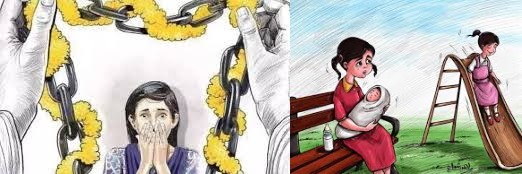
For Sabita, however, the journey did not end with the verdict. It was only the beginning of a long path toward reclaiming her life. The scars of her past did not vanish, but they did not define her either. With resilience and determination, she began to rebuild herself, step by step. In time, she came to be known as Laxmi Bai, a name that reflected her inner strength and quiet dignity. She pursued education with a determination that surprised many, refusing to let her circumstances dictate her future. Her efforts bore fruit when she was appointed as a teacher in a Lower Primary Government School.
In the classroom, she found not just a profession but a purpose. Surrounded by children, she saw reflections of the innocence that had once been taken from her, and she resolved to protect it in others. She taught them letters and numbers, but more importantly, she taught them courage—the courage to speak, to question, and to stand against injustice. Her life became a living lesson, one that her students would carry far beyond the classroom.
Years passed, and decades unfolded, bringing with them change and progress. The telegraph system that had once carried her cry for help eventually faded into history, replaced by newer technologies. But the memory of that day remained alive within her. She lived a long life, reaching the age of ninety, and before her passing in 2008, she reflected on the moment that had changed everything.
“I walked into a telegraph office at fourteen, seven months pregnant, and dictated one desperate message,” she said. “The operator sent it to several places—newspapers, police… Within three hours, people were arriving to help me. By next day my story was everywhere, and my husband was arrested.” Her voice carried both gratitude and wonder as she continued, “One telegram operator decided one message to several people was better than one message to one person. That decision saved me. Telegraph wires carried my cry for help across an entire state in thirty minutes.”
Dinabandhu Rath never considered himself extraordinary. He continued his work quietly, as he always had, yet his actions did not go unnoticed. He received commendations from various organizations, his decision praised as a “creative use of emergency communications to protect a child.” But beyond the recognition, his true legacy lay in the life he helped save and the example he set.
The telegraph wires may have fallen silent, but the story they once carried continues to resonate. It is a story of courage found in the most unlikely of places—a frightened girl who refused to remain silent and an ordinary man who chose to listen and act. Together, they proved that even in a world accustomed to indifference, a single decision can ignite change, and a single voice, when amplified, can travel farther than anyone could ever imagine.