
The Sun God
By Lokanath Mishra
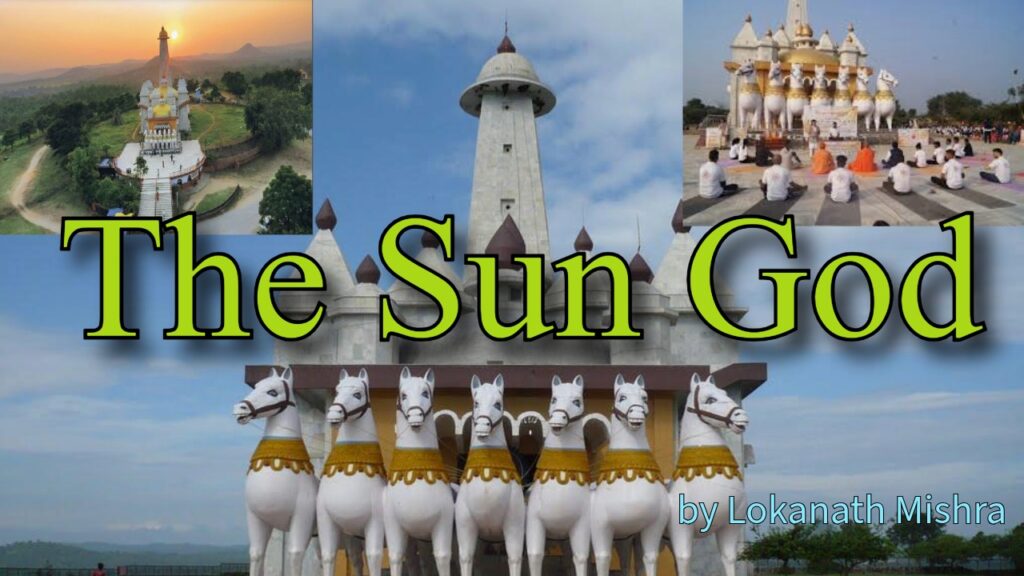
Before discussing the spiritual significance of the Sun God, it is meaningful to remember a remarkable temple dedicated to him near Ranchi in Jharkhand. The temple stands as a modern expression of India’s ancient tradition of Surya worship and reflects the continuity of this sacred heritage.

The Surya Temple, Ranchi is located near Bundu on the Ranchi–Tata road, about 40 kilometres from the city of Ranchi. Built on a small hill, the temple complex has become one of the important pilgrimage and tourist sites of Jharkhand. The shrine is dedicated to the solar deity Surya, and its architecture symbolically represents the cosmic chariot of the Sun. 
The temple was constructed in the early 1990s by the charitable organization Sanskriti Vihar under the leadership of Sita Ram Maroo, associated with the Ranchi Express group. The foundation stone of the temple was laid on 24 October 1991 by Swami Vasudevanand Saraswati, and the sacred consecration ceremony (Prana Pratishtha) was completed on 10 July 1994 by Swami Vamdev Ji Maharaj. 
One of the most striking features of this temple is its architectural design. The entire structure is fashioned like a gigantic stone chariot, inspired by the ancient tradition of Sun temples in India. The chariot has eighteen beautifully carved wheels and is drawn by seven life-like horses, symbolizing the seven colours of light and the seven days of the week. This imagery reflects the eternal journey of the Sun across the sky, a concept deeply rooted in Hindu cosmology. 
Within the temple complex there are shrines dedicated not only to Surya but also to other Hindu deities such as Shiva, Parvati, and Ganesha. A large sacred pond lies beside the temple where devotees perform rituals, especially during the festival of Chhath Puja, when thousands of worshippers gather to offer arghya (water offerings) to the rising and setting sun. 

Over the years, the temple has become a major centre of devotion for people from Jharkhand and neighbouring states. Pilgrims visit the shrine particularly during solar festivals and traditional celebrations such as Chhath and the Tusu festival. A dharmashala and other facilities have also been built to accommodate devotees and travellers visiting the temple. 
Though relatively modern compared to ancient Sun temples like the Konark Sun Temple in Odisha, the Surya Temple near Ranchi represents the revival of solar worship in contemporary India. Its architecture echoes the same spiritual symbolism that inspired earlier temples — the Sun as the eternal charioteer of time, guiding the universe with light and energy.
This sacred shrine reminds devotees that the reverence for the Sun has never faded from Indian spiritual consciousness. Even in the modern era, temples like this continue to preserve the ancient tradition of honoring the cosmic source of life, the radiant deity known as Surya.
In the vast spiritual vision of Hindu philosophy, the Sun is not merely a luminous celestial body but a living manifestation of divine consciousness. This sacred presence is known as Surya, the radiant lord who illuminates the universe and sustains all life on Earth. From the earliest Vedic hymns to the epics and temple traditions of India, Surya has been revered as the visible form of the divine — the god whom every human being can witness each day without the need for temples or rituals.
Surya symbolizes light, truth, knowledge, and vitality. Just as the rising sun dispels darkness from the world, Surya represents the removal of ignorance from the human mind. The sages of ancient India saw the Sun not simply as a physical star but as the cosmic eye that watches over the universe. In many sacred texts, Surya is described as the “eye of the universe,” the witness of all actions and the giver of life energy. Without the Sun, there would be no warmth, no crops, no rivers, and no life. Thus Surya became a natural symbol of divine grace and universal nourishment.
In the spiritual traditions of Hinduism, Surya holds a unique place because he is both visible and transcendent. Many deities are worshipped through symbols, idols, or sacred stories, but Surya is the one deity who can be directly seen by every person every day. For this reason, ancient sages regarded him as a bridge between the material world and the spiritual reality of Brahman, the supreme cosmic truth. In the Smarta tradition of Hindu worship, Surya is one of the five principal deities honored in the sacred practice of Panchayatana Puja, where he is worshipped alongside Shiva, Vishnu, Devi, and Ganesha as different manifestations of the same ultimate reality.
The Vedic scriptures speak of Surya with profound reverence. In the hymns of the Rigveda, Surya is praised as the dispeller of darkness and the awakener of consciousness. The rising sun was seen as the symbol of awakening not only for the world but also for the human soul. As the sun rises each morning, it reminds humanity of renewal, hope, and the possibility of spiritual awakening. The Vedic seers believed that Surya inspires wisdom and moral clarity, guiding people toward righteous living.
The sacred Gayatri Mantra, one of the most revered prayers in Hinduism, is directed to the solar divinity. Through this mantra, devotees meditate upon the divine light of the Sun and pray that it illuminates their intellect. The prayer reflects the ancient understanding that the Sun’s physical light is also symbolic of spiritual illumination.
Surya is often depicted riding a magnificent chariot drawn by seven horses, driven by his charioteer Aruna. These seven horses represent multiple layers of symbolism. They are said to signify the seven colours of light that compose sunlight, the seven days of the week, and even the seven levels of consciousness described in yogic philosophy. The movement of the chariot across the sky represents the passage of time and the continuous rhythm of cosmic order.
In Hindu cosmology, Surya belongs to the divine lineage of the Adityas, the celestial sons of sage Kashyapa and Aditi. He is also the central figure among the Navagraha, the nine cosmic influences that govern planetary energies in Vedic astrology. Among these, Surya is regarded as the king, representing authority, vitality, and the soul itself.
Many important figures of Hindu epics are connected to Surya. In the great epic Mahabharata, the heroic warrior Karna is believed to be the son of Surya. Karna inherited his father’s brilliance, generosity, and unwavering courage. Similarly, in the epic Ramayana, the mighty vanara king Sugriva is also described as a son of the Sun god. These connections symbolize the divine qualities of strength, righteousness, and illumination that Surya bestows upon his devotees.
Surya worship has been deeply rooted in Indian culture for thousands of years. Numerous festivals celebrate the life-giving power of the Sun. Among them are Makar Sankranti, Chhath Puja, Ratha Saptami, and Samba Dashami, especially revered in the region of Odisha. During these festivals, devotees offer water, prayers, and gratitude to the rising or setting Sun, expressing humility toward the cosmic force that sustains existence.
Historically, Surya worship once flourished across India with magnificent temples dedicated to the Sun god. One of the most remarkable examples is the Konark Sun Temple in Odisha, an architectural masterpiece that symbolizes the Sun’s celestial chariot. Built in the 13th century, the temple stands as a testament to the profound devotion that ancient Indian civilization held for Surya. Its grand stone wheels, horses, and carvings illustrate the cosmic journey of the Sun across the heavens.
Over time, the independent worship of Surya gradually declined as devotional traditions centered more prominently on Vishnu and Shiva. Yet Surya never disappeared from Hindu spiritual life. Instead, he became integrated into broader forms of worship and daily rituals. Even today, millions of Hindus greet the rising sun with folded hands, offering water in a ritual known as Arghya. Yogic practices such as Surya Namaskar also express reverence for the Sun through physical movement and spiritual mindfulness.
Beyond mythology and ritual, Surya represents a deeper philosophical truth. The Sun shines equally upon all beings without discrimination. It does not ask who is rich or poor, powerful or humble. Its light is universal, reminding humanity of the spiritual principle that the divine presence exists in all life. In this sense, Surya becomes a symbol of selfless giving and cosmic harmony.
The ancient sages often meditated upon the Sun not merely as a distant deity but as the inner light of consciousness within the human soul. Just as the external Sun illuminates the world, the inner Surya — the light of awareness — illuminates the mind and reveals truth. When ignorance fades and wisdom arises, it is said that the Sun of knowledge has risen within.
Thus, Surya stands as one of the most profound symbols in Hindu spirituality: the visible form of divine light, the eternal witness of human life, and the source of vitality that nourishes the universe. Each sunrise becomes a silent spiritual message — that darkness is temporary, that light will always return, and that the divine presence continues to shine over the world with unwavering brilliance.