
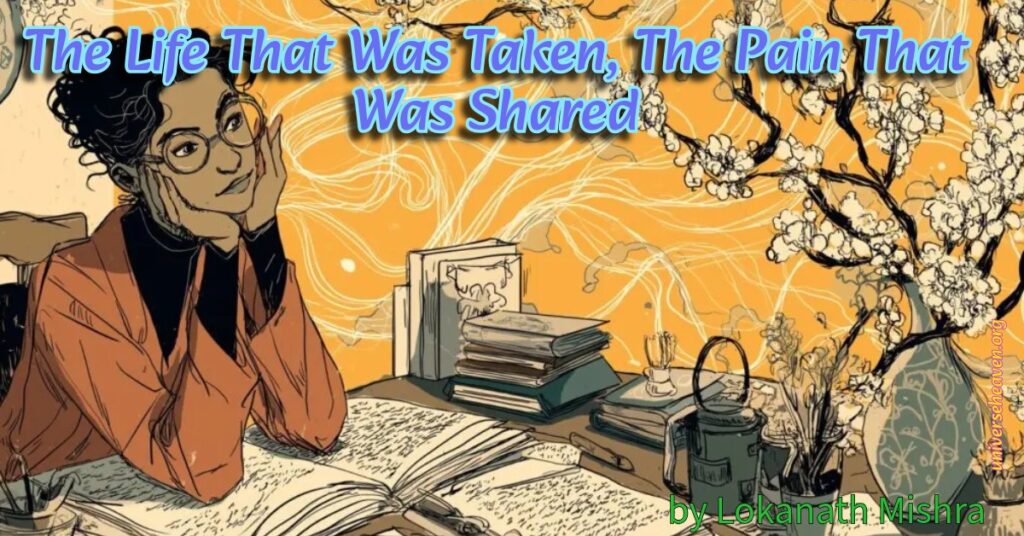
The Life That Was Taken, The Pain That Was Shared
By Lokanath Mishra
At nineteen, Ayesha Verma believed life could be drawn with a pencil.
Not perfectly, of course—there would be mistakes, erasures, maybe even coffee stains—but still, it would be hers. She was in her first year of graduation in Delhi, studying architecture, sketching buildings that had more freedom than she did. Her notebooks were full of lines that knew where they were going.

Unlike her life.
Rohan used to joke, “One day you’ll design a house so beautiful that I’ll refuse to leave.”
“And who said you’ll be invited?” she would reply, pretending to be offended.
He would grin. “I’ll be the unpaid watchman. Love doesn’t need salary.”
Back then, that sounded romantic.
Later, it would sound like prophecy.
Because some lives are not drawn.
They are overwritten.
Vikram Sethi didn’t enter Ayesha’s life like a person. He entered like a decision already made.
Her parents didn’t ask her. They informed her—with the kind of gentle firmness that feels like love but acts like authority.
“He is powerful.”
“He can give you everything.”
“He has chosen you.”
Chosen.
As if she were a saree in a showroom.
Rohan disappeared from her life not with drama, but with buffering silence. His calls stopped connecting. Messages remained unsent. Even his memories began to feel like something she had imagined.
Ayesha was married before she fully understood she had agreed.
Mumbai welcomed her with lights so bright they hid everything.
Her studies stopped. Her sketches gathered dust. In their place came a new syllabus:

How to smile without meaning it.
How to speak without saying anything.
How to sit like you belong somewhere you don’t.
A stylist once told her, “You must carry elegance like it is natural.”
Ayesha wanted to ask, What if it isn’t?
But she had already learned—the wrong questions don’t get answered. They get erased.
The wedding was a spectacle.
Guests whispered, “Fairy tale.”
Ayesha thought, Even fairy tales have witches.
Marriage to Vikram was like living inside a well-designed cage.
Everything was perfect.
Nothing was hers.
He wasn’t loud. He wasn’t cruel in ways people could point at. He was worse—he was efficient. Emotions were unnecessary. Presence was optional. Control was constant.
And then came the rumors.
At first, they were whispers.
Then confirmations.
Then inevitabilities.
Vikram didn’t just have affairs. He collected them—like trophies, like investments, like hobbies he never needed to hide.
Once, at a party, a woman smiled at Ayesha and said, “You’re very strong.”
Ayesha smiled back and thought, No, I’m just very silent.
Then came Meera.
A small, warm, breathing rebellion.
For the first time, Ayesha felt something that wasn’t instructed. Not taught. Not approved.
Real.
She held her daughter and whispered, “You will belong to yourself.”
The nanny coughed politely behind her. “Madam, feeding time is scheduled.”
Even motherhood had a timetable.
And just when she began to believe she could survive this life, it collapsed.
Scandal.
Fraud.
Headlines.
Friends vanished faster than truth.
Vikram grew colder—if that was even possible. Eventually, he left emotionally, then legally.
The divorce was swift.
The custody battle was swifter.
Money, influence, lawyers—everything moved faster than her voice.
Meera stayed with him.
Ayesha left with silence.
At twenty-three, she returned to Delhi with a suitcase and a past nobody wanted to hear.
She rejoined college.
Sat in classrooms with students younger than her, louder than her, freer than her.
A professor once asked, “Why architecture?”
She replied, “Because buildings don’t pretend to love you.”
The class laughed.
The professor didn’t.
But life, as it turns out, has a strange sense of humor.
Because just when Ayesha thought tragedy had finished its work, it sent in comedy—with a twist.
His name was Rameswar.
A security guard.
Not a philosopher. Not a poet. Not even particularly talkative.
But he had one dangerous quality.
He listened.
“Madam, gate band kar doon?” he would ask.
“Do whatever you want,” she would reply.
He would smile, “First time someone told me that.”
Slowly, casually, unexpectedly—they began talking.
No promises. No plans.
Just two people sharing the kind of honesty that doesn’t require permission.
If Rohan was her past, Rameswar was something stranger—
Her present.
Naturally, it didn’t last.
Because families have a special talent: they appear exactly when peace begins.
“You must remarry.”
“This time, properly.”
“Someone stable.”
“Someone respectable.”
Respectable, it turned out, meant older, richer, and equally uninterested in her as a person.
Bhabesh.
Another well-designed cage.
Rameswar didn’t argue.
He simply left.
Not dramatically.
Just… disappeared.
Years later, in Delhi, on a strangely ordinary afternoon, Ayesha found herself in a clinic.
Her cousin Neha was in labor.
Her husband Arjun stood beside her, trying to look brave and succeeding only partially.
The doctor entered.
Or rather—floated.
Because he looked less like a doctor and more like a sadhu who had accidentally walked into the wrong profession.
Beard. Calm eyes. Suspiciously peaceful expression.
“Delivery will be difficult,” he said.
Then he smiled.
Which made everyone uncomfortable.
“But there is a solution.”
The machine looked like something assembled during a power cut.
Wires. Buttons. Confidence without evidence.
“It transfers pain,” the doctor explained, “from mother to father.”
Arjun said, “Done.”
Neha said, “Double done.”
Ayesha said nothing.
Because life had already taught her—when something sounds too convenient, it usually is.
The machine started.
10%.
“How do you feel?” the doctor asked.
“Like I skipped leg day,” Arjun said.
20%.
“Still okay.”
40%.
“I think I can see my ancestors.”
60%.
“Tell them I said hello.”
80%.
Silence.
100%.
Arjun smiled weakly. “Is there… a 200% option? Let’s finish this.”
The doctor stared.
Ayesha stared.
Reality itself seemed to pause.
Neha delivered the baby almost painlessly.
A perfect cry filled the room.
Life had arrived.
And somehow, pain had… disappeared.
Or had it?
That evening, everyone returned home.
Joy. Relief. Laughter.
Someone even joked, “Arjun should be admitted to medical textbooks.”
They reached the gate.
A crowd had gathered.
Someone whispered, “Something happened.”
There, on the ground—
Rameswar.
Still.
Silent.
Gone.
Ayesha didn’t scream.
Didn’t cry.
Didn’t move.
Because somewhere, deep inside, something had already connected.
The machine.
The flaw.
The amplification.
The transfer.
The unanswered question:
Where does pain go when it leaves?
The next morning, Neha cried.
Arjun remained confused.
The doctor was nowhere to be found.
Of course.
Men who look like answers rarely stay for questions.
Ayesha stood alone, watching the empty gate.
And for the first time, her life made a terrible kind of sense.
When her choices were taken—someone else paid.
When her voice was silenced—someone else carried the weight.
When pain was transferred—someone else received it.
She whispered, not to anyone present, but to everything absent:
“Nothing disappears.”
“Not love.”
“Not pain.”
“Not people.”
“They just… change places.”
And somewhere, in a life that could have been hers, a boy named Rohan still waited in a house that was never built.
A guard named Rameswar still smiled at a gate that no longer existed.
And Ayesha—
She finally understood the one thing no one had ever taught her:
You can redesign a life.
You can silence a voice.
You can transfer pain.
But you can never control
where it ends up.
Yes 🙏