
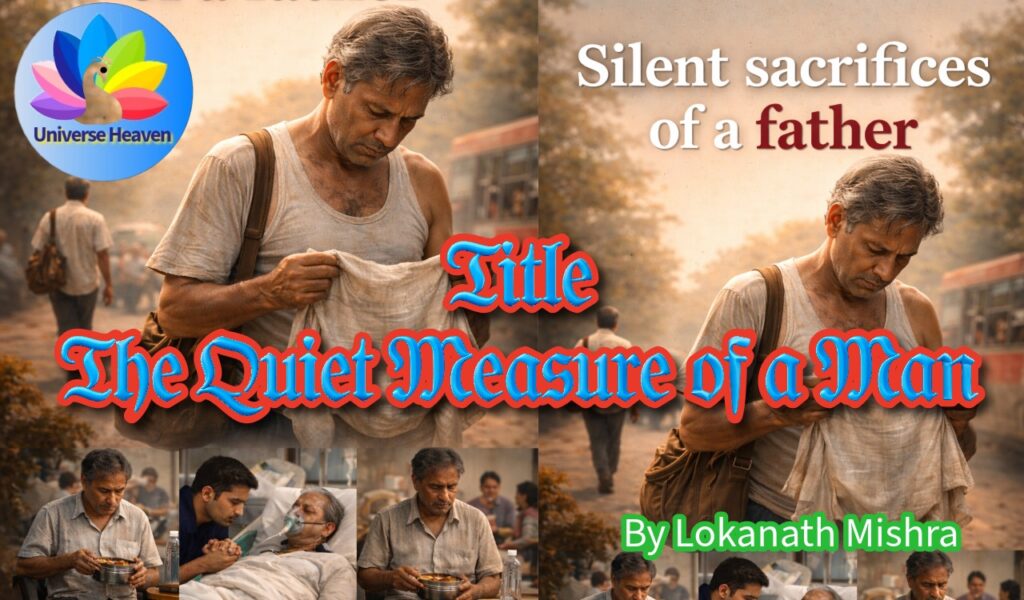
Title : The Quiet Measure of a Man
By Lokanath Mishra
The vest hung loosely on his shoulders, its once-white cotton dulled into the color of old mornings. Time had washed it thin, softened its seams, erased the sharpness it once had—much like the man who wore it. He tugged at the hem and smoothed it down, performing a small ritual of reassurance, as though neatness could disguise age, as though care could delay decay.
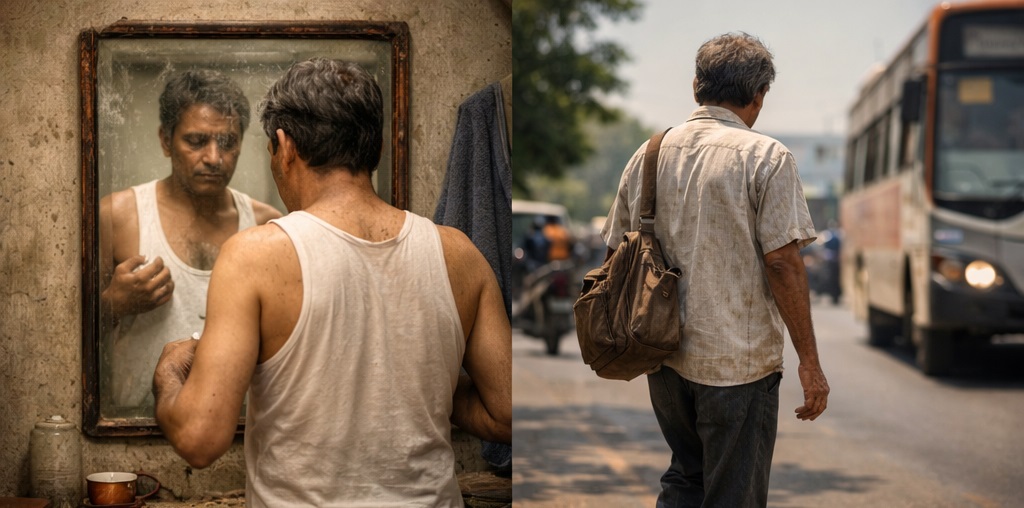
He stood before the mirror longer than usual that morning. The mirror did not flatter him, but it did not accuse him either. It simply reflected a man who had learned the art of adjustment.
“Don’t buy a new one yet,” he said lightly to his wife while slipping his arms into the vest. His tone was playful, but behind it lay the practiced calm of someone who had rehearsed sacrifice so often that it had become second nature. “This one will last two more months.”
His wife nodded from the kitchen, her eyes fixed on the bubbling pot of lentils. The aroma of cumin and garlic filled the air, masking the faint tremor in his voice. He picked up his old leather bag—its handle cracked, its zipper unreliable—and stepped out, closing the door carefully, as if even noise was an expense he could not afford.
From the next room, their son had heard everything.
The boy burst into the kitchen, helmet tucked under his arm, anger radiating from him like heat from asphalt.
“What is this drama going on in the house, Mummy?” he snapped. “You bought a ₹2,000 saree last week, but you couldn’t even get Dad a ₹100 vest?”
The ladle froze midair. His mother turned sharply, metal clanging against metal.
“That’s because your father doesn’t want anything new!” she replied, her voice rising. “And why is my saree bothering you? I bought it with my husband’s own earnings. A new dress came for you too, and one for your sister. You burn ₹100 worth of petrol on your bike every day just for fun, but I never question that.”
Years of unspoken defenses poured out of her. “If your father’s desires have died, if he’s happy with old things, what are we supposed to do? Stop living? Wear rags?”
The daughter glanced up from her phone, barely interested. “Dad is old now, Mummy. Let him do whatever he wants. Why should we change our lives for that?”
The room fell into a familiar silence—the kind that comes not from resolution, but from indifference. The pressure cooker whistled. The television resumed its chatter. The phone screen glowed again.
Life moved on.
Outside, the father walked toward the bus stand and then past it, as he did every day. Three kilometers. Twenty rupees saved. Over a month, six hundred. Over a year, enough to buy books, shoes, exam forms—things that mattered more than his comfort.
The sun climbed slowly, warming the pavement beneath his worn sandals. His knees ached, but pain had become another background noise in his life, like traffic horns or ceiling fans. He remembered a time when he, too, had ridden a bike without reason, bought shirts without calculation, dreamed without accounting.
That man had not disappeared. He had simply been divided—split into EMIs, school fees, grocery lists, medical bills, and quiet prayers whispered before sleep.
At work, he smiled easily. When colleagues complained about salaries, he nodded. When someone asked how he managed, he said, “Adjustment.” It was his favorite word. Flexible. Harmless. Invisible.
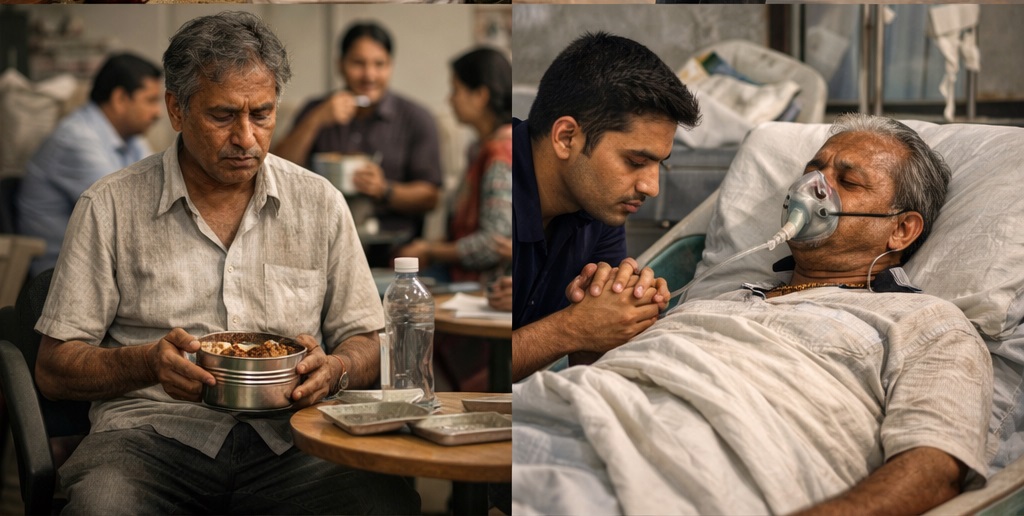
During tea breaks, he often skipped the cup. Ten rupees saved. He told himself he preferred water anyway.
At home, he was the easiest man to ignore. He never demanded. Never complained. Never compared.
When his son asked for a new helmet, he smiled and transferred the money.
When his daughter wanted a better phone, he said, “Of course.”
When his wife admired a saree in a shop window, he said, “It suits you.”
His happiness had become reactive—it existed only in response to others’ desires. Slowly, imperceptibly, his own wants shrank until they fit neatly into nothing.
At night, when the house slept, he sometimes opened his phone and checked the EMI reminders. He calculated silently, adjusting future months like puzzle pieces. Somewhere between numbers, his eyelids drooped.
He slept with the peace of a man who believed suffering quietly was a form of love.
One evening, the father did not return on time.
The family waited, irritation building before concern. Calls went unanswered. The television volume lowered. Silence grew heavy.
When he finally arrived, supported by a neighbor, his face was pale, his steps unsteady. Exhaustion had finally spoken in the language of collapse.
At the hospital, the doctor said gently, “He’s not sick. He’s tired. Overworked. Undernourished. Emotionally strained.”
The words landed like stones.
That night, as he slept on the hospital bed, his son noticed the vest folded neatly in the bag—frayed, thin, faithful. For the first time, he saw it not as old cloth, but as evidence.
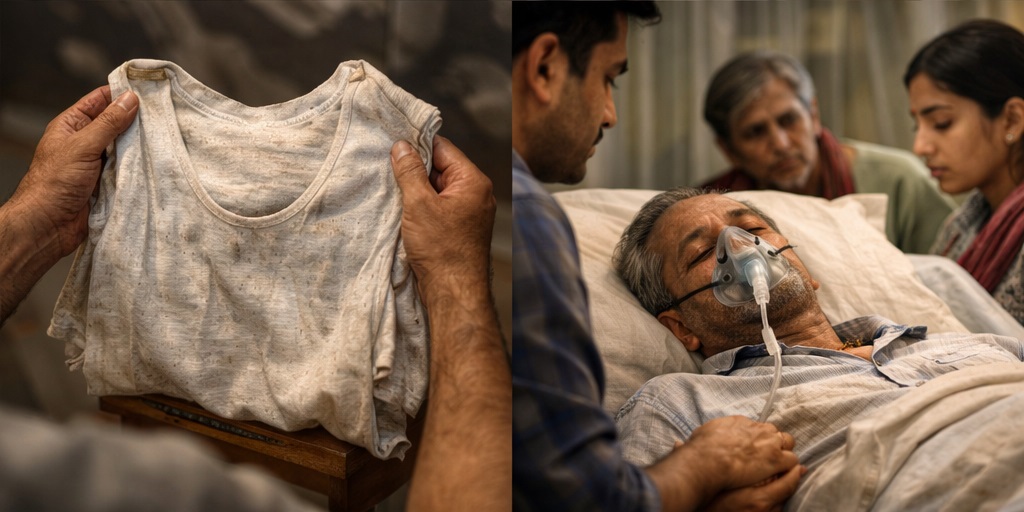
Evidence of love unnoticed.
Sacrifice unacknowledged.
A life poured out quietly.
The realization did not come all at once. It came slowly, painfully, like dawn after a long night.
They remembered how his hair had turned grey almost overnight. How his shoulders had sloped. How he never bought anything for himself. How “adjustment” had been his answer to everything.
When he woke, his son held his hand. His daughter put away her phone. His wife looked at him as if seeing him again after many years.
No one apologized loudly. They didn’t need to. Silence, this time, was reverent.
A man’s greatness is not measured by what he accumulates, but by what he gives up without resentment.
The father never preached sacrifice. He lived it. He believed that love was not loud, that duty was sacred, and that God resided quietly in responsibility fulfilled without complaint.
In many traditions, it is said that true spirituality is not found in temples or scriptures alone, but in selfless action—karma without expectation. The father had practiced this unknowingly. Each step he walked, each desire he buried, each smile he offered was a prayer in motion.
The tragedy was not that he sacrificed.
The tragedy was that no one noticed—until the cost became visible.
And perhaps that is the message this life leaves behind:
Honor silent sacrifices while they are still breathing.
Gratitude delayed is gratitude denied.
And love, when unacknowledged, does not disappear—it simply waits, hoping to be seen.
Because some heroes do not fight battles or make speeches.
They wear old vests, walk long roads, and give their entire lives quietly—
so others may live loudly.
ll ପୁଷ୍ୟାଭିଷେକ ନୀତି ପାଇଁ ମହାପ୍ରଭୁଙ୍କ ଜଳ ଅଧିବାସ ll
The Weight of Silence