
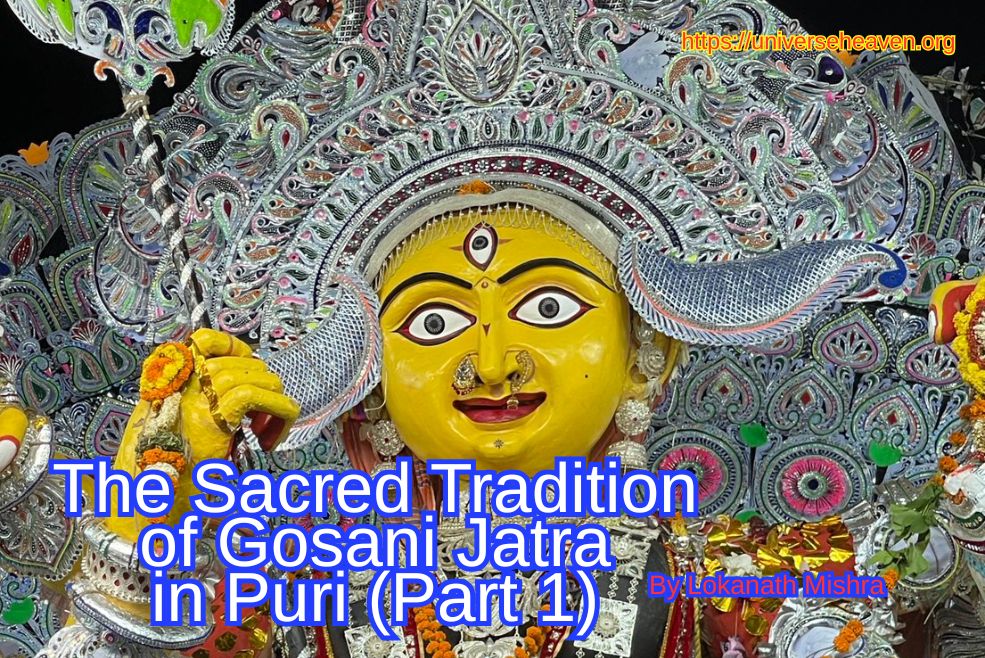
The Sacred Tradition of Gosani Jatra in Puri (Part 1)
By Lokanath Mishra
A Unique Form of Durga Worship in the Land of Lord Jagannath :
The sacred city Shreekhetra ( Puri) is revered across the world as the eternal abode of Lord Jagannath, the Lord of the Universe. Yet alongside the radiant Vaishnava culture of Jagannath, the land has also nurtured rich traditions of Shakti Aradhana (worship of the Divine Mother). In particular, during Sharadiya Navaratri, the worship of Goddess Durga here takes on a form unlike any other region of India. This distinctive celebration is known as Gosani Jatra.

In this tradition, clay idols of Goddess Durga — locally called Gosanis — are worshipped in different sahis (localities) of Puri during the nine days of Navaratri. These Gosanis are believed to be Yoginis and companions of the Divine Mother, who, after the slaying of Mahishasura, took their place in various sacred corners of Puri to eternally guard Shreekhetra. Each Gosani embodies a unique manifestation of the Goddess — fierce yet compassionate, terrifying yet protective — reflecting the many dimensions of Shakti.
The Gosani Jatra culminates on Ekadashi, the day following Vijaya Dashami (Dussehra). On this day, the idols of all the Gosanis are ceremonially brought to the Grand Road (Bada Danda), near the Lion Gate of Jagannath Temple or at Shardhabali. This coming together of the Mother’s many forms into a single divine assembly is itself a sight of supreme spiritual grandeur. Thousands of devotees throng the Bada Danda to have darshan of all Gosanis at once — an experience believed to cleanse karmic impurities and bestow the blessings of all aspects of Shakti simultaneously.
As midnight descends, the Gosanis are carried in grand procession, with music, drums, conches, and chants of “Jay Maa, Jay Jagannath”. Finally, they are immersed at the sacred Musa Nadi, symbolizing the Mother’s return to the cosmic waters — the eternal source from which creation itself emerges.

Unique Features of Gosani Jatra
Unlike Bengal’s Durga Puja or Cuttack’s Silver Filigree traditions, Puri’s Gosani Jatra reflects a deeply local, spiritual, and artistic character:
• Duration of worship: While Durga Puja generally concludes on Navami or Dashami, the Gosanis are worshipped from Saptami till Ekadashi.
• Distinctive idols: The clay images of the Gosanis are sculpted with unusual artistic imagination — sometimes fierce, sometimes motherly, always unique. Their forms are infused with local legends, folk symbolism, and ancient ritual traditions.
• Integration with Jagannath culture: Even Lord Jagannath acknowledges their presence. On specific days, betel nuts, cloth (khandua), and prasada from the temple are ceremonially sent to selected Gosanis, symbolizing a divine recognition of Shakti within the Vaishnava fold.
• Folk Performances: Alongside the Gosani idols, various folk traditions are displayed — Statues of Nāga medha and Sampati with Banara Sena (depiction of Jatayu’s brother with monkey warriors), and the playful Budha-Budhi dance, performed with large caricature masks, which draw laughter and joy. These elements add a communal and celebratory spirit, blending sacred devotion with local creativity.
Historically, this tradition is said to have flourished during the reign of Gajapati Prataprudra Deva (15th–16th century), during Bhakti era when the cult of Jagannath and Shakti were harmoniously integrated under royal patronage. Since then, each sahi of Puri has carried forward the legacy of their own Gosani with deep devotion.
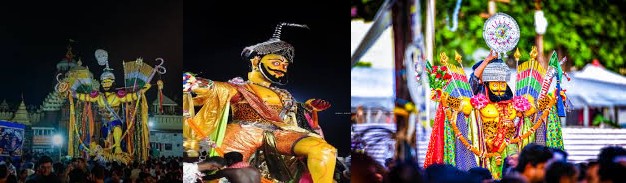
Some Prominent Gosanis of Puri
Though there are many Gosanis across the sahis of Puri, a few are considered especially significant, each with her unique form, worship style, and spiritual meaning:
- Maa Kakudikhai Gosani
Maa Kakudikhai is regarded as the representative manifestation of Maa Bimala, the primordial Shakti of the Jagannath Temple, without whose consent even Lord Jagannath does not accept bhoga.
Her shrine is located near the Meghanada Pacheri close to previous Bania Pati, attached to the sacred walls of previous Emar Math.
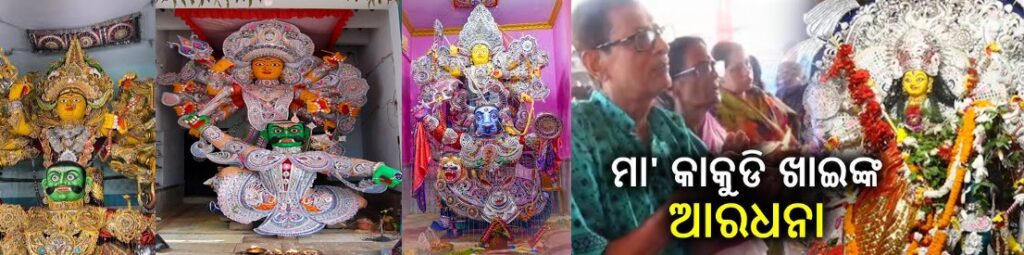
During Durga Puja, she is worshipped as Mahishasura Mardini. Her idol is extraordinary: Mahishasura is shown in hybrid form — half-human, half-buffalo — symbolizing the dual nature of ignorance and ego. The Goddess, fierce and luminous, pierces him with her trident. The severed buffalo head beneath her feet reminds devotees that tamas (darkness) can be overcome only through the light of divine wisdom.
The idol, adorned with sola (shola pith) ornaments, silver jewelry, and dazzling decorations, radiates power and compassion. On Ashtami night, a Gupta Niti (secret ritual), similar to the worship of Maa Bimala in the temple, is performed — reminding us of her intimate connection with Jagannath’s innermost rituals.
Her affectionate name has a charming legend: once, a cucumber (kakudi) offered as bhoga was found partly eaten, with marks on the Goddess’s lips. From that day, she came to be known as Kakudikhai — “the Mother who relishes cucumber,” showing that the Divine accepts even the simplest offering of love.
Traditionally, her immersion (bisharjan) took place at Musa Nadi on Dashami night .
- Barabati Gosani
Located at the Barabati jega this Gosani is one of the most awe-inspiring deities of Puri. Her pandal rises nearly 30 feet high, with the idol itself towering about 22 feet. She represents valour, invincibility, and the victory of dharma.
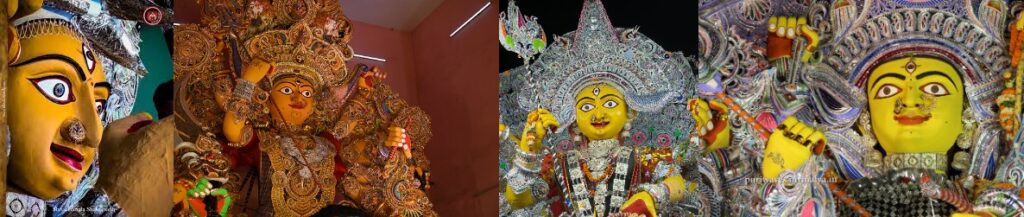
Her divine form is magnificent: standing astride her lion, with one foot pressing Mahishasura and the other firmly rooted in strength, she holds ten weapons — trident, sword, bow, chakra, conch, mace, thunderbolt, and more. These symbolize that the Mother is not just a protector but also the wielder of every cosmic force.
Her silver ornaments, tarakasi crown (Cuttack filigree work), and vibrant pattachitra colors (red cinnabar, yellow harital, and white from conch shell) make her radiate otherworldly brilliance.
The demon at her feet, with protruding tongue and terrified gaze, is a stark reminder that adharma, however mighty, must fall before divine truth.
Barabati Gosani is worshipped from Saptami to Navami. Importantly, Lord Jagannath’s ritual betel is ceremonially sent to her — a gesture that shows Jagannath himself acknowledges her divine presence in Shreekhetra.
- Jahnikhai Gosani
At Dolamandap Sahi, Jahnikhai Gosani is worshipped in a distinct form where the demon is not Mahishasura but Tarakasura. The Goddess, adorned with silver ornaments, sola work, and fiery eyes, presses her foot upon the demon’s shoulder, effortlessly subduing his might.
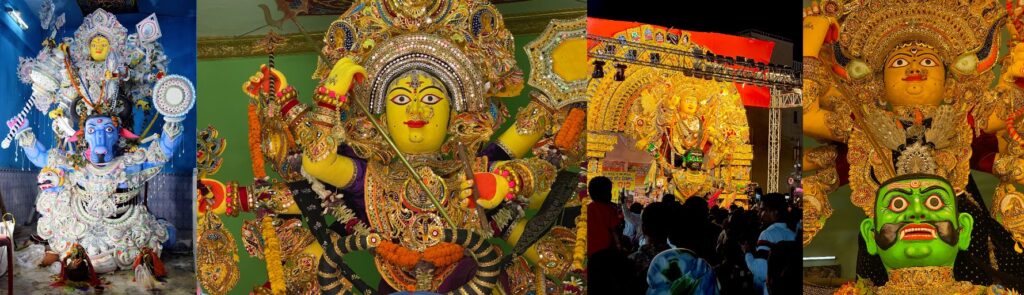
Here the demon represents arrogance and spiritual ignorance, trembling before Devi’s light.
Unlike other Gosanis, Jahnikhai does not receive animal sacrifice. She is worshipped purely as Parama Vaishnavi, with Vana Durga mantras. Instead of blood, water offerings (jahnibhali) are made, hence the name Jahnikhai — “she who receives water.” This unique form beautifully demonstrates the blending of Vaishnava and Shakta traditions in Puri.
- Shunya Gosani
At Matimandap Sahi, near the Harachandi temple, stands the striking idol of Shunya Gosani. Unlike most Durga idols which are grounded, she is depicted as floating in the sky, battling the demon Aditya.
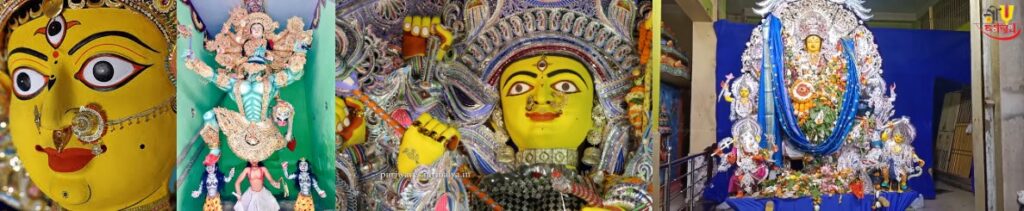
Her form, with eight arms, flanked by Chandi and Chamunda, represents the formless, boundless aspect of Shakti — Shunya (Void), the cosmic womb from which creation emerges and into which it dissolves.
Offerings to her include roasted fish, symbolically made to her attendants rather than to the Mother herself, signifying that the Goddess transcends worldly needs.
Shunya Gosani embodies the truth that the Divine Mother is both form and formless, manifest and unmanifest.
- Kantakadhi Gosani
In Manikarnika Sahi, Kantakadhi Gosani presents one of the most spiritually profound images: Lord Vishnu himself is shown removing a thorn from the foot of Goddess Durga, while Lord Shiva stands by.
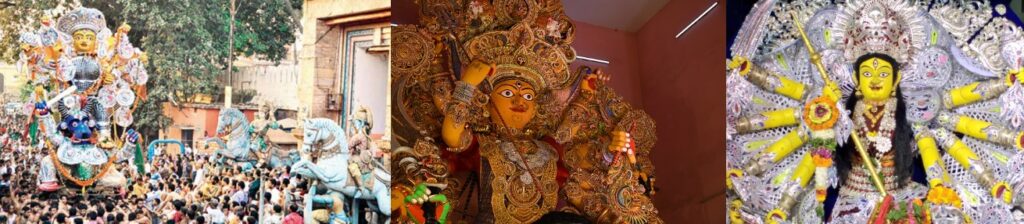
This imagery symbolizes that even the highest deities — Vishnu and Shiva — serve Shakti, for she is the source of their powers. It is a reminder that Shakti is supreme, the substratum of all existence.
Locals also know her as Vana Durga, believed to be returning from a forest journey. Philosophically, she represents the eternal union of Shaiva, Shakta, and Vaishnava traditions that harmoniously coexist in Puri.
Spiritual Significance of Gosani Jatra
The Gosani Jatra of Puri is far more than a folk festival. It is a sacred synthesis of traditions:
• Unity of Faiths: Shaiva, Shakta, and Vaishnava elements merge seamlessly, proving that the Divine Mother and Lord Jagannath are not separate but two dimensions of the same ultimate reality.
• Community Identity: Each Gosani belongs to a particular sahi, making her not just a goddess but the protective mother of that community.
• Victory of Dharma: Every Gosani’s image tells the eternal truth — that righteousness, purity, and wisdom must always triumph over arrogance, ignorance, and evil.
• Art and Devotion United: The clay idols, richly adorned with sola, silver, gold, and pattachitra colors, are not just artistic marvels but embodiments of devotion, shaped by the hands of artisans who see themselves as instruments of the Goddess.
Thus, Gosani Jatra is not merely a festival of images, but a living dialogue between Lord Jagannath’s Vaishnava cult and the all-encompassing motherly power of Shakti. It is a celebration of the eternal dance of Vishnu and Durga, temple and sahis, heaven and earth — all converging in Puri, the land where the Divine reveals herself in countless forms.
(to be continued…)
A Story of Dvapar Yuga in Prose ( part-16)
A Story of Dvapar Yuga in Prose (Part-12 B-)
Lakshmi Puja and the Grandeur of Gajalaxmi Puja in Dhenkanal