
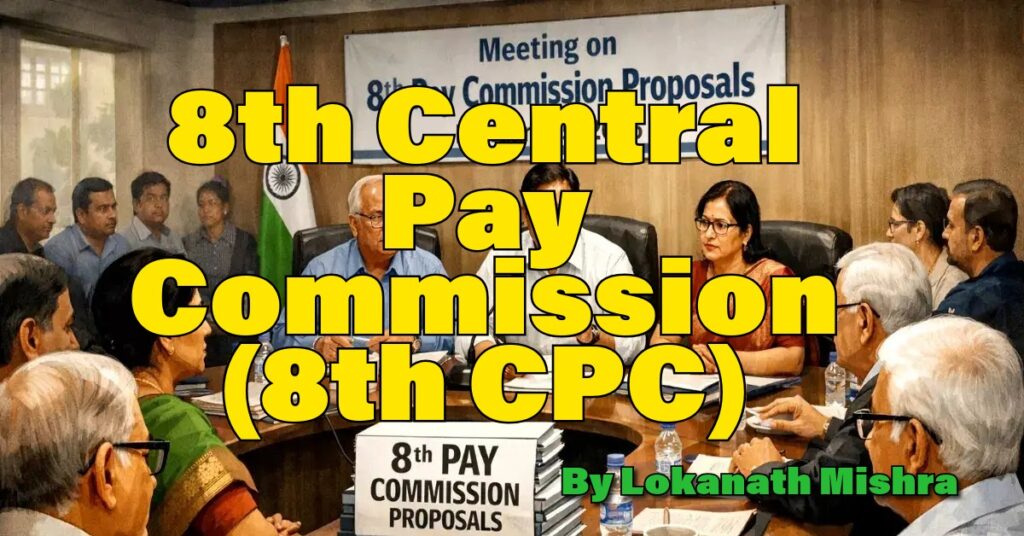
8th Central Pay Commission (8th CPC): An Era of Just Rewards for Pensioners in India
By Lokanath Mishra, The Chief Adviser, The All India Pensioners Association of CBIC
The 8th Central Pay Commission (CPC) has finally commenced its work, fulfilling a significant milestone in India’s long-standing tradition of periodically revising the pay structure and pension benefits of central government employees and pensioners. After nearly a decade since the implementation of the 7th CPC, expectations amongst serving employees and retired pensioners have surged — and with good reason. The present economic climate, persistent inflation, and rising healthcare demands underline the need for a comprehensive and humane review of pensioner welfare. 
- Pensioners: Assets, Not Liabilities
In a rapidly ageing society, senior citizens must be treated as assets — repositories of experience, social stability, and familial support — rather than liabilities. Pensioners have spent decades in service to the nation and deserve pension structures that enable a life of dignity, health, and active participation in society. Their expectations from the 8th CPC are not merely financial demands but calls for social justice, economic security, and humane governance. This perspective reflects evolving global benchmarks on ageing and retirement welfare.
- Fitment Factor: The Need to Increase It to at Least 3.0
One of the central mechanisms through which Pay Commissions enhance salaries and pensions is the fitment factor — a multiplier applied to existing basic pay to determine revised pay and pensions.
• Experts and pensioner unions have widely demanded a fitment factor of at least 3.0 for the 8th CPC. 
• Current discussions suggest expected fitment factors ranging from 1.83 to 2.86, with projections that a higher factor will result in significantly better pensions. 
Justification: The 7th CPC fitment factor was 2.57, which, at that time, doubled basic pay and pension effectively. A factor of 3.0 or higher in the current context — with persistent inflation and cost escalation — would ensure real terms growth in retirement income, and help pensioners maintain an acceptable standard of living.
- Pension Revision and Dearness Relief (DR)
A. Full Pension Revision under 8th CPC
The government has clarified that pension revision will be included in the 8th CPC recommendations, dispelling earlier concerns about possible exclusion of pensioners from benefits. 
This means:
• Revised pension based on the new pay matrix
• Full arrears due from the effective date (likely Jan 1, 2026)
• Revised family pension and gratuity limits
B. Continued Dearness Relief (DR) Increases
Dearness Relief (DR) is a crucial inflation adjuster for pensioners — currently around 58% — and continues to be revised biannually. 
Justification: For pensioners with fixed incomes, DR adjustments provide vital protection against rising living costs. Failure to maintain periodic DR hikes would erode pensioners’ purchasing power, making it one of the most important elements of pension security.
- Healthcare Improvements: A Must for Senior Citizens
Healthcare costs remain one of the biggest challenges for retirees. Current provisions under the Central Government Health Scheme (CGHS) are welcome but insufficient.
Key Pensioners’ Expectations:
1. Increase in CGHS Benefits — Comprehensive coverage beyond minimal reimbursement limits.
2. Top-Up Insurance at Government Cost — A higher insurance buffer to cover catastrophic health expenses.
3. Mandatory Annual Health Check-Ups — Preventive healthcare, early disease detection, and reduced long-term costs.
4. Supply of Quality Medicines — Assurance of essential medicines without delay or denial.
5. Mandatory Inclusion of Private Hospitals under CGHS Empanelment — Especially in areas where government healthcare infrastructure is limited.
6. CGHS Wellness Centres in Every District — To ensure accessible care for every pensioner regardless of geography.
Justification:
• India’s public healthcare system remains overstretched in many regions, particularly in rural and semi-urban areas.
• Senior citizens often face chronic diseases requiring frequent medical attention and costly treatments.
• Preventive care greatly reduces long-term medical expenses and improves quality of life.
These proposals are more than welfare measures — they represent a modern understanding of senior healthcare needs and a sustained investment in elder well-being.
- Leave Travel Concession (LTC) for Pensioners
Pensioners and senior citizens frequently seek the extension of Leave Travel Concession (LTC) benefits, traditionally accorded to serving employees, to retired employees.
Justification:
• LTC cannot be considered a luxury; it is essential for enabling family travel and peacetime recreation, which boosts mental and physical health among seniors.
• Travelling allows retirees to maintain active engagement with family and societal functions.
A grant of LTC to pensioners (either in cash or travel allowances) would be a significant step toward acknowledging retirees’ right to leisure and social participation.
- Restoration of Commutation After 10 Years
Under current rules, pensioners who opt for commutation (lump-sum withdrawal of a part of pension at retirement) have their reduced monthly pension restored after 15 years. 
However, pensioners argue that this period should be reduced to 10 years, in line with the fact that the government recovers the commuted amount much earlier than 15 years due to interest earnings. 
Justification:
• A shorter restoration timeline significantly improves monthly income for older retirees — a group particularly vulnerable to health and financial stress.
• Many state governments in India have already restored commutation earlier (e.g., in 12 years), demonstrating feasibility and fairness.
- Other Priorities for the 8th CPC
A. Annual Pension Increase and Quarterly DR Adjustments
Compound cost-of-living shifts demand more frequent revisions. Pension increases annually, and DR adjustments quarterly, would offer real-time relief rather than half-year cycles.
B. Recalibration of Family Pension
Family pensions should reflect contemporary costs of living — shifting from arbitrary percentages to a more equitable and need-based structure.
C. Enhanced Gratuity Ceilings and Benefits
Government employees and pensioners have historically benefited from phased increases in gratuity payments. Strengthening the ceilings and harmonising with rising pay scales ensures retirees are not penalised at the end of service.
D. Rationalisation of Health Allowances
Fixed Medical Allowance (FMA) has stagnated at low levels. Given rising healthcare expenditures, indexed and need-based health allowances must be considered.
Conclusion: Towards Pensioner-Centric Reforms
The 8th Central Pay Commission presents not just an administrative milestone, but a pivotal opportunity to redefine how a nation values its senior citizens.
Pensioners are not just beneficiaries of a pay revision; they are pillars of social stability, bearers of long service, and trusted custodians of decades of national development. Their welfare — in terms of financial security, healthcare rights, and quality of life — must be central to the 8th CPC’s recommendations for a truly inclusive and socially compassionate India.
Here is the additional section, expanded with detailed justification and verified citations, suitable for publication in a journal as part of your overall piece on the 8th Central Pay Commission (8th CPC) and senior citizen welfare:
⸻
Supplementary Policy Recommendations for Senior Citizens: Tax Relief, Social Security, Public Service Concessions etc:
As the 8th Central Pay Commission embarks on its task, it must strive to shape not only pay and pension structures but also foundational policies that impact the economic stability, social dignity, and well-being of India’s elderly citizens. Senior citizens, having contributed decades to the nation’s service and progress, merit recognition not just through pension revision but through holistic senior-friendly policy reforms. These should include tax reforms, protected access to public services, travel and mobility concessions, simplified service access, and enhanced safety measures.
- Comprehensive Tax Relief: Exemption of Pension Income and Interest from Income Tax
Despite prevailing concessions in tax law for older taxpayers, pension and bank interest income remain taxable in most cases, reducing disposable income for retirees with limited means.
Current Legal Framework
1. Under Section 194P of the Income-tax Act, seniors aged 75 years or more with income consisting only of pension and bank interest (from the same bank) are exempt from filing income tax returns; the bank, acting as a specified agent, computes tax and deducts applicable TDS, eliminating compliance burden. This relief simplifies tax procedures for elderly taxpayers. 
2. The broader tax regime still treats pension as taxable income under the “salary” head. Senior citizens often rely on interest from fixed deposits and pensions as their main livelihood; at times, these incomes combine to push them into marginal tax liability despite low overall annual receipts. 
Why Full Tax Exemption Is Justified
• Equity and Financial Security: Pensioners often have no other income stream besides their pension and interest earnings. Unlike working taxpayers who can invest in many tax-planning instruments, pensioners’ risk capacity and income streams are limited.
• Inflation Impact: In periods of high inflation, the real purchasing power of fixed pension amounts shrinks. Taxing even modest income sources further erodes retirees’ ability to meet essential expenses such as healthcare.
• Administrative Ease: Eliminating tax liability for pension and interest income for all senior citizens regardless of age (not just 75+) would reduce compliance complexity, particularly for those managing chronic conditions or limited mobility.
• Global Precedents: Many advanced economies exempt basic retirement income from tax or apply higher exemption thresholds to honor lifetime contributions of citizens.
• Social Justice: Pensioners, especially those without alternative support, should not be treated as taxable entities on modest, non-productive income. Exempting pension and interest income from tax aligns with principles of redistributive justice and elder welfare.
Policy Proposal
It is recommended that the 8th CPC advocate for a statutory exemption — under the Income-tax Act — of all pension income and interest income earned by senior citizens up to a clearly defined threshold or entirely, subject to socio-economic criteria. This would materially enhance economic security and reduce administrative burdens for retirees.
Current exemptions such as Section 194P provide only limited procedural relief and do not remove the tax burden itself. 
- Priority Access to Public Services and Institutions
Ensuring dignity and ease in public services is a core component of inclusive governance.
A. Dedicated Queues and Priority Access
Senior citizens should be guaranteed priority service counters or designated service windows in:
• Banks (for pension withdrawals, cash deposits, pensioner services)
• Railway reservation counters
• Hospital outpatient departments and diagnostic centers
• Administrative offices (for pension documentation, subsidy claims)
Justification:
• Older citizens often have limited mobility, chronic health conditions, and reduced stamina. Long waiting times can cause undue physical strain and discourage access to essential services.
• Priority queues are already recommended for groups such as pregnant women and persons with disabilities; extending similar priority to senior citizens aligns with principles of accessibility and social inclusion.
- Concessions on Travel and Mobility
Mobility is crucial for emotional, psychological, and social well-being. It also supports access to healthcare, family participation, cultural engagement, and tourism.
A. Railway Fare Concessions
For decades, Indian Railways provided significant fare discounts — 40% for male and 50% for female senior citizens — on Mail/Express trains. These concessions were suspended in 2020 amid the Covid-19 pandemic and have not been fully reinstated nationwide, although local reintroductions have been reported. 
Benefits of Restoring Concessions:
• Reduces financial burden on fixed-income retirees.
• Encourages social connectivity and health-related travel.
• Signals governmental commitment to senior support.
B. Lower Berth Allocation and Comfort Provisions
Automatic allocation of lower berths for senior passengers — especially women and the physically challenged — improves travel comfort and safety. Recent policy updates automatically consider lower berth allocation for senior citizens where available, enhancing accessibility. 
C. Extension to Other Public Transport
Discounted or priority seating in state bus services, metro systems, and domestic flight concessions should be uniformly mandated for senior citizens and pensioners, not left to discretionary schemes that vary by region or provider.
- Enhanced Safety and Social Security
While financial and service concessions address economic and administrative needs, physical security is another essential dimension.
A. Special Protection Measures
Senior citizens are often vulnerable to:
• Street crimes (petty theft, frauds targeting elderly, digital scams)
• Accidents due to inadequate civic safety measures
• Exploitation in public spaces
Recommended Measures:
• Dedicated police outreach programs for senior communities, particularly in areas with high pensioner populations.
• Rapid response units linked to elderly distress calls and community watch programs.
• Train station and hospital premises safety staffing to assist seniors in navigation, boarding, and safe movement.
Conclusion
Senior citizens represent an invaluable section of the Indian populace — repositories of knowledge, culture, and economic contribution. The 8th Central Pay Commission offers a historic opportunity not merely to revise pay scales and pensions but to institutionalize dignity, security, and economic independence for pensioners.
Key reforms to consider:
1. Exemption of all pension and bank interest incomes from income tax — ensuring real financial upliftment and justice.
2. Priority public services through dedicated counters and queues — reducing physical strain and improving service access.
3. Travel and mobility concessions, including reinstated railway discounts and lower berth privileges, plus expanded concessions across transport modes.
4. Safety and security initiatives tailored to senior citizen needs.
Such reforms — grounded in equity, administrative ease, and respect for human dignity — are not mere policy additions but societal imperatives. They will transform retirement from an era of vulnerability into a phase of continued participation, contribution, and dignity.