
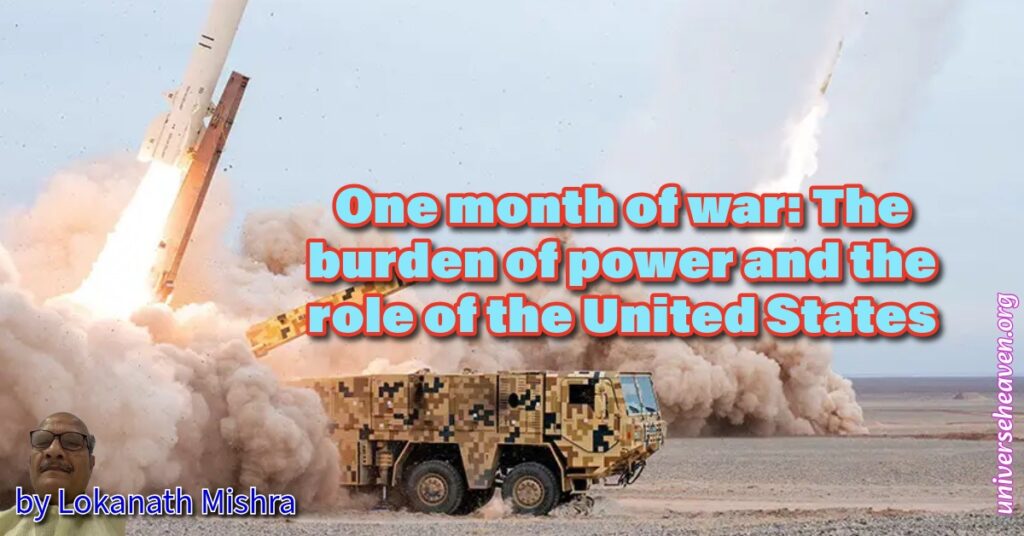
One month of war: The burden of power and the role of the United States
By Lokanath Mishra
One month into the conflict in West Asia, the familiar narratives of power are being tested. Yet amid the shifting assessments and contested claims, one reality stands out with greater clarity: in a deeply unstable region, the United States continues to shoulder a disproportionate burden of maintaining order.
This is neither a simple story of dominance nor of decline. It is, rather, a story of responsibility—of a nation repeatedly called upon to act when the costs of inaction become too high for the global system to bear.
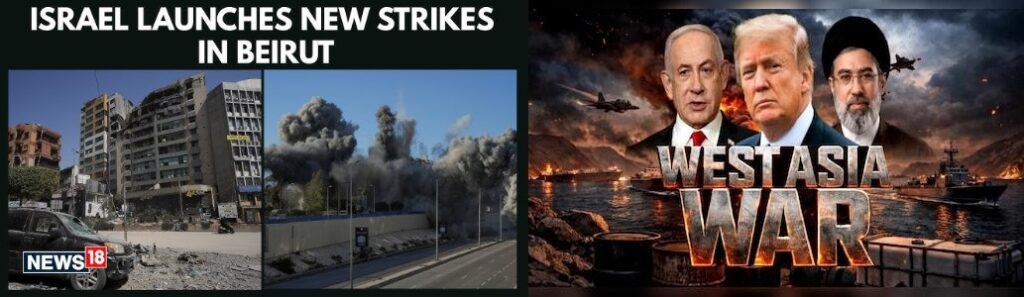
Power under constraint
Much has been made of the limits of American military power in this conflict. Indeed, the United States has encountered resistance in complex and contested environments. But to interpret this as weakness is to misunderstand the nature of modern warfare.
The United States is not merely fighting an adversary; it is simultaneously managing escalation, protecting allies, securing global trade routes, and preventing a regional conflict from spiralling into a wider war. Power, in this context, is exercised not through unchecked force, but through calibrated restraint.
That restraint, often criticised, is in fact a defining feature of responsible leadership.
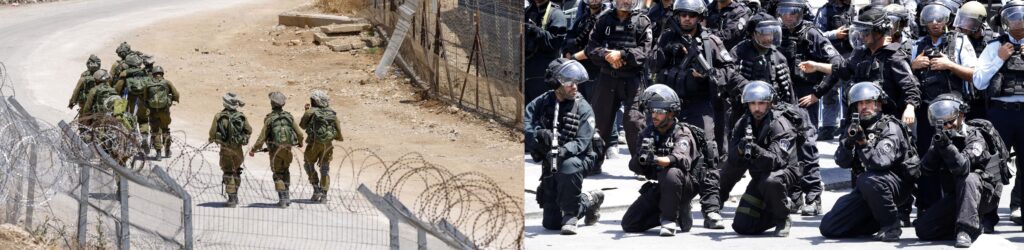
The stabilising force
In a region marked by volatility, the United States remains the principal stabilising actor. Its naval presence secures vital sea lanes, particularly around the Strait of Hormuz, through which a significant portion of the world’s energy supply flows.
Without such a presence, the consequences would be immediate and severe—disrupted oil supplies, economic shockwaves, and heightened insecurity across continents. The global economy, despite its diversifications, still depends on the stability of these routes.
In this sense, American intervention is not merely strategic; it is systemic.
Adapting to a new battlefield
The conflict has highlighted the growing importance of drones, asymmetric tactics, and intelligence-driven operations. Yet it is also evident that the United States is at the forefront of adapting to these changes.
From integrating advanced surveillance systems to developing counter-drone technologies, the U.S. military continues to evolve. The challenges it faces are not signs of obsolescence, but indicators of a rapidly changing battlefield—one in which even the most advanced forces must innovate continuously.
Leadership in such an environment is defined not by invulnerability, but by the capacity to adapt under pressure.
Defending allies, shaping outcomes

Another dimension often overlooked is the role of the United States in defending its allies. Israel’s security, the stability of Gulf states, and the broader balance of power in the region are all linked, directly or indirectly, to American engagement.
This is not a transactional arrangement; it is part of a larger framework that has, for decades, prevented major interstate wars in the region. The current conflict, intense as it is, has not escalated into a full-scale regional war—a fact that owes much to the deterrent presence of the United States.
Deterrence, by its nature, is invisible when it succeeds.
The cost of leadership
To be the central actor in a global system is to invite scrutiny. Every action is debated, every misstep amplified. Yet the absence of such a central actor would create a vacuum—one that could be filled by far more destabilising forces.
Critics often point to the costs of American intervention. These costs are real. But so too are the costs of withdrawal: fragmentation, uncertainty, and the erosion of international norms.
The United States operates not in an ideal world, but in a deeply imperfect one. Its choices are rarely between good and bad, but between difficult and worse.
A message for emerging powers
For countries like India, the conflict offers an important lesson. Strategic autonomy does not preclude recognising the role of stabilising powers in the global order.
India’s own interests—energy security, maritime stability, and regional balance—are indirectly supported by the continued engagement of the United States in critical theatres. At the same time, India must strengthen its own capabilities, particularly in securing maritime chokepoints such as the Strait of Malacca.
The future will likely demand both cooperation and self-reliance.

A world in transition, not in collapse
It is tempting to interpret every challenge faced by a dominant power as evidence of decline. But history suggests otherwise. Periods of transition often produce friction, resistance, and recalibration.
What we are witnessing today is not the retreat of the United States, but its adjustment to a more complex and distributed global landscape. The responsibilities remain; only the methods are evolving.
A prayer beyond geopolitics
Even as nations calculate strategy and power, the human cost of war continues to mount. Civilians bear the consequences of decisions taken far from the battlefield. In such moments, it is necessary to look beyond analysis and towards conscience.
May Lord Jagannath, the eternal protector and guide, bless humanity with wisdom and compassion. May He guide world leaders to act with restraint, to choose dialogue over destruction, and to restore peace where conflict now prevails. May His divine grace bring an end to suffering and lead the world back to harmony.