
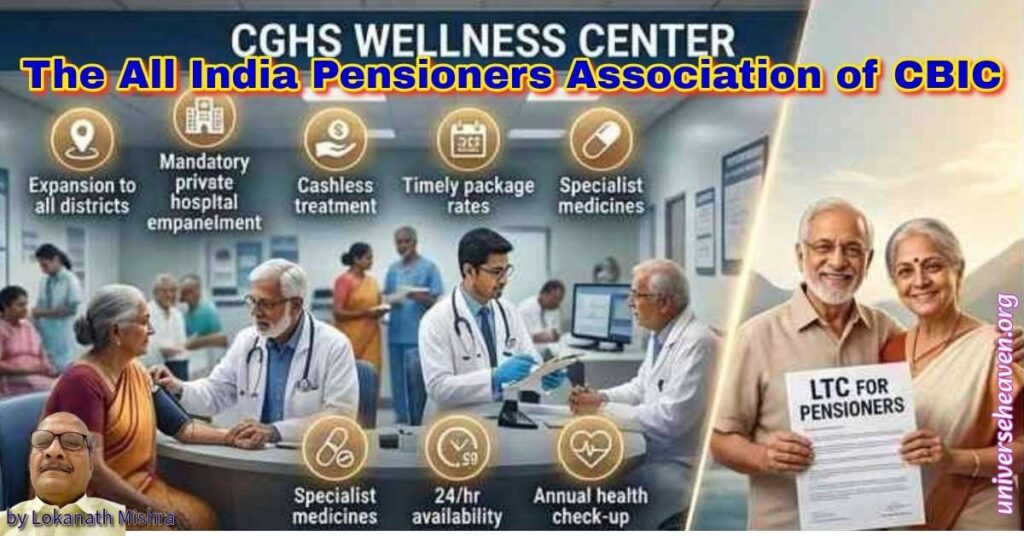
The All India Pensioners Association of CBIC
he evolution of pension reforms in India has been shaped not only by governmental initiatives such as the 7th Central Pay Commission and the upcoming 8th Central Pay Commission, but also by the persistent efforts of dedicated associations representing pensioners. Among these, the All India Pensioners Association stands out as a significant force advocating for equity, justice, and dignity for retired government employees.
The All India Pensioners Association was founded in 2015 through the vision and leadership of two eminent figures: Late Shri Shankar Biswas, who was then serving as Secretary General of the All India Association of Central Excise Gazetted Executive Officers, and Shri R. Kumar, who was its President at the time. Recognizing the growing concerns of pensioners and the need for a unified platform to address them, they established this association to systematically represent pension-related issues at the national level.
From its very inception, the association demonstrated a proactive and purposeful approach. Its first major initiative was the submission of a memorandum to the 7th Central Pay Commission. This step was not merely procedural but deeply strategic, aimed at influencing policy decisions at a crucial juncture when pension structures were under review. Shri Shankar Biswas assumed the role of the first President of the association and continued to guide it with dedication until his demise. Shri R. Kumar served as the first Secretary General during the formative period of 2015–16, laying down a strong administrative and organizational foundation.
Parallel to these efforts, the IRS Promotee Officers also submitted their own memorandum to the Pay Commission. In a remarkable display of unity and clarity of purpose, both groups collectively fought for a crucial and long-pending demand: the fixation of pension by granting notional increments from the date of implementation of the previous Pay Commission’s recommendations. This demand addressed a fundamental disparity affecting pensioners who had retired before pay revisions took effect. Their combined advocacy yielded a historic outcome, as the 7th Central Pay Commission accepted this principle. The decision significantly benefited the entire pensioner community across the country, marking a milestone achievement in pension reform.
Following the initial phase, Shri Lokanath Mishra served as Secretary General of the association from 2016 to 2022. During this period, the association expanded its activities, strengthened its organizational structure, and continued its advocacy on multiple fronts. After 2022, Shri Ravi Malik took over as Secretary General and continues to lead the association with commitment and continuity. In the wake of the passing of Shri Shankar Biswas, Shri Ashok Kumar assumed the role of President and has since been steering the association’s efforts with resolve.
The association has consistently remained engaged with policy processes. After its significant contribution to the 7th Central Pay Commission, it is now actively preparing a comprehensive memorandum for submission to the 8th Central Pay Commission. This memorandum is expected to address longstanding issues and propose pragmatic solutions grounded in the experience of past reforms.
One of the central issues the association has been striving to resolve is the question of pay parity, particularly anomalies dating back to 1986. Despite successive pay commissions, disparities between past and present pensioners have persisted, leading to inequities that the association continues to highlight. Beyond pay parity, the association is also working on several other important matters, including Non-Functional Grade Pay (NFGP), the Modified Assured Career Progression (MACP) scheme, and the demand for restoration of commuted pension after 10 years—a significant concern for many retirees.
In addition to these systemic issues, the association plays a vital role in addressing individual grievances of pensioners. It acts as a support system for members facing procedural hurdles, administrative delays, or discrepancies in pension fixation. Through sustained representation, dialogue with authorities, and collective action, the association has emerged as a reliable advocate for pensioners’ rights.
In conclusion, the All India Pensioners Association exemplifies how collective organization and determined leadership can influence policy and bring about meaningful change. From its founding in 2015 to its ongoing preparations for engagement with the 8th Central Pay Commission, the association has maintained a clear focus on fairness, equity, and the welfare of pensioners. Its journey reflects not only past achievements but also a continuing commitment to securing a just and dignified future for the pensioner community in India.
Issue of Revised Pay Scale with effect 1.1.1996 have already been attained finality and MOE has also conveyed their concerns to grant benefit in personum. So even after obtaining favourable decision, the applicants are not paid Arrears and leading to this inaction, divulging rumours are going on amongst pensioners affected in this case.
There is not a single instance came to know where Arrears have been paid. In such an uncertain environment, the beneficiaries have become hopeless and helpless.
It is urged to the Association to address them clarifying status of the issue at the earliest.
Please go through the recent order issued by board.