
Ashes of Illusion – Part II
By Lokanath Mishra
The first court notice arrived on a humid afternoon.
Rajesh held the envelope in his hand for several minutes before opening it. Though he had anticipated legal escalation, anticipation never softened reality. The allegations were structured, formal, and cold—words that reduced an entire marriage into accusations and counter-accusations.
His father adjusted his glasses and read the document slowly. The man who had once interpreted ancient philosophies with ease now struggled to understand how truth itself could be so easily distorted.
“Truth,” he murmured quietly, “has always been fragile in the hands of the agitated.”
Rajesh said nothing.
The case dragged them into a world they had never imagined—police visits, lawyer consultations, whispered conversations among relatives, and the silent judgment of society. For a family that had spent decades building intellectual respect, the humiliation was not loud, but it was constant.
At the university, Rajesh maintained composure. He still taught philosophy—ethics, logic, metaphysics. Ironically, he now lived in a contradiction where justice seemed procedural, not moral.
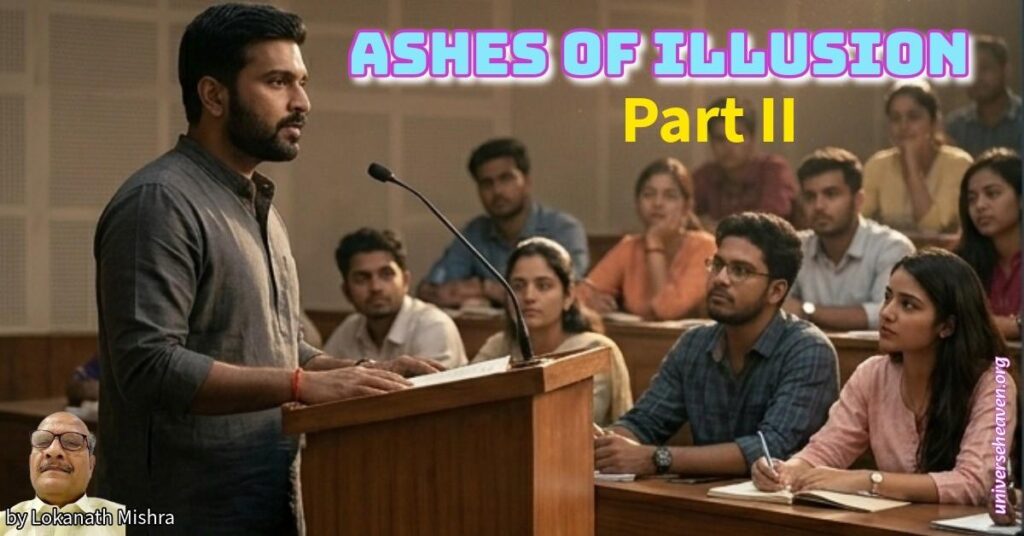
One day, during a lecture on truth and perception, a student asked,
“Sir, is truth always objective?”
Rajesh paused longer than usual.
“No,” he finally said. “Truth often depends on who is speaking… and who is believed.”
That day, he realized something had changed inside him.
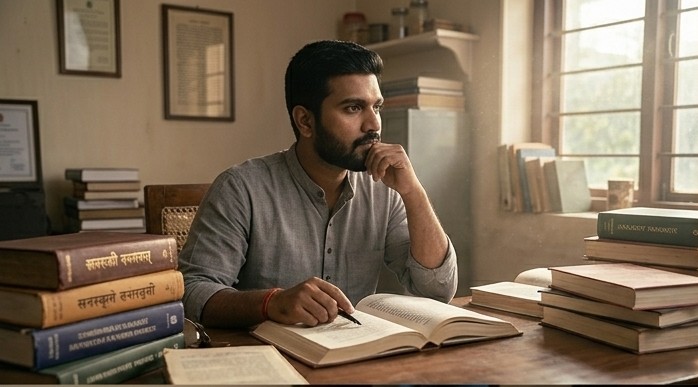
Months passed, and the case did not move quickly. Adjournments became routine. Dates were given, postponed, and forgotten. Meanwhile, his wife remained absent—not just physically, but emotionally, legally, and morally.
She neither returned nor ended the marriage.
It was a suspension—deliberate and strategic.
Through mutual acquaintances, Rajesh learned more about her life abroad. Frequent visits to London. A lifestyle that seemed increasingly detached from the values she once spoke about. The rumors about her relationship became stronger, more detailed.
But Rajesh chose silence.
Not because he was weak—but because he had begun to understand the futility of chasing explanations from someone who had already chosen distance.
Financial strain tightened its grip.
Loan repayments consumed a large part of his salary. The grandeur of his wedding now stood as a quiet irony—celebrated by hundreds, sustained by debt, and remembered with regret.
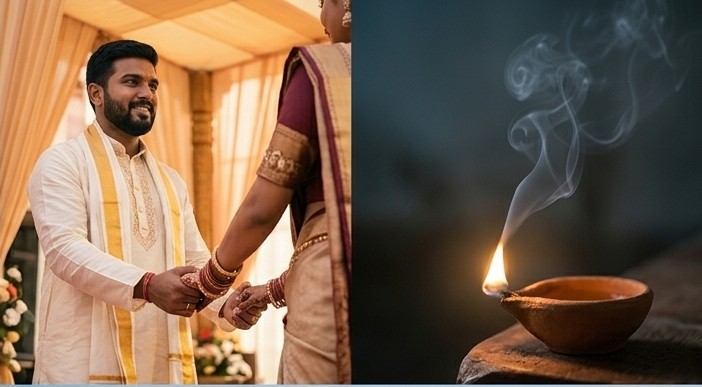
One evening, while organizing old documents, Rajesh found a wedding photograph.
They were both smiling.
He looked at it for a long time.
Then he placed it back—not in anger, but with detachment.
“Memory,” he whispered to himself, “is not always truth.”
His transformation deepened.
What began as an escape into spirituality slowly became a discipline. He started waking up before sunrise, meditating, reading scriptures, and journaling his thoughts.
He revisited philosophies he once taught academically—now experiencing them personally.
Detachment was no longer a concept.
It was survival.
He began visiting places within the country—quiet temples, riverbanks, ancient sites. Not out of ritual, but reflection. Each journey felt like a step away from the chaos of his past.
⸻
One such journey changed everything.
In a small ashram near the mountains, Rajesh met an elderly monk. The man had no followers, no fame—only a calm presence that seemed untouched by the world’s noise.
They spoke briefly.
Rajesh did not narrate his entire story. He simply asked one question:
“Why do people betray?”
The monk smiled faintly.
“People do not betray others,” he said. “They only reveal who they truly are… when circumstances allow.”
Rajesh sat in silence.
“And what about suffering?” he asked after a pause.
“Suffering,” the monk replied, “is what remains when expectation refuses to die.”
⸻
That sentence stayed with him.
When Rajesh returned home, he made a decision—not impulsive, but clear.
He would file for divorce.
Not out of revenge.
Not out of anger.
But out of closure.
⸻
The legal process began again—this time initiated by him.
Unlike before, he was prepared. His lawyer structured the case carefully, documenting timelines, financial records, communication attempts, and inconsistencies in allegations.
For the first time in two years, Rajesh felt active in his own life.
The courtroom became a space of confrontation—not emotional, but factual.
When she finally appeared after months of absence, Rajesh saw her not as the person he once loved, but as someone he no longer knew.
There was no hatred in his eyes.
Only distance.
⸻
During one hearing, the judge observed both sides carefully.
“Marriage,” the judge said, “is not sustained by law. Law only intervenes when it has already failed.”
Rajesh understood that deeply.
Because his marriage had not failed in the courtroom.
It had failed long before that.
⸻
Outside the court, her father attempted one last intimidation—subtle, controlled, but familiar.
Rajesh listened quietly.
Then, for the first time, he responded:
“Respect cannot be forced through fear. And truth does not change because you threaten it.”
It wasn’t anger.
It was clarity.
⸻
Months later, the judgment came.
The marriage was legally dissolved.
No dramatic victory.
No celebration.
Just an ending.
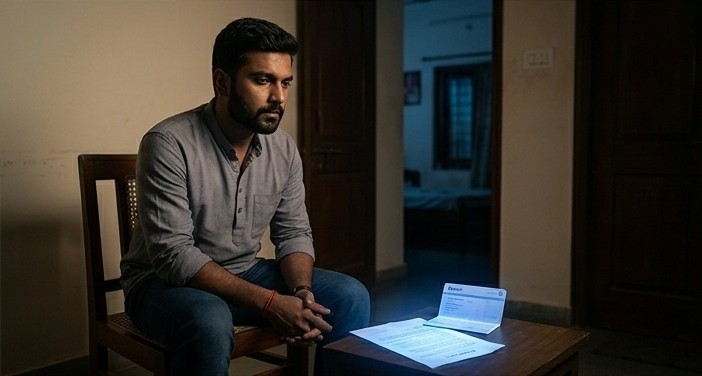
That evening, Rajesh returned home alone.
He sat in silence, not overwhelmed, not relieved—just aware.
A chapter had closed.
Not the one he had imagined.
But the one he had earned.
⸻
Years later, Rajesh became known not just as a professor, but as a speaker.
He spoke about life, choices, illusions, and resilience. Not from books—but from experience.
Students listened differently now.
Because his words carried something more than knowledge.
They carried truth.
⸻
One day, after a lecture, a student approached him and asked:
“Sir, do you still believe in love?”
Rajesh smiled—not with innocence this time, but with understanding.
“Yes,” he said. “But not the kind that blinds you… the kind that lets you see clearly.”
⸻
And for the first time in a long time—
Rajesh felt free.
( to be  continued in part-III)