
Mahabharata in Prose – Part 46 (continued)
( A story of Dvapar Yuga) by Lokanath Mishra, Jenamath Lane, Puri
As the exile of the Pandavas continued, the forest became not merely a place of hardship, but a भूमि of transformation. The passing years slowly strengthened their resolve, sharpening both mind and body for the trials yet to come.
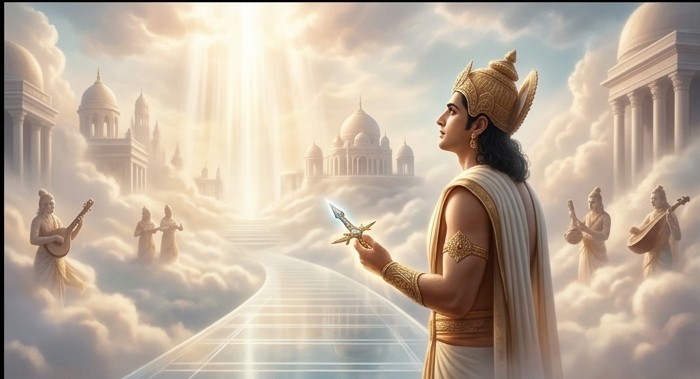
Arjuna, having received divine weapons from Shiva and other devas, did not return immediately. His journey carried him further into celestial realms. Invited by Indra, he ascended to the heavenly abode.
There, Arjuna beheld wonders beyond mortal imagination—divine palaces, radiant beings, and the music of the Gandharvas that filled the air like flowing nectar. Under Indra’s guidance, he learned not only the use of celestial weapons but also the finer arts of warfare and discipline that transcended earthly limits.
He was taught by the Gandharva Chitrasena, mastering dance, music, and the art of subtle expression—skills that would later serve him in unexpected ways.
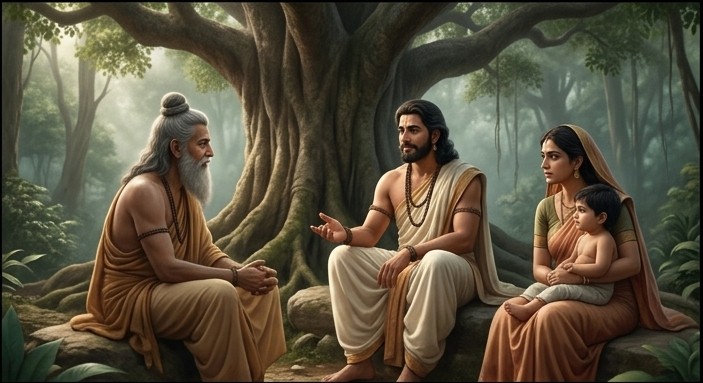
Yet even in heaven, Arjuna’s mind remained anchored to his purpose. He knew that all these gifts were not for glory, but for the inevitable युद्ध that awaited.
Back in the forest, Yudhishthira continued to engage in deep discussions with sages who visited their hermitage. Through their words, he explored the complexities of dharma, gaining wisdom that would guide him in times of crisis.
Bhima, restless and fierce, often roamed the forest, confronting dangers without hesitation. It was during this time that he encountered powerful beings and rakshasas, defeating them and ensuring the safety of the hermits dwelling in the region.
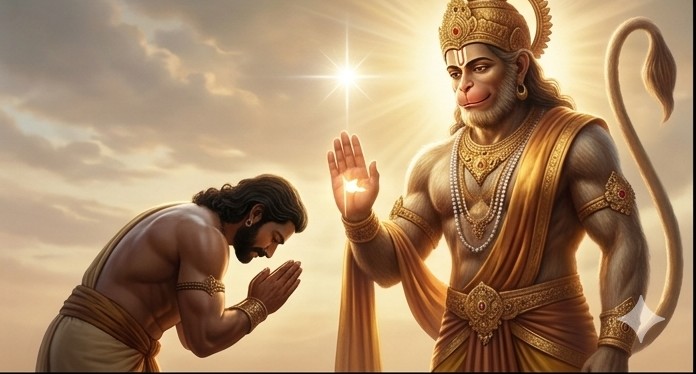
One such encounter led him to a mysterious meeting—with Hanuman, the महान vanara and elder brother of Bhima, both born of Vayu.
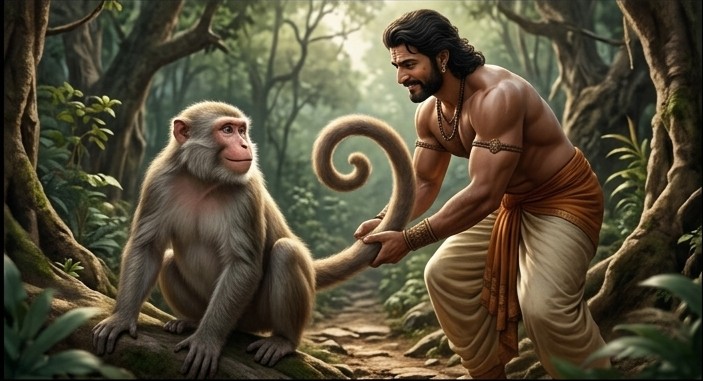
Bhima, filled with pride in his strength, came upon an old monkey lying across his path, its tail blocking the way. Irritated, he asked the creature to move.
The monkey replied calmly,
“I am too weak to move. If you wish to pass, kindly lift my tail and set it aside.”
Confident in his might, Bhima attempted to lift the tail—but to his astonishment, he could not move it even slightly. His pride began to crumble.
Realizing that this was no ordinary being, Bhima bowed in humility.
At that moment, Hanuman revealed his true form—vast, radiant, and divine. He smiled upon Bhima and said,
“Strength without humility leads to downfall. Remember this.”
Hanuman blessed him, promising to be present in spirit upon Arjuna’s chariot during the great war, strengthening the Pandavas’ cause.
Meanwhile, Draupadi continued to endure the कठिन life of exile with remarkable patience. Yet, at times, the memory of her humiliation would resurface, bringing tears and anger alike.
In those moments, Bhima would console her with fierce promises of vengeance, while Yudhishthira would remind her of the greater path of dharma and time’s न्याय.
Nakula and Sahadeva, though quieter, remained steadfast—serving their elder brother and supporting the family with loyalty and wisdom.
Thus, the years of exile unfolded—not as a period of defeat, but as a time of preparation. Each brother, in his own way, was being shaped by destiny.
Far away in Hastinapura, however, Duryodhana grew increasingly confident. Believing the Pandavas to be broken, he immersed himself in power and luxury, unaware that the fire he had ignited would one day return to consume him.
And so, while the forest witnessed the silent rise of strength, the palace nurtured the illusion of victory.
The wheel of time continued to turn, drawing all toward the महान संग्राम that could no longer be avoided.
(Continued in Part 47…)