
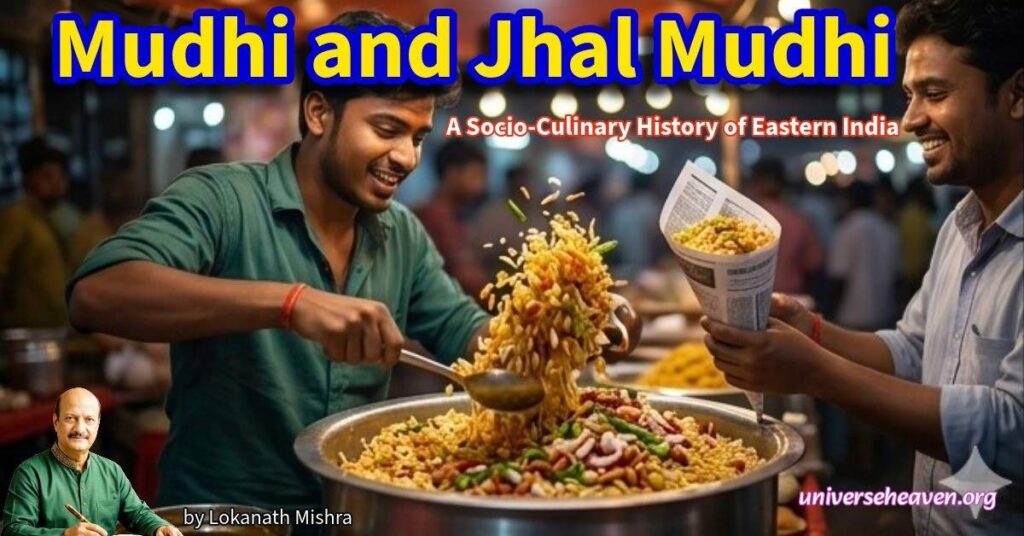
Mudhi and Jhal Mudhi : A Socio-Culinary History of Eastern India
By Lokanath Mishra, Jenamath Lane, Puri.
The history of mudhi—puffed rice—is a compelling example of how a modest, subsistence food can travel across regions, classes, and historical moments to become a widely celebrated culinary symbol. Rooted in the agrarian life of Odisha, mudhi’s journey intersects with patterns of rural livelihood, migration, wartime encounters, interregional trade, and urban street food innovation, eventually culminating in the iconic jhal mudhi of West Bengal and beyond.

Rural Foundations: Mudhi as a Food of Necessity
In traditional Odia society, mudhi was long regarded as a food of the economically weaker sections. Its importance lay in its affordability, simplicity, and practicality. Prepared in village households through a careful process of heating parboiled rice in sand or earthen ovens, mudhi required skill but minimal resources.
The key ingredient was usuna chaula (parboiled rice), a variety widely cultivated in Odisha. The parboiling process—soaking, steaming, and drying paddy before milling—imparted structural integrity to the grain, allowing it to puff effectively when roasted. This made it uniquely suited for mudhi preparation. In contrast, finer, polished rice varieties, though preferred for regular meals, lacked the necessary properties to produce good-quality puffed rice.
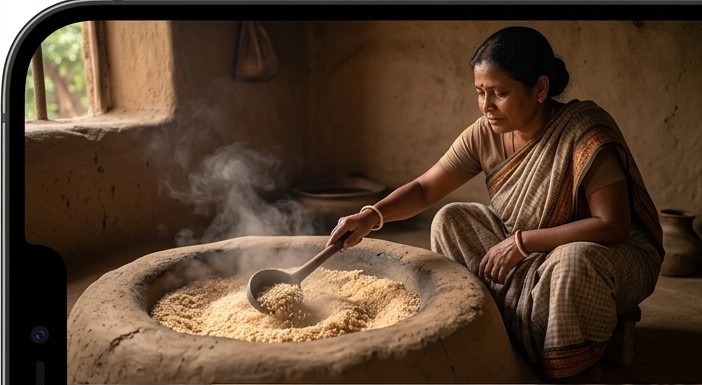
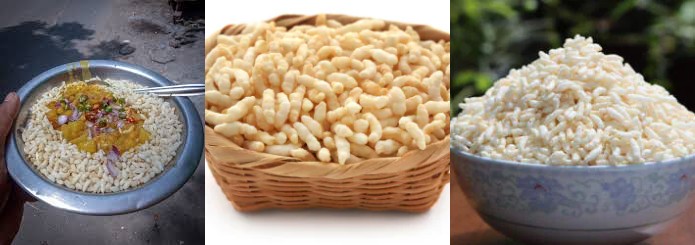
Mudhi formed a regular part of daily consumption: eaten as breakfast before work or as a midday snack in the fields. It was typically mixed with chopped onions, green chilies, mustard oil, and roasted peanuts, creating a simple yet flavorful dish. Alongside mudhi, rice bhuja (roasted rice) was another common preparation among rural households.
Migration and the Movement of Food Culture
Economic pressures led many laborers from Odisha to migrate to urban centers, particularly Kolkata, during the late colonial period. Carrying their food habits with them, these workers continued to rely on mudhi as an inexpensive and filling meal.
In the urban environment of Kolkata, mudhi gradually moved from private consumption to public space. Odia laborers began selling it on the streets, making it visible to a broader population. However, at this stage, it largely retained its identity as a humble, working-class food.

Wartime Encounter: American Soldiers and Mudhi
A decisive moment in the transformation of mudhi’s social status occurred during World War II. As Kolkata emerged as a major Allied military base, large contingents of American soldiers were stationed in key areas such as Dharmatala and Esplanade.
Amid this setting, Odia laborers continued their daily routines, including the consumption and sale of mudhi. The American soldiers, intrigued by this unfamiliar food, began to observe and eventually taste it. Finding it light, convenient, and surprisingly flavorful—especially with mustard oil and spices—they developed a liking for it.
Importantly, these soldiers did not merely sample mudhi; they regularly purchased it from Odia vendors and laborers, integrating it into their daily diet during their stay. This act of cross-cultural consumption had a subtle but meaningful impact. The sight of foreign troops consuming mudhi contributed to a shift in perception among local populations, enhancing its social acceptability and visibility.
Thus, a food once associated primarily with poverty began to cross social boundaries, aided by an unexpected global encounter.
Agricultural Linkages and Interregional Trade
As demand for puffed rice increased in Bengal following its growing popularity, a practical challenge emerged: the locally available fine rice varieties were not suitable for producing quality mudhi. This led to a dependence on usuna chaula sourced from Odisha.
Trade networks developed to transport parboiled rice from Odisha into Bengal, reinforcing agricultural and economic linkages between the two regions. In this way, Odisha not only contributed the culinary knowledge of mudhi preparation but also supplied the essential raw material that sustained its expansion elsewhere.

Culinary Transformation: The Emergence of Jhal Mudhi
While Odia migrants introduced mudhi to Bengal, it was the innovative spirit of Bengali street vendors that transformed it into jhal mudhi. The term “jhal” refers to spiciness, and this preparation elevated puffed rice into a vibrant and complex snack.
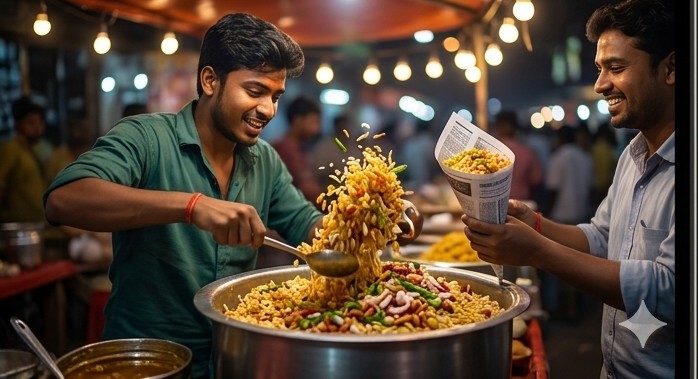
Jhal mudhi incorporated a variety of ingredients: mustard oil, chopped onions, green chilies, roasted peanuts, boiled potatoes, spice mixtures, sev, and tangy chutneys. Prepared fresh and served in paper cones, it became a quintessential urban street food—portable, affordable, and bursting with flavor.
This transformation marked a shift from subsistence to gastronomy. Mudhi was no longer merely a necessity; it had become a culinary experience.
Regional Diffusion and Urban Expansion
Over time, jhal mudhi spread across eastern and northeastern India, becoming popular in Bihar, Jharkhand, Assam, and Tripura, while continuing to thrive in Odisha and West Bengal.
In the post-independence and contemporary periods, migration and urbanization carried this snack into major metropolitan centers such as Mumbai and Bangalore. In each new location, it adapted subtly to local tastes while retaining its essential character.
Contemporary Recognition and Cultural Symbolism
In recent years, jhal mudhi has received renewed attention in public discourse. A widely noted moment occurred when Narendra Modi was seen purchasing and eating jhal mudhi from a street vendor at a nominal price. This act symbolized the enduring appeal of the snack across social strata and highlighted its place within India’s shared culinary heritage.
Conclusion
The evolution of mudhi into jhal mudhi illustrates the dynamic interplay between food, society, and history. Beginning as a staple of rural Odisha, shaped by the properties of usuna chaula, it traveled through migration to Kolkata, gained visibility during World War II through interactions with American soldiers purchasing it from Odia laborers, and was transformed through Bengali culinary innovation.
Today, it stands not merely as a snack but as a marker of cultural exchange, resilience, and adaptation. Its journey underscores a broader truth: that even the simplest foods can carry within them the complex histories of regions, peoples, and times.