
Old vs New Tax Regime for Pensioners: A Practical Guide for AY 2026–27
By Lokanath Mishra, Chief Adviser, All India Pensioners Association of CBIC
India’s income tax system has undergone a significant shift with the introduction of the new tax regime as the default from Financial Year 2023–24 onwards. For pensioners—particularly those from the Central Board of Indirect Taxes and Customs (CBIC)—understanding the nuances of the old and new regimes is essential for making an informed and beneficial choice while filing Income Tax Returns (ITR) for Assessment Year 2026–27.
This article aims to provide clarity on both regimes, filing procedures, and key considerations specifically relevant to pensioners.

- Taxation of Pension: The Basics
Pension is treated as “Income from Salary” under the Income-tax Act. Therefore, pensioners are eligible for a standard deduction:
- ₹50,000 under the old regime
- ₹75,000 under the new regime (as per latest provisions)
Family pension, however, is taxed under “Income from Other Sources,” with a deduction of ₹15,000 or one-third of the pension, whichever is less.
ITR Filing Requirement and Forms
Most pensioners fall under the category of individuals earning income from:
- Pension
- Interest from savings or fixed deposits
Such individuals can generally file ITR-1 (Sahaj), provided:
- Total income does not exceed ₹50 lakh
- No capital gains or multiple house properties exist
If these conditions are not met, ITR-2 should be used.
Due Date: July 31, 2026

- Documents Required
Before filing, pensioners should keep the following ready:
- Form 16 / 16A (issued by bank or pension disbursing authority)
- Form 26AS (tax credit statement)
- AIS (Annual Information Statement)
- Bank interest certificates
- Investment proofs (for old regime deductions)
- The New Tax Regime (Default System)
The new regime is now the default option. Unless specifically opted otherwise, a taxpayer will be taxed under this regime.
Key Features:
- Lower tax rates across income slabs
- Higher standard deduction (₹75,000)
- Simplified compliance
- No requirement to file any separate form (for non-business income)
Major Limitation:
- Most deductions and exemptions are not allowed, including:
- Section 80C (LIC, PPF, etc.)
- Section 80D (medical insurance)
- Section 80TTB (interest for senior citizens)
Suitable For:
- Pensioners with minimal investments
- Those who prefer simplicity over tax planning
- Individuals without significant deductions to claim
- The Old Tax Regime
The old regime continues to be available as an option, allowing taxpayers to claim various deductions and exemptions.
Key Features:
- Higher tax rates
- Multiple deductions available:
- Section 80C (up to ₹1.5 lakh)
- Section 80D (health insurance premium)
- Section 80TTB (interest up to ₹50,000 for senior citizens)
- Standard deduction of ₹50,000
Suitable For:
- Pensioners with substantial investments and savings
- Those paying health insurance premiums
- Individuals claiming multiple deductions
- Choosing Between Old and New Regime
The choice between regimes should be based on tax liability comparison.
General Guidance:
- If total deductions exceed ₹2–3 lakh → Old regime may be beneficial
- If deductions are minimal → New regime is often better
Taxpayers should compute tax under both regimes before finalizing.
- Special Provision for Senior Citizens (75+)
Pensioners aged 75 years or above are exempt from filing ITR if:
- They have only pension and interest income
- Both incomes are from the same bank
- They have submitted Form 15H
The bank will compute and deduct tax accordingly.
- Form 10-IEA: When is it Required?
- Applicable only if the pensioner has business or professional income
- Required to opt for the old regime
- Must be filed before the due date
For most pensioners (without business income), this form is not required.
- Step-by-Step Filing Process
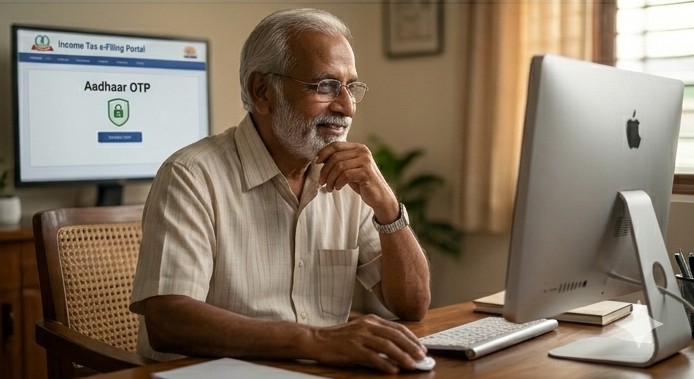
- Log in to the Income Tax e-Filing Portal
- Select Assessment Year 2026–27
- Choose ITR-1 (Sahaj) or ITR-2
- Verify pre-filled details
- Select tax regime (old or new)
- Enter additional income/deductions
- Validate and submit
- e-Verify using Aadhaar OTP, net banking, etc.
- Conclusion
The introduction of the new tax regime marks a shift toward simplification, but it does not necessarily benefit all pensioners equally. The old regime continues to offer significant advantages to those who actively invest and claim deductions.
Pensioners must not adopt the default option blindly. A careful comparison, based on individual financial circumstances, is essential to minimize tax liability.
As responsible taxpayers and senior citizens who have contributed immensely to the nation’s development, pensioners deserve clarity and ease in tax compliance. It is hoped that this guide will assist them in making informed decisions and fulfilling their obligations with confidence.
Very analytical information. Thanks. With regards.
Thank you very much.