
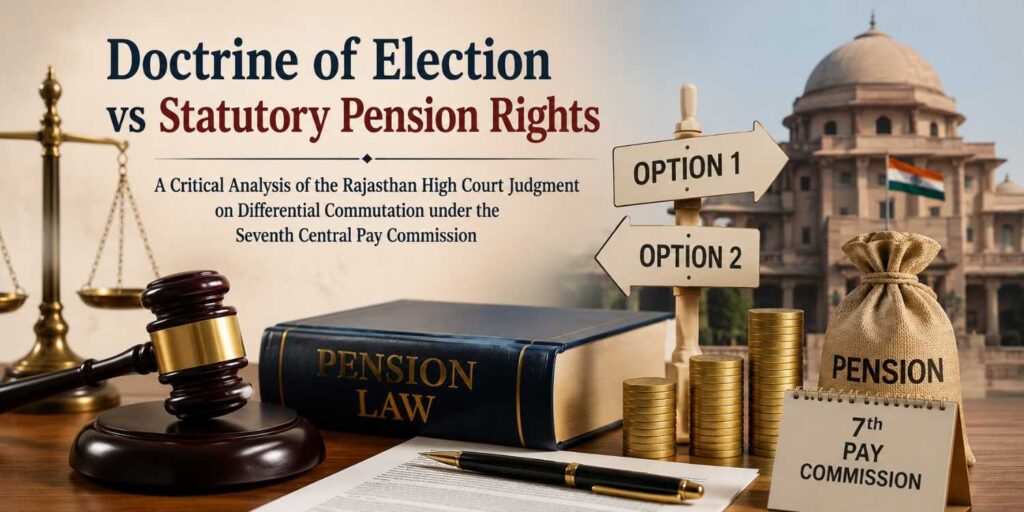
Doctrine of Election versus Statutory Pension Rights: A Critical Analysis of the Rajasthan High Court Judgment on Differential Commutation under the Seventh Central Pay Commission
By Lokanath Mishra
Introduction
The recent judgment of the Rajasthan High Court concerning the denial of differential commuted value of pension to Central Government pensioners has attracted considerable attention. The Court held that once a pensioner voluntarily exercised one of the options provided under the Office Memorandum dated 24 October 2016, the pensioner could not subsequently seek the alternative benefit of enhanced commutation.
While the judgment proceeds on the principle of election and administrative certainty, it raises several important questions regarding the relationship between statutory pension rules and executive instructions. A closer examination reveals that certain fundamental legal issues appear to require deeper judicial scrutiny.

Was the Real Issue Properly Identified?
The High Court treated the dispute primarily as one relating to the employee’s voluntary choice.
However, the fundamental issue may not have been whether the employee exercised an option, but whether a statutory right created under the Central Civil Services (Commutation of Pension) Rules, 1981 could be curtailed by an executive Office Memorandum.
This distinction is significant.
If Rule 10 itself creates a statutory entitlement to recomputation whenever pension is revised retrospectively, then an executive option cannot extinguish that entitlement.
The judgment appears to proceed on the assumption that the Office Memorandum merely supplements the Rules.
Whether that assumption is legally correct deserves closer examination.
Executive Instructions Cannot Override Statutory Rules
It is a settled constitutional principle that executive instructions cannot amend, dilute or supersede statutory rules framed under Article 309 of the Constitution.
If Rule 10 confers a statutory consequence upon retrospective revision of pension, an executive memorandum cannot substitute that consequence with an option.
The judgment appears not to have fully analysed whether the Office Memorandum effectively modified the operation of Rule 10.
Instead, the Court accepted the Government’s argument that the memorandum was only a transitional arrangement.
That conclusion required a much deeper examination.
Rule 10 May Create an Automatic Consequence
Rule 10 is based upon the principle that commutation depends upon the amount of pension actually sanctioned.
When pension is revised retrospectively, the pension itself is deemed to have existed at the revised rate from the original date.
If that legal fiction is accepted for payment of arrears, the same legal fiction arguably applies to commutation.
The judgment does not appear to examine whether retrospective revision necessarily carries with it retrospective recalculation of the commuted portion.
Pension Is Not a Contract
The judgment substantially relies upon the doctrine of election.
However, pension jurisprudence developed by the Supreme Court consistently treats pension not as a contractual benefit but as a statutory right.
An election generally applies where two independent benefits are available.
Here, however, the question is whether there were genuinely two separate benefits or merely one statutory consequence flowing from retrospective revision of pension.
If the latter is correct, the doctrine of election may have only limited application.
Whether There Was Truly an Informed Choice
The judgment assumes that the option exercised by the pensioner was informed and voluntary.
Several factual questions deserve consideration:
- Were pensioners supplied with actuarial calculations?
- Were they informed about the exact financial implications?
- Was the revised pension amount known when the option was exercised?
- Was the option exercised before issuance of the revised PPO?
If these questions were answered in the negative, the validity of the so-called voluntary election becomes questionable.
An election is legally binding only when made with full knowledge of the consequences.
Financial Comparison May Not Decide Legal Rights
The High Court compared monthly pension under both options and concluded that the petitioner had actually benefited financially.

This reasoning may be open to criticism.
Courts ordinarily determine legal rights according to statutory provisions, not according to whether one option appears economically advantageous in hindsight.
A citizen cannot be denied a statutory entitlement merely because the Court considers another arrangement financially preferable.
The issue was one of legality, not comparative economics.
Failure to Examine the Nature of Retrospective Revision
The Seventh Central Pay Commission recommendations were implemented retrospectively from 1 January 2016.
Once retrospective effect is granted, the revised pension legally replaces the earlier pension from that date.
The judgment appears not to have fully examined the legal consequences of retrospective operation.
If the revised pension is deemed to have existed from the original retirement date, every benefit linked to pension—including commutation—may arguably require recalculation unless the statute expressly provides otherwise.
Legitimate Expectation
Retired employees could reasonably expect that every pension-related benefit would be recalculated after retrospective revision.
The Office Memorandum introduced a limitation not expressly found in the statutory Rules.
Whether this defeated the legitimate expectation arising from retrospective revision appears not to have been fully examined.
Administrative Convenience Cannot Defeat Statutory Rights
The judgment emphasises administrative certainty.
Administrative convenience is undoubtedly important.
However, constitutional courts have consistently held that administrative convenience cannot override statutory rights.
If the Rules mandate recalculation, administrative inconvenience cannot justify denial.
Whether Rule 10 Was Read Harmoniously or Restricted
The Court states that Rule 10 must be read along with Rule 5 and the Office Memorandum.
A contrary argument is equally possible.
The Rules should first be interpreted independently.
Only where ambiguity exists may executive instructions assist interpretation.
Executive instructions should not become an additional condition restricting statutory rights.
Possible Questions of Law for the Supreme Court
An appeal under Article 136 may raise substantial questions such as:
- Whether an executive Office Memorandum can restrict rights flowing from statutory pension rules framed under Article 309.
- Whether Rule 10 creates an automatic entitlement upon retrospective revision of pension.
- Whether retrospective revision necessarily requires retrospective recalculation of commuted pension.
- Whether the doctrine of election applies where the entitlement claimed arises directly from statute rather than from an optional scheme.
- Whether the option exercised by retirees constituted a legally valid election in the absence of complete financial disclosure.
- Whether the High Court erred in deciding statutory rights primarily on comparative financial consequences.
- Whether the High Court failed to apply settled principles governing pension as a continuing statutory right.
- Whether the Office Memorandum is ultra vires the CCS (Commutation of Pension) Rules, 1981 to the extent it limits statutory entitlement.

Conclusion
The Rajasthan High Court judgment seeks to preserve certainty in pension administration. Nevertheless, certainty cannot come at the cost of statutory rights if those rights are indeed conferred by the Rules themselves.
The central issue is not whether a pensioner later regretted the option chosen. Rather, the constitutional question is whether an executive instruction can curtail the legal consequences of retrospective pension revision under statutory rules.
If the Supreme Court ultimately concludes that Rule 10 creates an automatic statutory entitlement, the doctrine of election may have only a limited role to play, and the Office Memorandum may require reconsideration to the extent it restricts rights conferred by the Rules.
The controversy therefore transcends the interests of individual pensioners. It concerns the broader constitutional relationship between statutory service rules and executive instructions—a question that deserves authoritative determination by the Supreme Court of India
Excellent analysis.